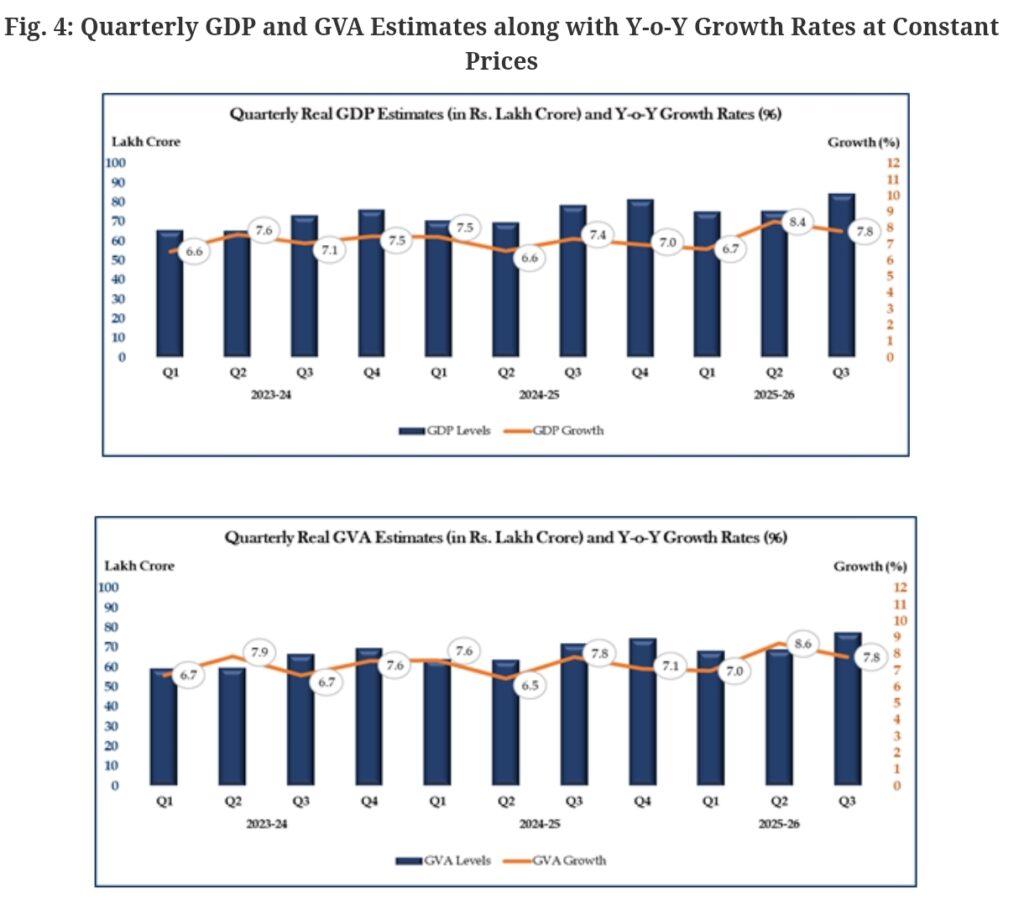
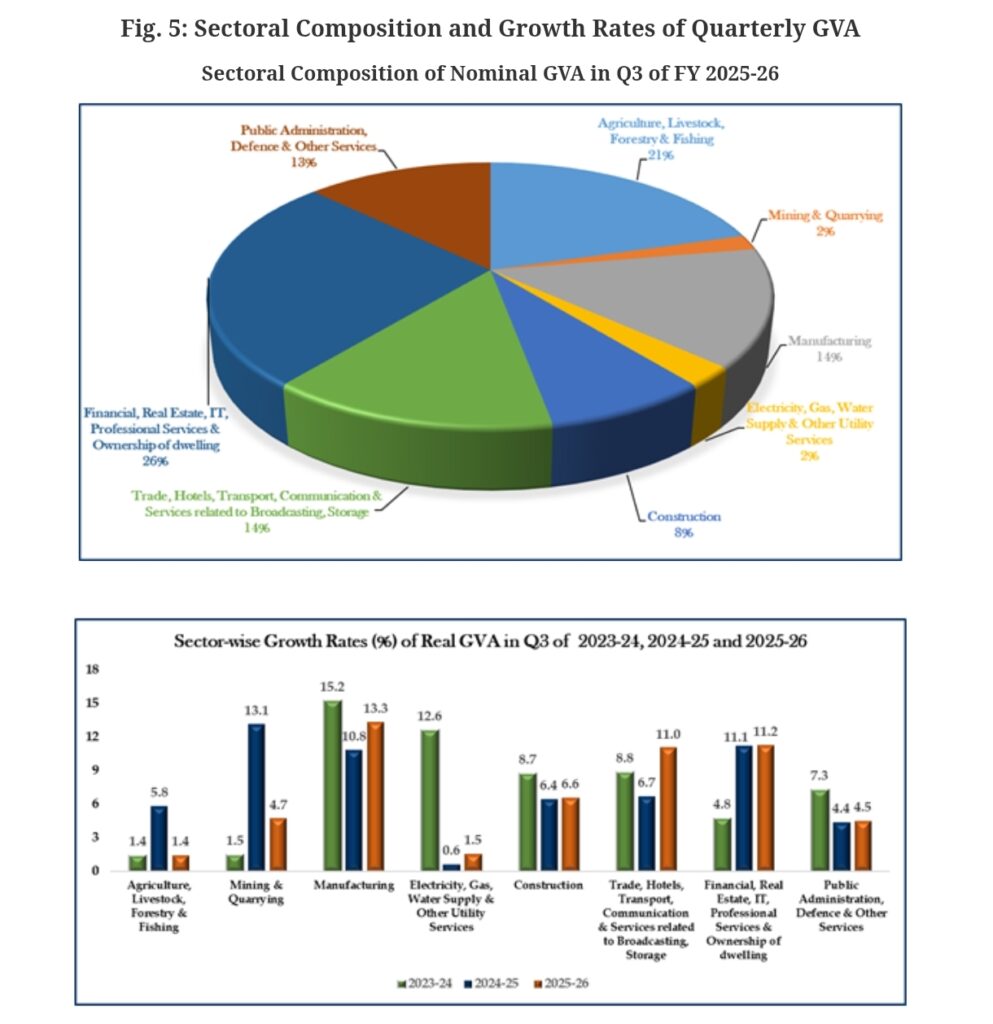
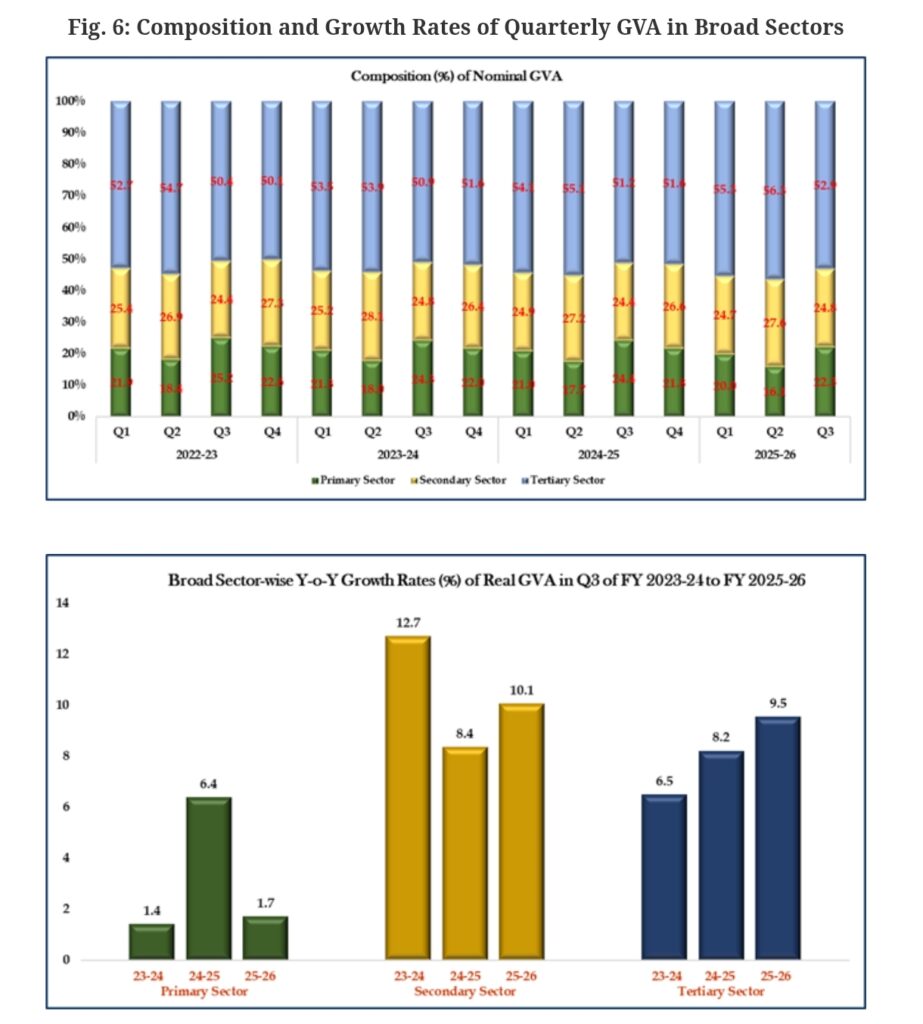
India’s Ministry of Statistics and Programme Implementation (MoSPI) has launched a new GDP series with base year 2022-23, replacing the earlier 2011-12 framework. Real GDP growth for FY 2025-26 is now estimated at 7.6%, while nominal GDP growth stands at 8.6%. The revision reflects updated data sources, improved methodology, and post-COVID structural normalization across sectors. The new estimates affect policymakers, investors, global institutions, and market participants tracking India’s macroeconomic trajectory.
What Happened in India’s New GDP Base Year Revision
MoSPI released a new series of Annual and Quarterly National Accounts with 2022-23 as the base year, aligning India’s statistical framework with international best practices. The revision replaces the 2011-12 base year and incorporates updated surveys, GST data, improved benchmarking, and expanded coverage of the unincorporated sector.
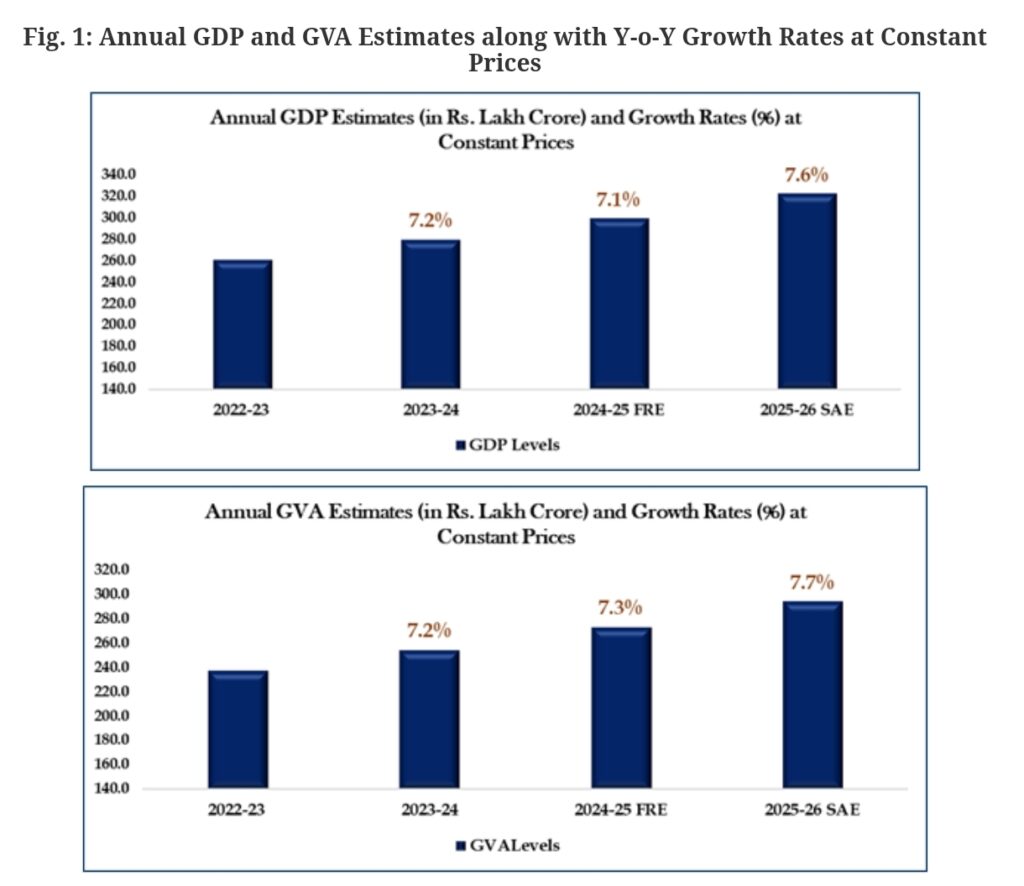
Under the revised framework, Real GDP for FY 2025-26 is estimated at Rs 322.58 lakh crore, up from Rs 299.89 lakh crore in FY 2024-25, indicating 7.6% growth. Nominal GDP is projected at Rs 345.47 lakh crore in FY 2025-26 compared to Rs 318.07 lakh crore in the previous year, reflecting 8.6% growth.
| Indicator | FY 2024-25 | FY 2025-26 (New Series) |
| Real GDP (Constant Prices) | Rs 299.89 lakh crore | Rs 322.58 lakh crore |
| Nominal GDP | Rs 318.07 lakh crore | Rs 345.47 lakh crore |
| Real GDP Growth | 7.1% | 7.6% |
| Nominal GDP Growth | 9.7% | 8.6% |
Quarterly data also shows strong momentum, with Q3 FY 2025-26 real GDP growth at 7.8% and nominal GDP growth at 8.9%, indicating resilient economic expansion during the second half of the fiscal year.
India New GDP Series Key Revisions (Old Vs Revised base year)
| Category | Period | Old | Revised |
|---|---|---|---|
| Real GDP Growth (%) | FY26 | 7.4 | 7.6 |
| Real GDP Growth (%) | FY25 | 6.5 | 7.1 |
| Real GDP Growth (%) | FY24 | 9.2 | 7.2 |
| Nominal GDP Growth (%) | FY26 | 8 | 8.6 |
| Nominal GDP Growth (%) | FY25 | 9.8 | 9.7 |
| Nominal GDP Growth (%) | FY24 | 12 | 11 |
| Nominal GDP (Rs lakh crore) | FY26 | 357.4 | 345.47 |
| Nominal GDP (Rs lakh crore) | FY25 | 330.6 | 318.07 |
| Nominal GDP (Rs lakh crore) | FY24 | 301.23 | 289.83 |
| Nominal GDP (Rs lakh crore) | FY23 | 268.9 | 261.17 |
| Quarterly GDP Growth (%) | Q1 FY26 | 7.8 | 6.7 |
| Quarterly GDP Growth (%) | Q2 FY26 | 8.1 | 8.4 |
| Quarterly GDP Growth (%) | Q3 FY26 (Poll) | 7.6 | 7.8 |
Why Did the GDP Base Year Revision Happen
Base year revisions are conducted periodically to reflect structural changes in the economy, especially after major disruptions like the COVID-19 pandemic. FY 2022-23 was selected as it represents a stable, post-pandemic year with broad sectoral data availability.
The new series integrates GST data, updated surveys, COICOP 2018 consumption classification, double deflation in agriculture and manufacturing, and improved quarterly benchmarking using the Proportional Denton method. These upgrades significantly enhance the reliability of national accounts estimates.
Another major driver behind the revision is the rapid formalization of India’s economy through digital transactions, GST compliance, and improved corporate reporting. The older 2011-12 base year increasingly underrepresented these structural shifts in services, manufacturing, and consumption.
India’s GDP Revision May Delay Overtaking Japan
India’s latest GDP revision, based on a new base year, shows the economy at Rs 345.47 trillion in nominal terms for the fiscal year ending March. This is lower than the earlier estimate of Rs 357.14 trillion under the previous data series.
At the average exchange rate, India’s GDP is now estimated to be around $4 trillion, while Japan’s economy stood at about $4.4 trillion in 2025.
Economists say that with the revised and smaller GDP size, India is unlikely to overtake Japan as the world’s fourth-largest economy this year, and possibly not even next year.
Bigger Context Behind India’s GDP Revision in Economy and Geopolitics
India’s GDP rebasing comes at a time when global growth is slowing and major economies are facing structural headwinds. With supply chains diversifying away from China and global capital seeking high-growth markets, accurate GDP measurement strengthens India’s macroeconomic credibility.
For global institutions such as the IMF, World Bank, and sovereign wealth funds, updated GDP data plays a critical role in investment allocation, credit assessment, and policy forecasting. A stronger and methodologically improved GDP series reinforces India’s position as a key growth pillar in the global economy.
Geopolitically, the revision supports India’s strategic narrative of post-pandemic resilience, especially as it negotiates trade deals, promotes manufacturing under industrial policies, and positions itself as an alternative hub in global supply chains.
How the New GDP Series Affects Markets, Companies, Investors, and Economy
The upward revision in real GDP growth to 7.6% strengthens India’s macro growth outlook, which is positive for equity markets, foreign institutional investors, and long-term capital inflows. Stronger growth data also improves fiscal metrics such as the debt-to-GDP ratio and tax buoyancy.
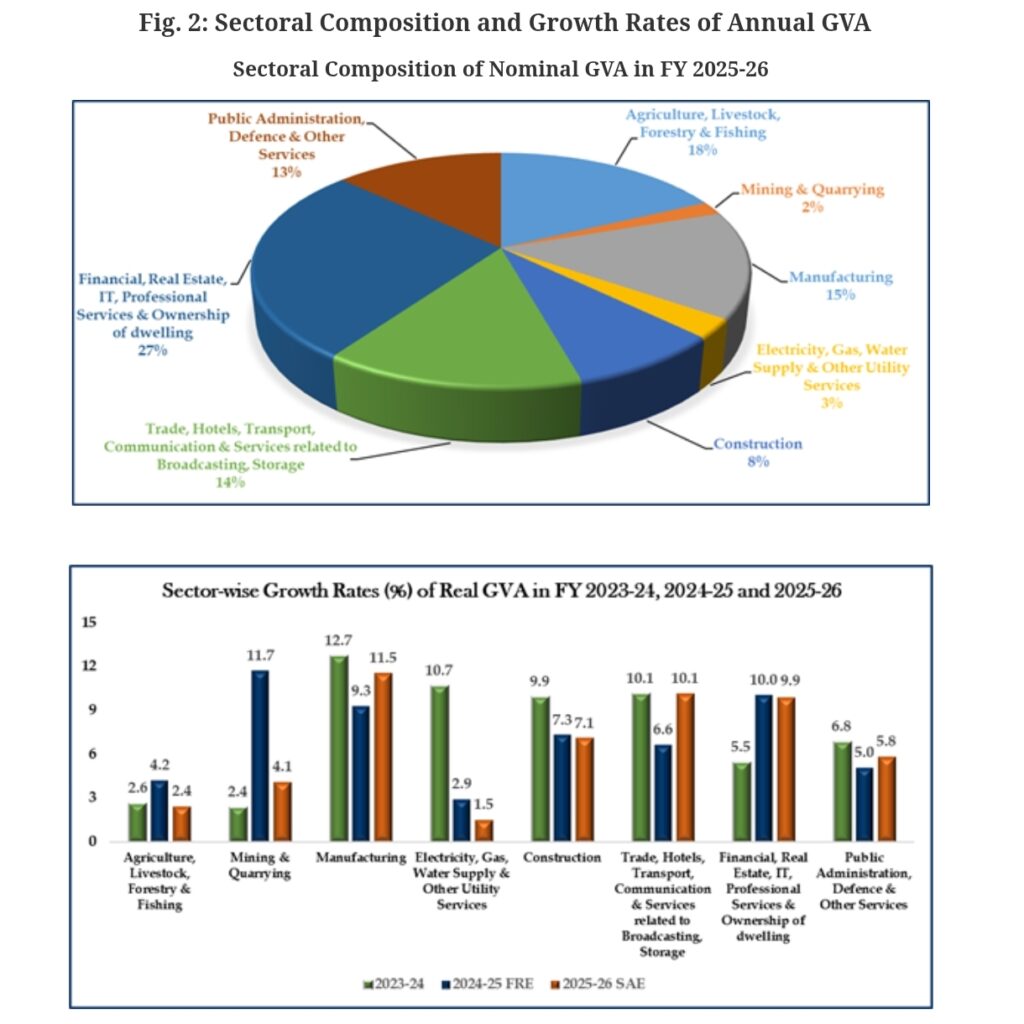
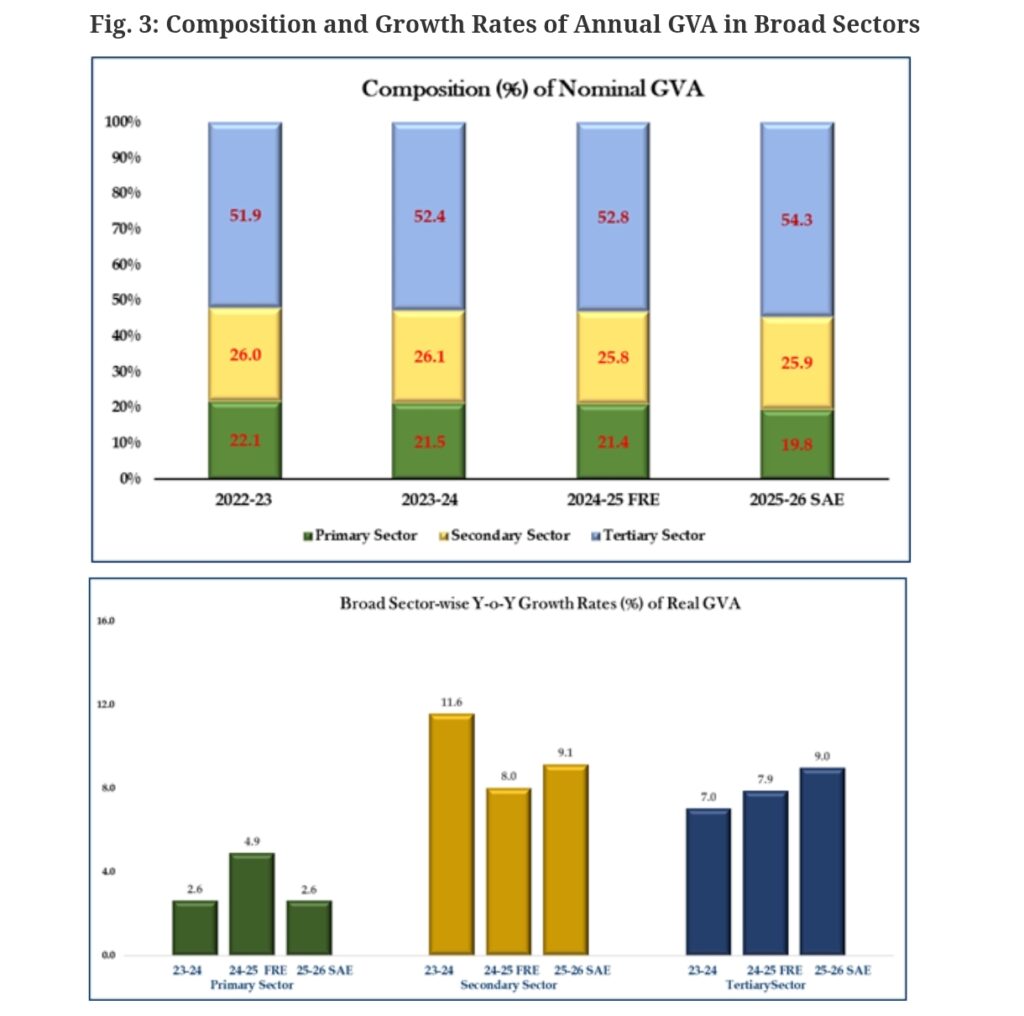
Manufacturing has emerged as a key growth engine, achieving double-digit expansion in FY 2023-24 and FY 2025-26, indicating policy traction from industrial incentives and domestic production push. Secondary and tertiary sectors also recorded over 9.0% growth in FY 2025-26, showing broad-based economic strength.
| Sector | Growth Signal | Economic Impact |
| Manufacturing | Double-digit growth | Boost to industrial output and capex cycle |
| Trade, Transport & Communication | 10.1% growth | Supports logistics, telecom and services demand |
| Consumption (PFCE) | Above 7.0% | Positive for retail, FMCG and domestic demand |
Higher nominal GDP at Rs 345.47 lakh crore also gives the government greater fiscal flexibility, potentially supporting infrastructure spending, welfare programs, and long-term growth investments without sharply worsening deficit ratios.
What Happens Next in India’s GDP and Policy Outlook
The new GDP series will directly influence future monetary policy decisions, fiscal planning, and global economic comparisons. Stronger growth estimates may provide the Reserve Bank of India with more policy space while balancing inflation and growth risks.
Going forward, extensive use of GST data, enterprise surveys, and supply-use table integration is expected to make GDP estimates more responsive to real-time economic trends. Markets will closely monitor whether consumption, investment, and manufacturing momentum sustain above 7% growth levels.
If manufacturing expansion, services growth, and capital formation remain strong, India is likely to maintain its position as the fastest-growing major economy, reinforcing its strategic role in global economic rebalancing.
Frequently Asked Questions
What is India’s new GDP base year?
India has revised its GDP base year to 2022-23, replacing the earlier 2011-12 series to better reflect current economic structure and data sources.
What is the revised GDP growth for FY 2025-26?
Real GDP growth is estimated at 7.6%, while nominal GDP growth is projected at 8.6% under the new GDP series.
Why is GDP rebasing important for the economy?
GDP rebasing improves accuracy, captures structural economic changes, and enhances policy planning and global investor confidence.
How does the new GDP series impact investors and markets?
It strengthens growth outlook, improves fiscal indicators, and enhances India’s credibility among global investors and rating agencies.
Conclusion
India’s shift to a 2022-23 GDP base year marks a critical upgrade in its statistical and economic framework. The revised 7.6% growth estimate, stronger sectoral performance, and improved methodology highlight structural resilience in the economy. In the coming years, accurate GDP measurement will play a decisive role in shaping monetary policy, fiscal strategy, capital flows, and India’s geopolitical standing as a leading global growth engine.

BBW News Desk is the editorial team of BigBreakingWire, a digital newsroom focused on global finance, markets, geopolitics, trade policy, and macroeconomic developments.
Our editors monitor government decisions, central bank actions, international trade movements, corporate activity, and economic indicators to deliver fast, fact-based reporting for investors, professionals, and informed readers.
The BBW News Desk operates under the editorial standards of BigBreakingWire, prioritizing accuracy, verified information, and timely updates on major global developments.











Be First to Comment