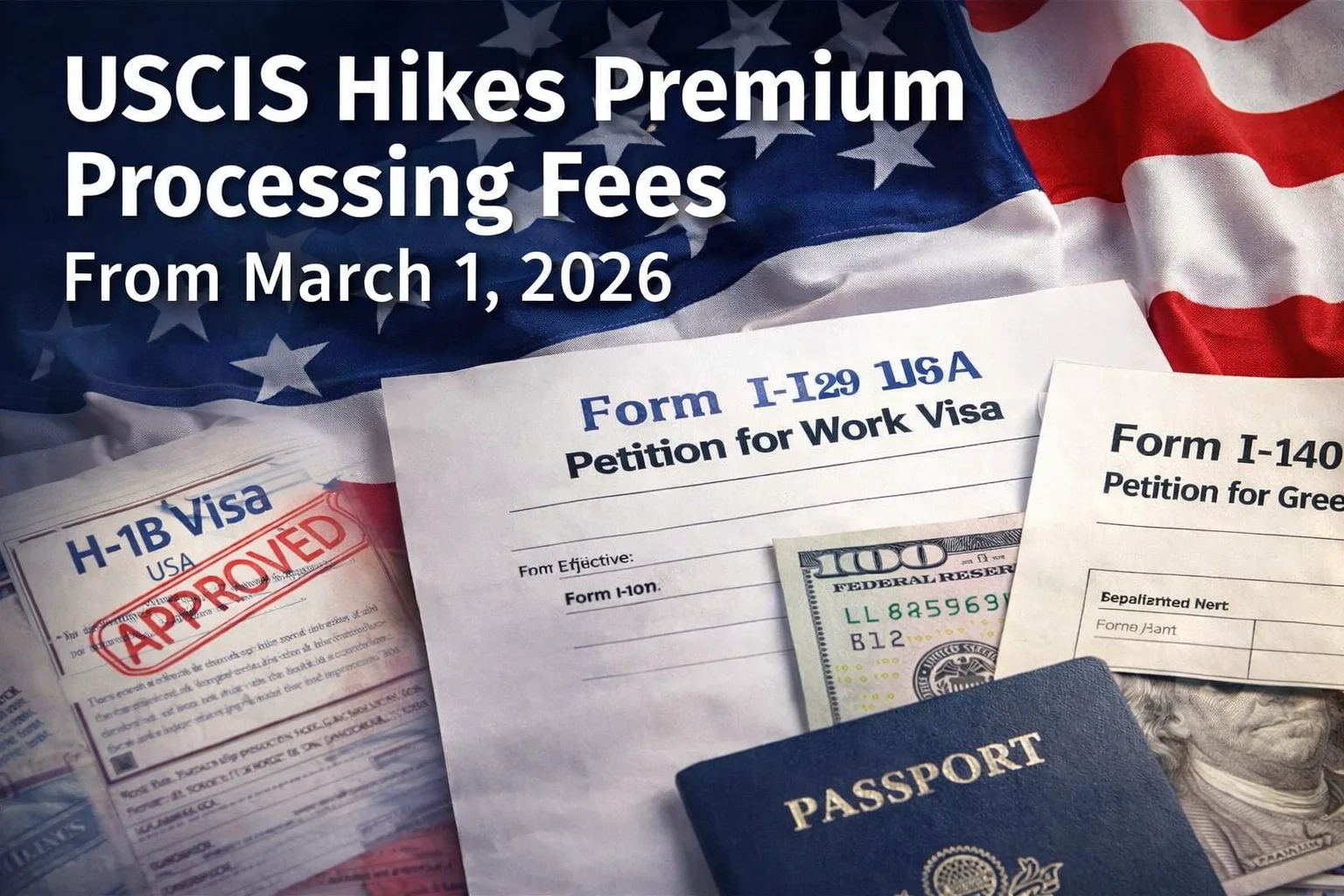
The US Citizenship and Immigration Services (USCIS) has announced an increase in premium processing fees for several visa and immigration applications, including the popular H-1B visa. The new fees will apply from March 1, 2026, and will affect only those applicants who choose faster processing. Standard filing fees will remain unchanged.
Why Is USCIS Increasing Premium Processing Fees?
According to USCIS, the fee hike reflects inflation between June 2023 and June 2025. The Department of Homeland Security (DHS) is legally allowed to revise premium processing fees every two years under the USCIS Stabilization Act to protect the real value of the service.
USCIS said the additional revenue will be used to improve adjudication systems, reduce processing backlogs, handle rising application volumes, and support immigration and naturalization services.
When Will the New Fees Apply?
The revised premium processing fees will apply to applications that are postmarked on or after March 1, 2026. Applicants filing before this date can continue using the existing fee structure.
New USCIS Premium Processing Fees (Effective March 1, 2026)
Form I-129: Nonimmigrant Worker Petitions
H-2B and R-1 visas
- Old Fee: $1,685
- New Fee: $1,780
All other I-129 classifications including H-1B, L-1, O-1, TN, E visas and more
- Old Fee: $2,805
- New Fee: $2,965
This category covers H-1B, E-1, E-2, E-3, H-3, L-1A, L-1B, O-1, O-2, P visas, Q-1, and TN-1 and TN-2.
Form I-140: Immigrant Petition for Alien Worker
- Old Fee: $2,805
- New Fee: $2,965
The revised fee applies to all employment-based green card categories, including EB-1, EB-2 (NIW and non-NIW), EB-3, and EW3.
Form I-539: Change or Extension of Status
- Old Fee: $1,965
- New Fee: $2,075
This impacts F-1 and F-2 students, J-1 and J-2 exchange visitors, and M-1 and M-2 vocational students.
Form I-765: Employment Authorization (OPT and STEM OPT)
- Old Fee: $1,685
- New Fee: $1,780
Who Will Be Most Affected?
The fee increase is expected to impact a large number of Indian professionals, students, and employers. Indians account for the majority of H-1B and L-1 visa approvals and are the largest beneficiaries of US employment-based visas, receiving over 70 percent of approvals each year.
Indian students also heavily use Optional Practical Training (OPT) and STEM-OPT extensions as pathways to long-term work visas such as H-1B.
Is Premium Processing Mandatory?
No. Premium processing is completely optional. It is mainly used by applicants and employers who want faster decisions for reasons such as job changes, visa extensions, travel plans, or quicker clarity on immigration status.
What Remains Unchanged?
USCIS has clarified that only premium processing fees are being increased. Standard visa filing fees and regular processing timelines remain the same.
Bottom Line
If you are planning to file an H-1B, green card, OPT, or other employment-based application with premium processing after March 1, 2026, you should be prepared for higher costs. However, the faster processing option remains voluntary, and regular applicants will not be affected by the change.

BBW News Desk is the editorial team of BigBreakingWire, a digital newsroom focused on global finance, markets, geopolitics, trade policy, and macroeconomic developments.
Our editors monitor government decisions, central bank actions, international trade movements, corporate activity, and economic indicators to deliver fast, fact-based reporting for investors, professionals, and informed readers.
The BBW News Desk operates under the editorial standards of BigBreakingWire, prioritizing accuracy, verified information, and timely updates on major global developments.

































Be First to Comment