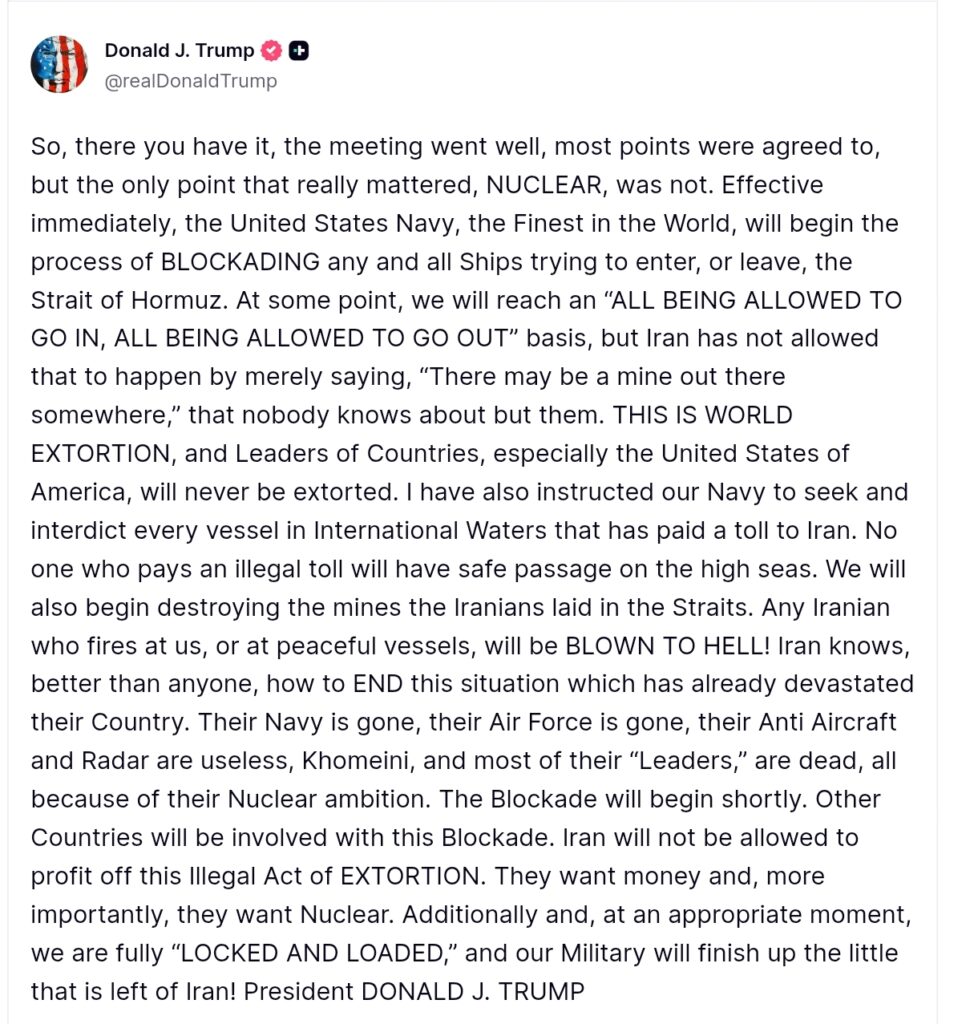
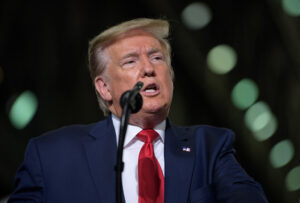
US President Donald J. Trump said the United States will begin a naval blockade of the Strait of Hormuz after talks with Iran failed to resolve key nuclear issues. “So, there you have it, the meeting went well, most points were agreed to, but the only point that really mattered, NUCLEAR, was not,” Trump said.
He said the United States Navy will take immediate action. “Effective immediately, the United States Navy, the Finest in the World, will begin the process of BLOCKADING any and all Ships trying to enter, or leave, the Strait of Hormuz,” he said. Trump added that Iran had created uncertainty, saying, “There may be a mine out there somewhere,” and described the situation as “WORLD EXTORTION.”
Trump said U.S. forces will target vessels and threats linked to Iran. “I have also instructed our Navy to seek and interdict every vessel in International Waters that has paid a toll to Iran,” he said. “We will also begin destroying the mines the Iranians laid in the Straits,” he added, warning that “Any Iranian who fires at us, or at peaceful vessels, will be BLOWN TO HELL!”
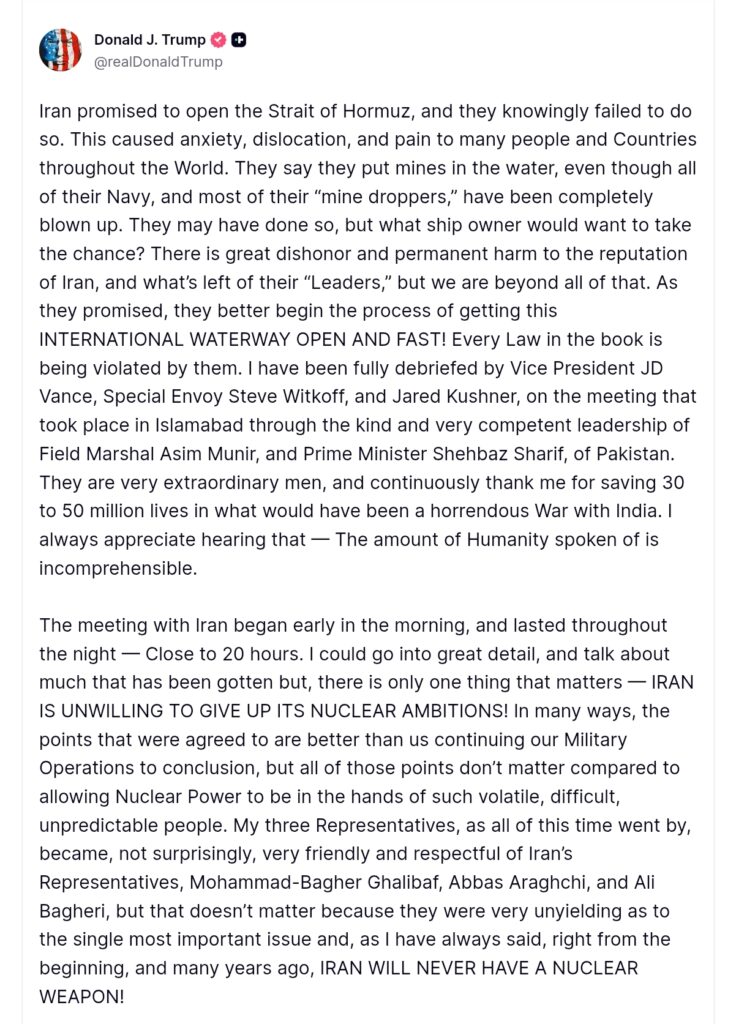
He said Iran failed to meet commitments on keeping the waterway open. “Iran promised to open the Strait of Hormuz, and they knowingly failed to do so,” Trump said. He added the situation caused “anxiety, dislocation, and pain to many people and Countries throughout the World,” and called for action, saying, “They better begin the process of getting this INTERNATIONAL WATERWAY OPEN AND FAST!”
Trump said talks lasted nearly 20 hours but failed on the main issue. “There is only one thing that matters — IRAN IS UNWILLING TO GIVE UP ITS NUCLEAR AMBITIONS!” he said. He added, “IRAN WILL NEVER HAVE A NUCLEAR WEAPON!” and said the U.S. is “fully ‘LOCKED AND LOADED,’ and our Military will finish up the little that is left of Iran.”
Trump Says U.S. Will Block Hormuz, Deploy Mine Clearing Forces Soon
U.S. President Donald Trump said the United States is preparing to block the Strait of Hormuz, adding that the move may take some time but could happen soon, as he told Fox News. He claimed the U.S. does not rely on the strait due to its own oil supply and warned that Iran is using naval mines to pressure global shipping.
Trump also said the U.S. and its allies, including the UK, are deploying more mine-clearing equipment to secure the route. He stressed that the U.S. will ensure safe passage through the strait and expressed disappointment that NATO has not provided stronger support in the effort.
Trump Announces Full Hormuz Blockade, “All or Nothing” Warning to Iran
U.S. President Donald Trump said the U.S. will impose a complete blockade of the Strait of Hormuz to stop Iran from selectively selling oil. He stressed it will be “all or none,” adding that multiple countries may join and naval forces are being positioned.
Trump linked the move to Iran’s nuclear threat, claiming recent B-2 strikes destroyed key sites and delayed any weapon capability. He said the U.S. is closely monitoring Iran via satellites and warned Tehran would have used nuclear weapons in the region if unchecked.
Trump escalates rhetoric on Iran, oil, and global security
Trump said oil prices may not drop immediately due to current tensions, but will fall once the situation is resolved. He warned that any nuclear conflict anywhere could trigger a massive stock market collapse and stressed how critical the Strait of Hormuz is for countries like Japan and South Korea.
Donald Trump criticized NATO as “shameful,” claiming allies failed to support the U.S. during the Iran war. He targeted UK PM Keir Starmer, comparing his delayed response to Neville Chamberlain, and also faulted Germany, saying NATO now needs to be reconsidered.
He criticized these allies for relying on U.S. military protection while offering little support in return, despite tens of thousands of American troops stationed there. He added that NATO countries are now willing to help secure and clear the strait, with efforts like minesweeping already underway.
On Iran, Trump said negotiations were intense and largely successful but failed on the key issue of nuclear ambitions. He pushed for complete compliance, not partial deals, and signaled aggressive measures ahead including cutting off Iran’s oil revenues and taking stronger actions similar to Venezuela, even claiming the U.S. could act decisively within a day if needed.
U.S. Vice President JD Vance said the 21-hour talks ended without agreement, calling it “bad news for Iran, more than for the US.” He said the discussions broke down after Iran refused to commit that it would not develop nuclear weapons and rejected U.S. terms.
According to reports, the talks were the first direct negotiations between the two sides since 1979 but failed to produce results. Fars News reported Iran has no plans to continue talks. Elijah Magnier said the process stalled due to strict U.S. demands on permanent limits to Iran’s nuclear enrichment, which Iran rejected.
Iran’s Foreign Ministry said the talks came after 40 days of conflict in an environment of deep mistrust. Spokesperson Esmail Baghaei said some common ground was reached, but disagreements on two to three major issues prevented a deal. He said expecting a full agreement in the first round was unrealistic and thanked Pakistan’s leadership for their support.
Pakistan’s Foreign Minister Ishaq Dar said the talks failed but noted both sides acknowledged Pakistan’s role in facilitating a ceasefire. The Foreign Ministry said maintaining the ceasefire is critical and urged continued dialogue, adding Pakistan will keep supporting diplomatic efforts.
Separately, Saudi Arabia has deployed around 13,000 Pakistani troops and 10 to 18 Pakistan Air Force fighter jets to King Abdulaziz Air Base in the eastern region under a joint defence agreement. A Pakistani official said the move is part of a pact where an attack on one country is treated as an attack on the other, while Saudi officials said it aims to strengthen regional security.
Saudi Arabia and Qatar have also pledged about $5 billion in financial support to help stabilize Pakistan’s foreign reserves, according to reports. Pakistan faces repayment obligations of $3.5 billion to the UAE by the end of April, adding pressure to its financial situation.

BBW News Desk is the editorial team of BigBreakingWire, a digital newsroom focused on global finance, markets, geopolitics, trade policy, and macroeconomic developments.
Our editors monitor government decisions, central bank actions, international trade movements, corporate activity, and economic indicators to deliver fast, fact-based reporting for investors, professionals, and informed readers.
The BBW News Desk operates under the editorial standards of BigBreakingWire, prioritizing accuracy, verified information, and timely updates on major global developments.









Be First to Comment