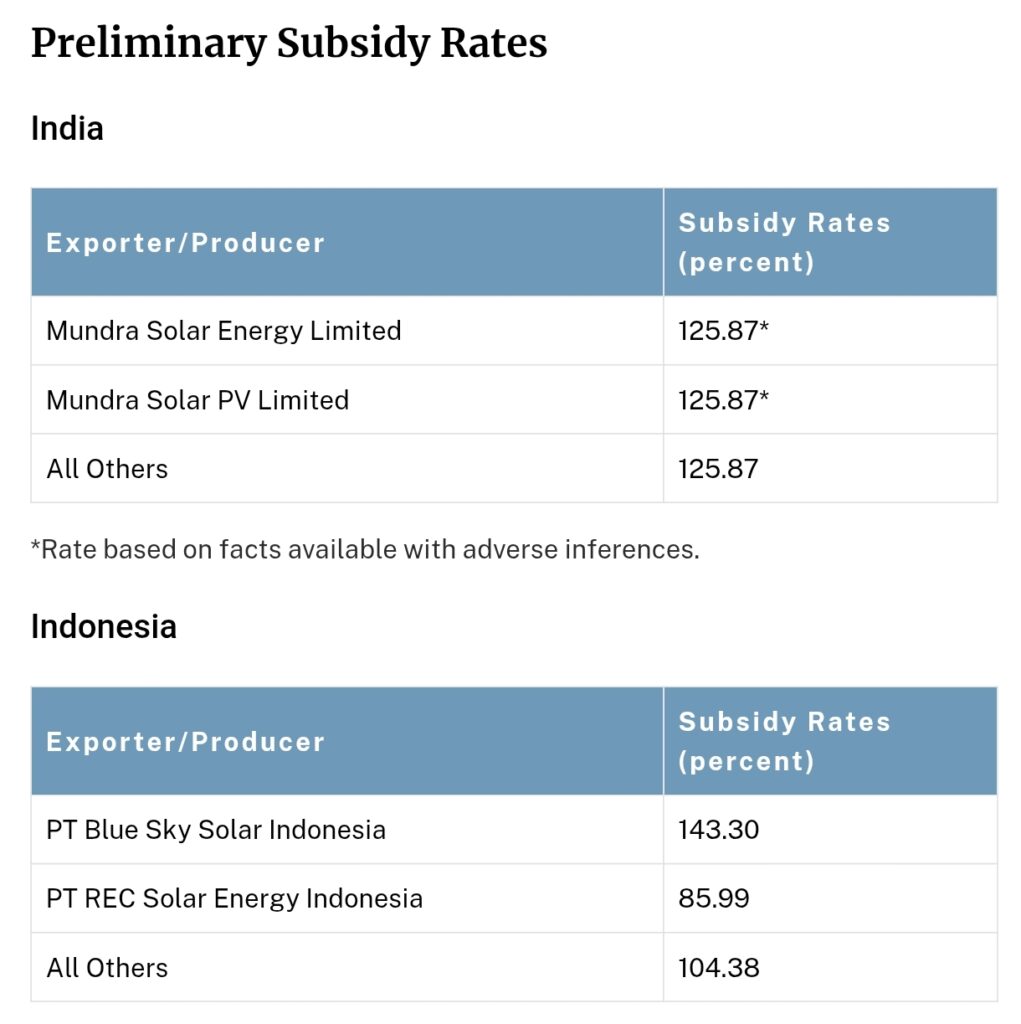
The U.S. Department of Commerce on February 24, 2026, announced preliminary countervailing duties of 125.87% on imports of certain Indian crystalline silicon photovoltaic cells, citing alleged government subsidies. The investigation also covers imports from Indonesia and Laos, with subsidy rates ranging from 85.99% to 143.30% and 80.67% respectively. The move is significant for global solar supply chains, trade policy, and renewable energy costs in the U.S. market.
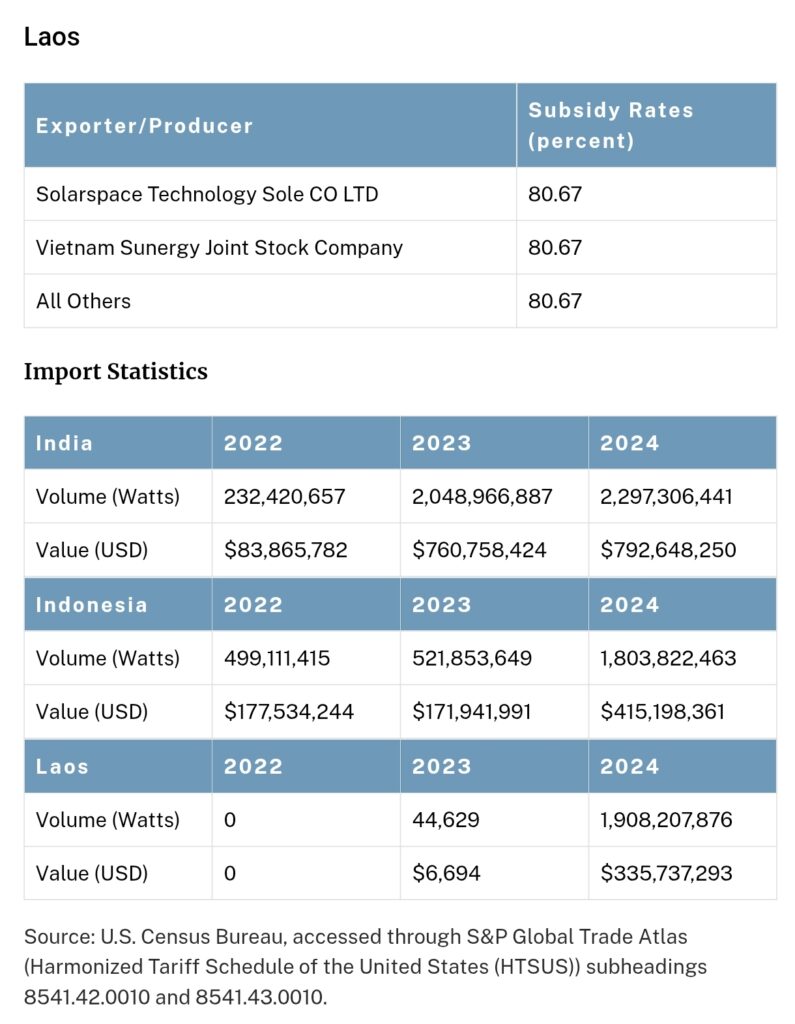
The decision affects solar cells whether or not assembled into modules and is separate from the broader 10% tariff framework announced by the U.S. administration. Solar imports from India into the U.S. surged to $792.6 million in 2024, up from $83.86 million in 2022, reflecting a rapid shift in sourcing patterns.
What Happened in the U.S. Countervailing Duty Investigation
The U.S. Commerce Department issued preliminary affirmative determinations in countervailing duty (CVD) investigations into crystalline silicon photovoltaic cells imported from India, Indonesia, and the Lao People’s Democratic Republic. The investigation examines whether exporters benefited from subsidies that distorted pricing in the U.S. market.
For India, exporters including Mundra Solar Energy Limited and Mundra Solar PV Limited were assigned preliminary subsidy rates of 125.87%, with the same rate applied to all other producers based on facts available with adverse inference.
| Country | Product Covered | Preliminary Subsidy Rate |
| India | Crystalline Silicon Photovoltaic Cells | 125.87% |
| Indonesia | Crystalline Silicon Photovoltaic Cells | 85.99% – 143.30% |
| Laos | Crystalline Silicon Photovoltaic Cells | 80.67% |
Why Did the Countervailing Duty Decision Happen
The case was filed by the Alliance for American Solar Manufacturing and Trade, whose members include Hanwha Q CELLS USA Inc., First Solar Inc., and Mission Solar Energy LLC. U.S. authorities argue that subsidy programs in exporting countries provided unfair financial support to manufacturers, enabling lower export pricing.
This aligns with Washington’s broader industrial policy aimed at strengthening domestic clean energy manufacturing and reducing reliance on foreign solar supply chains amid rising geopolitical competition in renewable technologies.
Bigger Context Behind Solar Trade in Economy and Geopolitics
The duty decision comes at a time when solar energy accounts for nearly 72% of U.S. power capacity additions through November 2025, making module imports a strategically important sector. After earlier tariffs on other Asian suppliers, importers increasingly shifted sourcing toward India, Indonesia, and Laos.
Together, these three countries supplied about 57% of U.S. solar module imports in the first half of 2025, highlighting their growing role in the global renewable energy supply chain.
| Country | 2022 Import Value ($) | 2023 Import Value ($) | 2024 Import Value ($) |
| India | 83,865,782 | 760,758,424 | 792,648,250 |
| Indonesia | 177,534,244 | 171,941,991 | 415,198,361 |
| Laos | 0 | 6,694 | 335,737,293 |
The sharp increase in imports also reflects supply chain realignment as developers sought alternative sourcing to maintain project timelines and manage costs under evolving trade restrictions.
How the Duty Affects Markets, Companies, Investors, and Economy
For Indian solar exporters, a 125.87% preliminary duty significantly raises effective export costs to the U.S., potentially reducing competitiveness and impacting future order pipelines. Companies with strong U.S. exposure may face revenue pressure if sourcing shifts to other regions.
For U.S. solar developers and installers, higher import duties could increase project costs, affecting utility-scale solar economics and potentially slowing installation growth in the near term. This may also influence power pricing and renewable investment decisions.
Domestic U.S. manufacturers may benefit from improved pricing power and policy protection, while global investors may reassess supply chain risks across the renewable energy sector.
| Stakeholder | Impact |
| Indian Solar Manufacturers | Higher export barriers and margin pressure |
| U.S. Solar Producers | Stronger market protection and competitiveness |
| Solar Developers | Potential increase in project costs |
| Global Investors | Repricing of renewable supply chain risk |
What Happens Next in the Solar Trade Investigation
Unless postponed, the final determination in the countervailing duty investigations is scheduled for July 6, 2026. The U.S. International Trade Commission (ITC) is conducting a concurrent injury investigation to determine whether domestic industry has suffered material harm due to imports.
The Commerce Department is also pursuing concurrent antidumping duty investigations on solar cells from the same countries, which could further increase the overall tariff burden if final findings confirm dumping and subsidy allegations.
Given the scale of solar imports and the strategic importance of clean energy, the final ruling could reshape global solar trade flows, trigger diplomatic engagement, and influence long-term investment in renewable manufacturing capacity.
Frequently Asked Questions
What duty did the U.S. impose on Indian solar imports?
The U.S. announced a preliminary countervailing duty of 125.87% on certain Indian crystalline silicon photovoltaic cells.
Is the 126% duty final?
No, it is a preliminary determination. The final decision is expected on July 6, 2026.
Why is the U.S. investigating solar imports?
The investigation alleges that subsidy programs in exporting countries provided unfair support to manufacturers, impacting U.S. domestic industry.
How large are India’s solar exports to the U.S.?
U.S. imports of Indian solar products rose to about $792.6 million in 2024 from $83.86 million in 2022.
Conclusion
The preliminary 126% countervailing duty on Indian solar imports marks a major escalation in clean energy trade policy and industrial protectionism. While the move supports U.S. domestic manufacturing, it may disrupt global supply chains, raise renewable project costs, and intensify trade negotiations. The final ruling in mid-2026 will be crucial in determining long-term market dynamics, geopolitical trade relations, and investment flows in the global solar sector.

BBW News Desk is the editorial team of BigBreakingWire, a digital newsroom focused on global finance, markets, geopolitics, trade policy, and macroeconomic developments.
Our editors monitor government decisions, central bank actions, international trade movements, corporate activity, and economic indicators to deliver fast, fact-based reporting for investors, professionals, and informed readers.
The BBW News Desk operates under the editorial standards of BigBreakingWire, prioritizing accuracy, verified information, and timely updates on major global developments.









Be First to Comment