
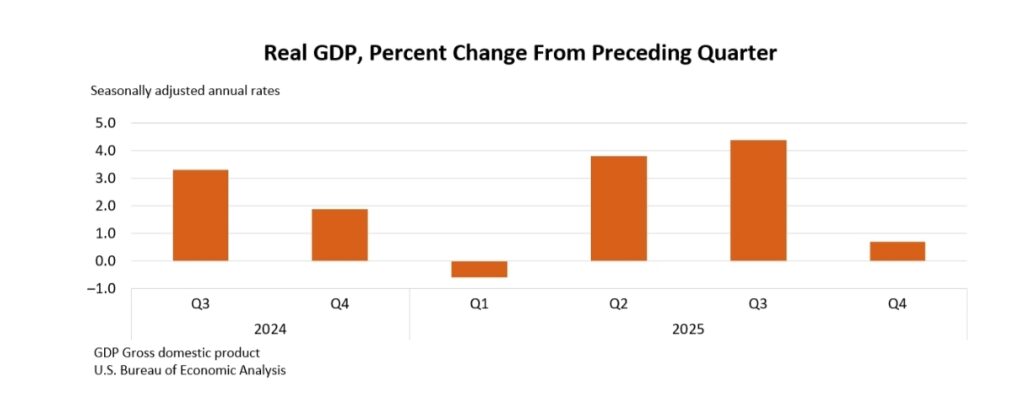
The United States economy slowed sharply at the end of 2025, with real GDP expanding at an annualized rate of 0.7% in the fourth quarter, according to the second estimate released by the U.S. Bureau of Economic Analysis (BEA).
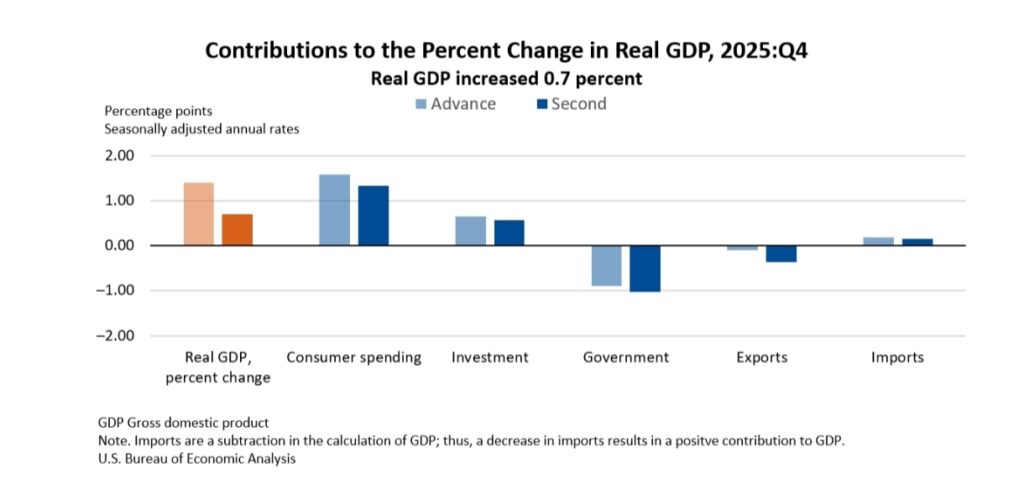
The growth rate was revised down from the earlier estimate of 1.4%, reflecting weaker exports, slower consumer spending, and lower government spending. Investment provided some support to economic activity.
For the full year 2025, the U.S. economy grew 2.1%, highlighting continued expansion but also signs that momentum cooled significantly in the final months of the year.
What Happened in the Latest US GDP Data
The BEA’s second estimate showed that real GDP increased at an annualized rate of 0.7% during the October to December quarter of 2025. This was a sharp slowdown compared with 4.4% growth recorded in the third quarter.
The downward revision from the initial estimate reflected weaker data on exports, consumer spending, government expenditure, and private investment. Imports declined slightly but not as much as previously estimated.
Despite the slowdown, household consumption and business investment still contributed positively to overall economic activity during the quarter.
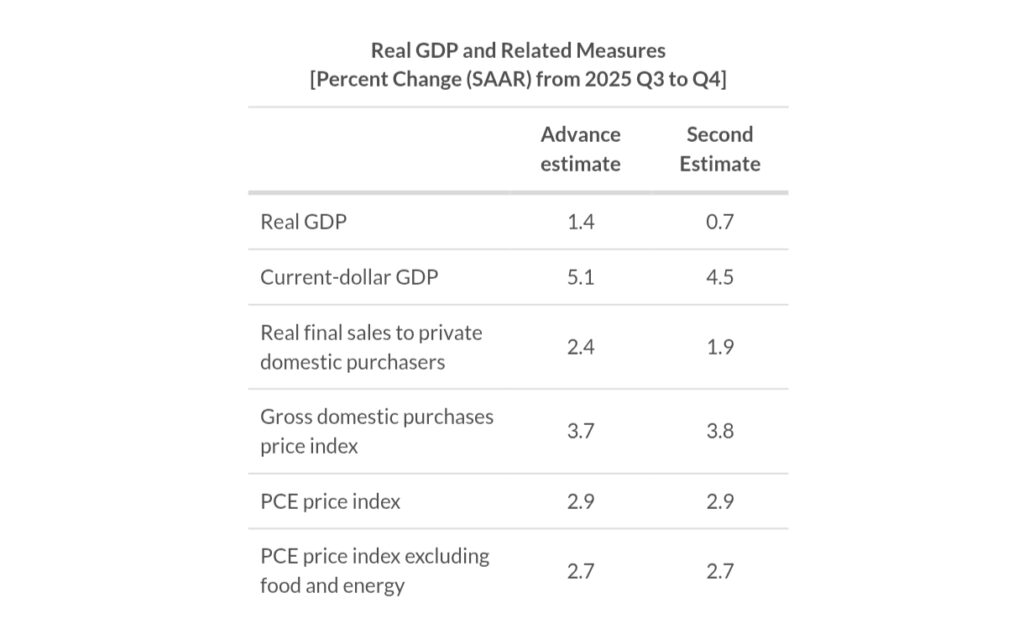
| Indicator | Advance Estimate | Second Estimate |
| Real GDP Growth (Q4 2025) | 1.4% | 0.7% |
| Current Dollar GDP | 5.1% | 4.5% |
| Final Sales to Domestic Purchasers | 2.4% | 1.9% |
| PCE Inflation | 2.9% | 2.9% |
Why Did the US Economy Slow in Late 2025
Several factors contributed to the economic slowdown in the fourth quarter. Government spending declined, while exports weakened amid slower global demand and ongoing geopolitical tensions affecting trade flows.
Consumer spending remained positive but lost momentum compared with earlier quarters. Higher borrowing costs and tightening financial conditions throughout 2025 likely contributed to the moderation in household demand.
Another factor was the partial U.S. federal government shutdown between October 1 and November 12, 2025. The BEA estimates that reduced federal labor services alone subtracted roughly 1 percentage point from fourth-quarter GDP growth.
Bigger Context Behind US Economic Growth in 2025
The U.S. economy entered 2025 with strong momentum driven by consumer demand, government spending programs, and business investment in technology and infrastructure.
However, by the second half of the year, several structural pressures began to emerge. Higher interest rates implemented earlier by the Federal Reserve to control inflation gradually slowed credit growth and investment activity.
Global economic uncertainty also played a role. Slower growth in Europe and China weakened export demand, while geopolitical tensions in key energy routes and trade corridors added volatility to global supply chains.
These factors combined to create a pattern seen frequently in late-cycle economic expansions: strong growth early in the year followed by deceleration as financial conditions tighten and policy stimulus fades.
How the GDP Data Affects Markets, Companies, Investors, and the Economy
Slower GDP growth signals cooling economic momentum, which can influence financial markets and policy expectations.
For equity markets, moderate growth combined with stable inflation can sometimes be viewed positively, as it reduces the likelihood of aggressive interest rate hikes. However, weaker growth may also pressure corporate earnings if consumer demand slows further.
Bond markets often react more directly to GDP revisions. Lower growth expectations tend to support government bond prices because investors anticipate a less restrictive monetary policy path.
From a business perspective, slower demand growth can affect sectors such as manufacturing, exports, and consumer discretionary spending. Technology and services sectors tied to structural investment trends may remain more resilient.
| Economic Driver | Impact on GDP |
| Consumer Spending | Positive contribution but slower growth |
| Investment | Moderate increase supporting GDP |
| Government Spending | Declined during the quarter |
| Exports | Reduced growth due to weaker global demand |
| Imports | Declined slightly, adding modest support |
Inflation Trends and Price Pressures
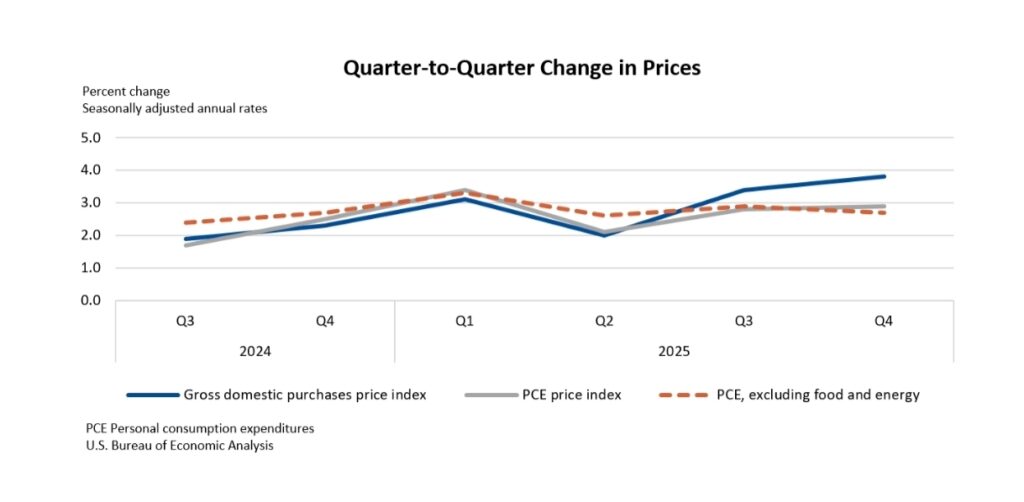
Inflation remained relatively stable during the fourth quarter. The price index for gross domestic purchases increased 3.8% on an annualized basis.
The Personal Consumption Expenditures (PCE) price index, the Federal Reserve’s preferred inflation gauge, rose 2.9%. Core PCE inflation, which excludes food and energy, increased 2.7%.
These figures indicate that inflation pressures continued to moderate compared with earlier years, though they remained slightly above the Federal Reserve’s long-term 2% target.
| Inflation Indicator | Q4 2025 Rate |
| Gross Domestic Purchases Price Index | 3.8% |
| PCE Price Index | 2.9% |
| Core PCE Price Index | 2.7% |
What Happens Next for the US Economy
The next GDP estimate scheduled for April 9, 2026 will provide updated data on corporate profits, industry output, and further revisions to fourth-quarter economic performance.
Investors and policymakers will closely monitor whether the slowdown represents a temporary adjustment or the beginning of a broader deceleration in economic activity.
If consumer spending remains stable and investment continues to expand, the U.S. economy may sustain moderate growth in 2026. However, persistent geopolitical risks, global trade uncertainty, and financial conditions will remain key variables shaping the outlook.
Frequently Asked Questions
What was US GDP growth in the fourth quarter of 2025?
Real GDP grew at an annualized rate of 0.7% in the fourth quarter of 2025, according to the second estimate released by the U.S. Bureau of Economic Analysis.
Why was the GDP estimate revised downward?
The revision reflected weaker exports, slower consumer spending, lower government spending, and reduced private investment.
How much did the US economy grow in 2025?
Real GDP expanded by 2.1% for the full year 2025 compared with 2024 levels.
Did inflation increase in the fourth quarter?
The PCE inflation index rose 2.9%, while core PCE inflation excluding food and energy increased 2.7%.
Conclusion
The latest GDP data shows that the U.S. economy remained resilient in 2025 but lost momentum toward the end of the year. Slower consumer spending, weaker exports, and government spending cuts contributed to the deceleration.
While growth remains positive, the shift toward a slower expansion phase suggests that policymakers, investors, and businesses will need to closely monitor economic indicators in 2026. The balance between inflation control, interest rate policy, and global economic conditions will determine whether the U.S. economy stabilizes or faces deeper slowdown risks.

BBW News Desk is the editorial team of BigBreakingWire, a digital newsroom focused on global finance, markets, geopolitics, trade policy, and macroeconomic developments.
Our editors monitor government decisions, central bank actions, international trade movements, corporate activity, and economic indicators to deliver fast, fact-based reporting for investors, professionals, and informed readers.
The BBW News Desk operates under the editorial standards of BigBreakingWire, prioritizing accuracy, verified information, and timely updates on major global developments.










Be First to Comment