
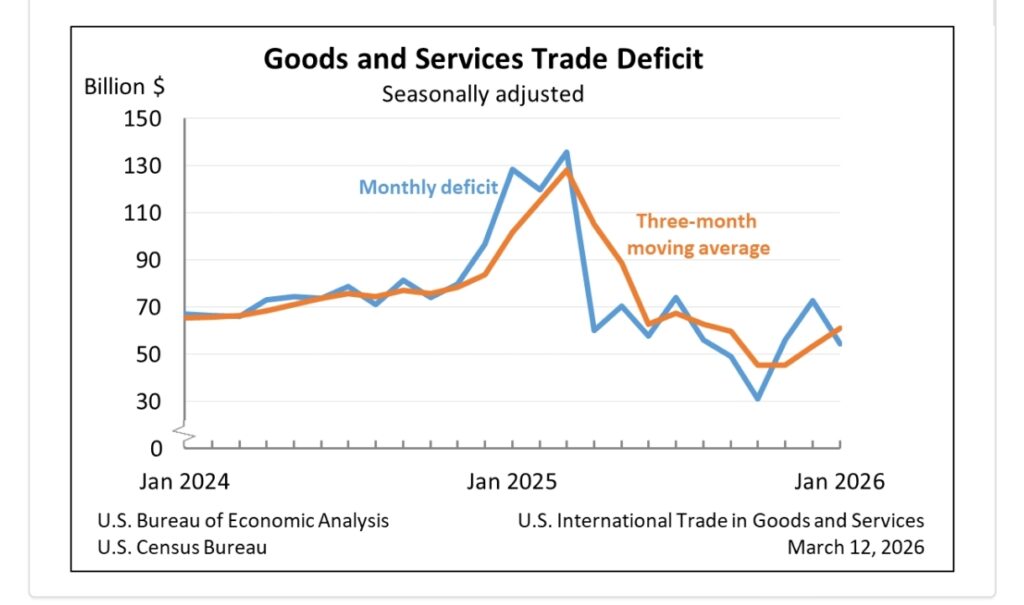
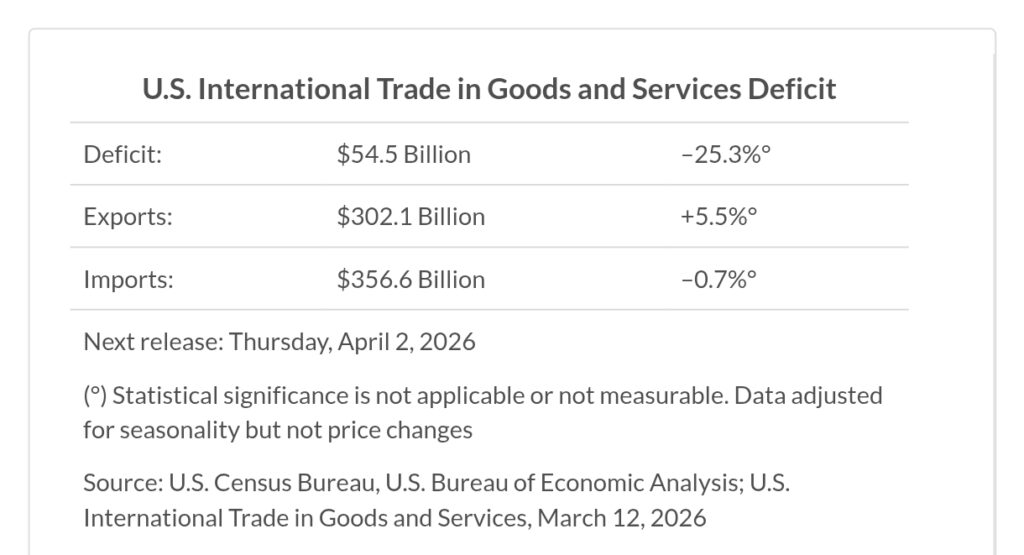
The United States trade deficit narrowed sharply in January 2026 as exports increased and imports declined slightly, signaling an improvement in the country’s external balance at the start of the year. According to data released by the U.S. Census Bureau and the Bureau of Economic Analysis, the goods and services trade deficit fell to 54.5 billion dollars in January. This marks a decline of 18.4 billion dollars from the revised deficit of 72.9 billion dollars recorded in December.
The improvement reflects stronger demand for American exports along with a modest pullback in imports. Exports rose 5.5 percent to reach 302.1 billion dollars during the month, while imports slipped 0.7 percent to 356.6 billion dollars. The combination helped narrow the gap between what the United States sells abroad and what it buys from other countries.
The January report highlights several important shifts within the trade balance. A major contributor to the improvement came from a sharp reduction in the goods deficit. The goods deficit declined by 17.5 billion dollars to 81.8 billion dollars. At the same time, the services sector maintained a healthy surplus that increased slightly to 27.3 billion dollars.
Exports of goods increased significantly during the month. Goods exports climbed 14.6 billion dollars to reach 195.5 billion dollars. Industrial supplies and materials were a major driver of this increase. Nonmonetary gold exports rose 4.7 billion dollars, while exports of other precious metals increased by 4.1 billion dollars. Capital goods exports also strengthened, rising by 5.4 billion dollars.
Within capital goods, exports of computers increased by 2.6 billion dollars, while civilian aircraft shipments rose by 1.6 billion dollars. Computer accessories also saw strong growth with exports increasing by 1.6 billion dollars. These gains suggest continued global demand for advanced manufacturing products produced in the United States.
Exports of services also posted moderate gains. Total services exports rose by 1.2 billion dollars to 106.7 billion dollars. Growth was driven by increases in business services, financial services, and payments for intellectual property. However, travel related services declined slightly during the month, showing weaker tourism flows compared with the previous period.
On the import side, the overall decline in goods imports contributed to the narrower deficit. Imports of goods decreased by 2.8 billion dollars to 277.3 billion dollars. Consumer goods imports fell by 3.3 billion dollars, with pharmaceutical preparations accounting for much of the decline. Imports of automotive vehicles, parts, and engines also decreased by 2.8 billion dollars.
Some import categories did show increases. Capital goods imports rose by 3.4 billion dollars, largely driven by stronger purchases of computers and telecommunications equipment. Computer imports alone increased by 3.9 billion dollars, indicating continued investment in digital infrastructure and technology.
Services imports rose slightly as well. Imports of services increased by 0.2 billion dollars to 79.3 billion dollars. Growth in business services and insurance services offset a small decline in travel related spending.
When adjusted for inflation, the improvement in trade flows remained evident. The real goods deficit declined by 14 billion dollars to 83.9 billion dollars in January. Real exports of goods increased 7.4 percent while real imports of goods fell by 1.3 percent.
The report also provides insight into the United States trade relationships with key global partners. In January, the United States recorded trade surpluses with several countries including the United Kingdom, the Netherlands, Switzerland, Hong Kong, and Saudi Arabia. The largest surplus was with the United Kingdom at 7 billion dollars.
However, the United States continued to run trade deficits with many major manufacturing economies. The largest deficits were recorded with Vietnam at 19 billion dollars, Taiwan at 17.3 billion dollars, Mexico at 12.8 billion dollars, and China at 12.5 billion dollars. The country also reported deficits with the European Union, South Korea, Japan, Germany, and India.
The deficit with the European Union declined to 6.1 billion dollars during the month as both exports and imports fell. Meanwhile, the surplus with the United Kingdom widened sharply to 7 billion dollars due to stronger exports. The deficit with Vietnam increased as imports from the country rose while exports declined slightly.
Financial markets often watch trade data closely because it provides insight into global demand and domestic economic strength. A narrower trade deficit can support economic growth by increasing the contribution of exports to overall output. Strong export growth may also reflect improving global demand for American products and services.
For investors, the January trade figures suggest a modestly positive signal for economic activity. Rising exports of industrial supplies, technology products, and aircraft highlight continued strength in several key sectors of the economy. Meanwhile, the slight decline in imports could indicate a stabilization of domestic demand following strong consumption in previous months.
The data arrives at a time when investors are monitoring global supply chains, energy prices, and geopolitical tensions that could influence trade flows in the months ahead. Changes in trade balances can also affect currency markets, government bond yields, and expectations about economic growth.
The next trade report, covering February 2026, is scheduled for release on April 2. Analysts will be watching closely to see whether the improvement in the trade balance continues or if shifting global demand alters the trajectory of U.S. international trade.

BBW News Desk is the editorial team of BigBreakingWire, a digital newsroom focused on global finance, markets, geopolitics, trade policy, and macroeconomic developments.
Our editors monitor government decisions, central bank actions, international trade movements, corporate activity, and economic indicators to deliver fast, fact-based reporting for investors, professionals, and informed readers.
The BBW News Desk operates under the editorial standards of BigBreakingWire, prioritizing accuracy, verified information, and timely updates on major global developments.










Be First to Comment