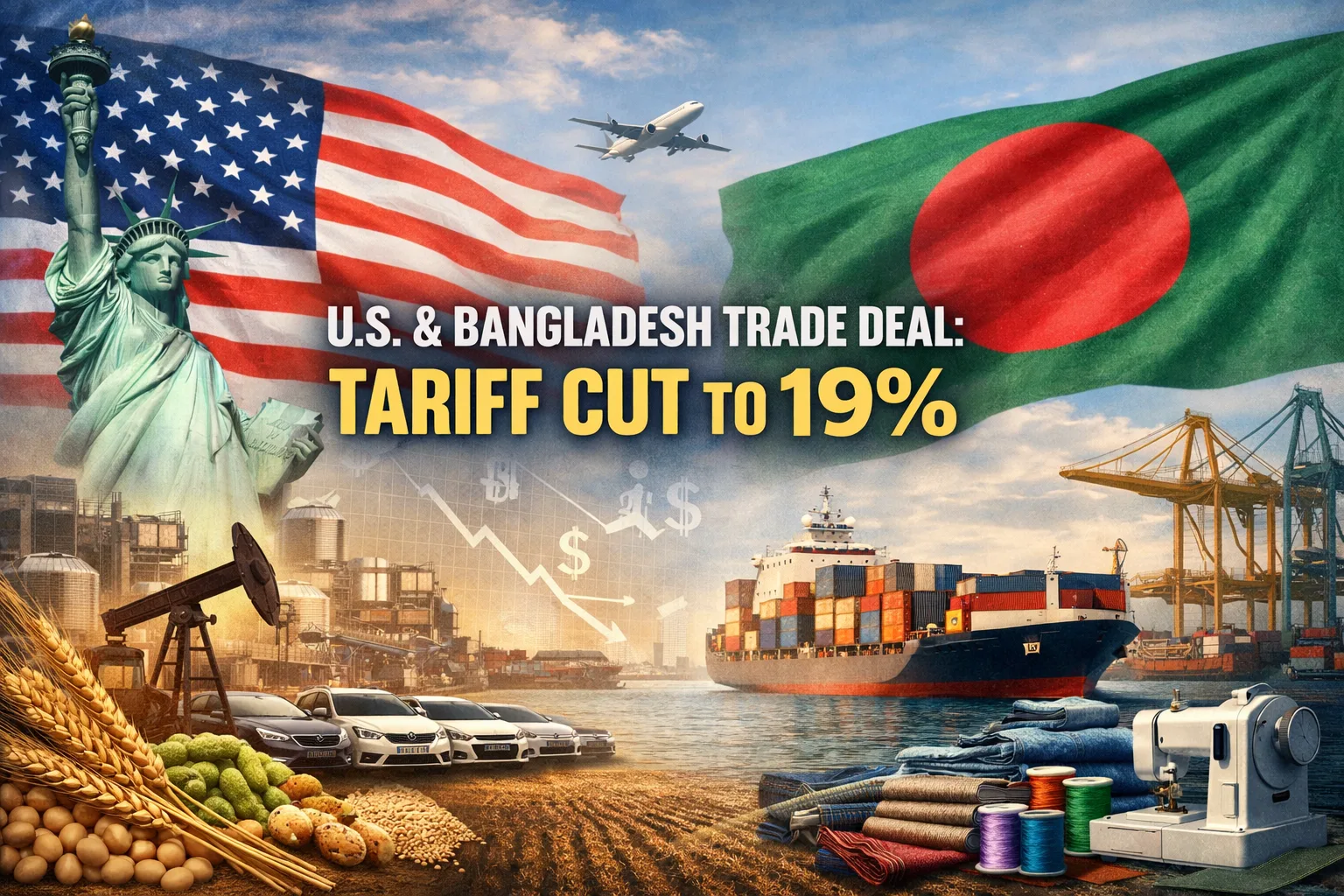
The United States and Bangladesh have agreed to a major trade deal that lowers U.S. tariffs on Bangladeshi goods from 37% to 19%.
The agreement expands market access for American farm and industrial products while helping Bangladesh’s key export sectors, especially textiles.
The move strengthens economic ties, supply chains, and long term trade cooperation between the two countries.
Exporters, manufacturers, and investors on both sides are directly affected.
What Happened in the US Bangladesh Trade Deal
The two countries finalized an Agreement on Reciprocal Trade aimed at improving bilateral economic relations.
The United States will reduce tariffs on goods from Bangladesh to 19%, with selected products eligible for a 0% tariff rate.
A special mechanism will allow certain Bangladeshi textile and apparel goods to enter the U.S. at zero tariff, linked to U.S. textile input exports.
Bangladesh will provide preferential access to U.S. products such as chemicals, medical devices, machinery, ICT equipment, energy goods, soy, dairy, beef, poultry, nuts, and fruits.
Why the US Reduced Tariffs on Bangladesh
The deal aims to rebalance trade and expand exports for both countries.
The U.S. wants to increase sales of agricultural, energy, and industrial goods.
Bangladesh seeks better access for its export driven sectors, especially apparel manufacturing.
The agreement also strengthens cooperation on supply chain security, export controls, and tackling unfair trade practices.
Global Trade Context Behind the US Bangladesh Agreement
Bangladesh is a key global apparel exporter and a major part of international supply chains.
Total U.S.-Bangladesh trade reached $12.4 billion in 2024, up 3% from 2023.
The U.S. goods trade deficit with Bangladesh stood at $6.1 billion in 2024.
The agreement includes commitments on labor rights, environmental standards, intellectual property protection, and anti corruption enforcement.
Bangladesh will also remove non tariff barriers, modernize customs, and allow cross border data flows.
Impact on Businesses, Markets, and Workers
U.S. farmers and energy companies benefit from expected Bangladeshi purchases of $3.5 billion in agricultural goods and $15 billion in energy over 15 years.
U.S. exporters of vehicles, machinery, and medical devices gain easier market entry.
Bangladeshi textile exporters receive improved tariff treatment, supporting factory output and employment.
Institutions such as EXIM Bank and DFC may help finance new investments in Bangladesh.
What Happens Next in the Trade Agreement
Both countries must complete domestic procedures before the agreement becomes active.
Final product lists eligible for zero tariffs will be announced.
Labor, environmental, and regulatory commitments will be monitored during implementation.
Frequently Asked Questions
What is the new tariff rate on Bangladeshi goods?
The U.S. tariff is reduced to 19%, with some products eligible for 0%.
Which sector benefits the most?
Textiles and apparel gain through a special zero tariff entry mechanism.
How large is trade between the two countries?
Total trade reached $12.4 billion in 2024.
What major purchases are planned?
Bangladesh plans $3.5B in U.S. agriculture and $15B in energy imports.
Conclusion on the US Bangladesh Trade Pact
The agreement lowers trade barriers, strengthens supply chains, and creates new export opportunities, marking a significant step in U.S.-Bangladesh economic cooperation.

BBW News Desk is the editorial team of BigBreakingWire, a digital newsroom focused on global finance, markets, geopolitics, trade policy, and macroeconomic developments.
Our editors monitor government decisions, central bank actions, international trade movements, corporate activity, and economic indicators to deliver fast, fact-based reporting for investors, professionals, and informed readers.
The BBW News Desk operates under the editorial standards of BigBreakingWire, prioritizing accuracy, verified information, and timely updates on major global developments.












Be First to Comment