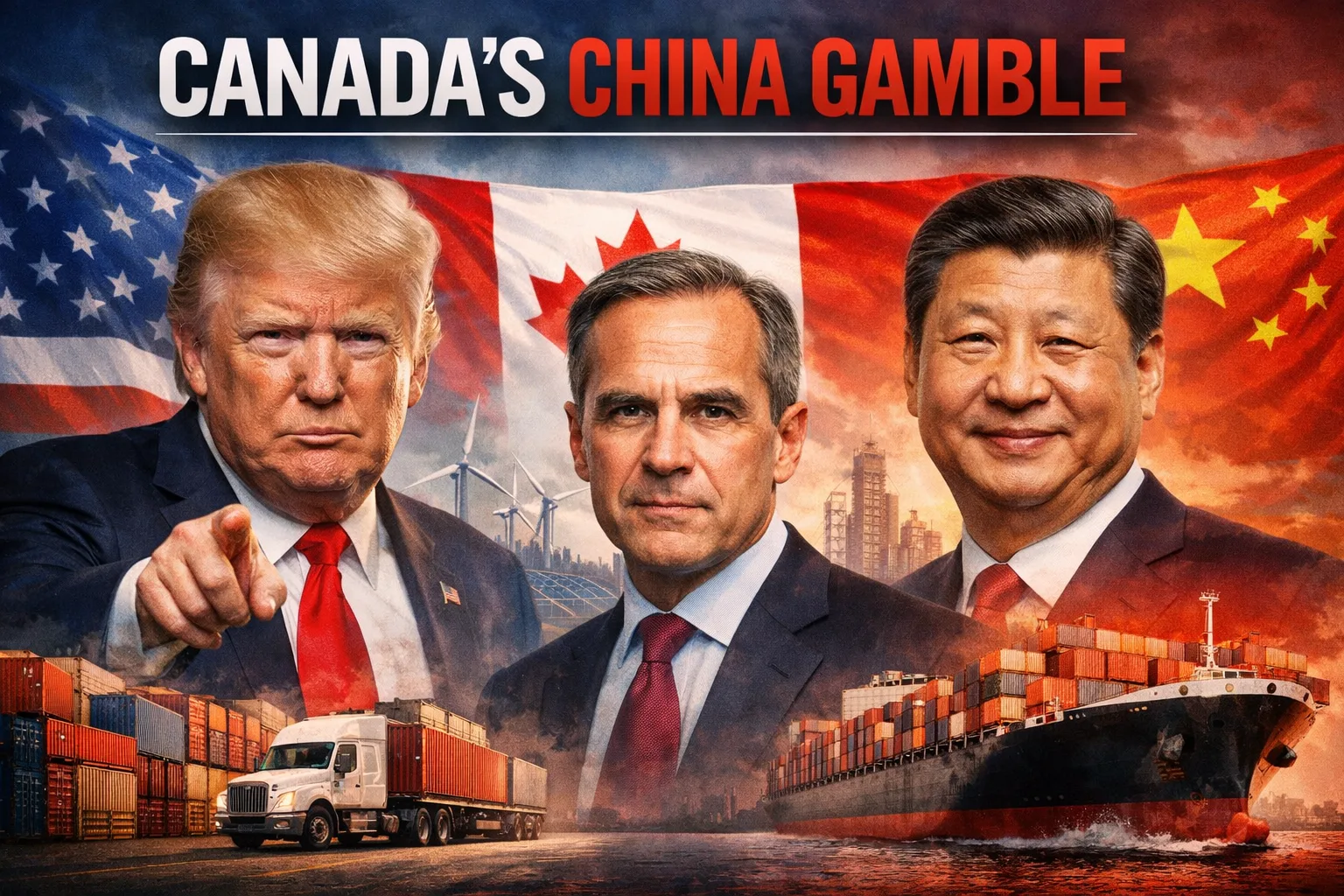
US President Donald Trump has warned Canada against becoming a transit route for Chinese goods entering the United States. Trump said such a move would seriously damage Canada’s economy and way of life.
He claimed that deeper trade integration with China could allow Chinese companies to dominate Canadian businesses and weaken the country’s social and economic fabric.
Trump also issued a strong trade warning. He said that if Canada signs a major trade deal with China, the US would impose an immediate 100% tariff on all Canadian goods entering the American market.
Canada China Strategic Partnership Explained
Despite the warning, Canada has moved ahead with closer engagement with China. Canadian Prime Minister Mark Carney visited Beijing last week, marking the first visit by a Canadian Prime Minister to China since 2017.
In Beijing, he met Chinese President Xi Jinping, Premier Li Qiang, and Zhao Leji, Chairman of China’s National People’s Congress.
After the meetings, Canada and China released a joint statement outlining a new strategic partnership focused on energy, clean technology, climate competitiveness, and trade.
Energy and Clean Technology Cooperation
Energy cooperation sits at the core of the new partnership. Both countries see themselves as energy superpowers and aim to expand two way cooperation.
The agreement focuses on:
- Clean energy investment
- Batteries, solar, wind, and energy storage
- Reducing emissions while expanding industrial capacity
During the visit, Canadian officials met Chinese clean energy companies to attract long term investment into Canada’s energy and manufacturing sectors.
Chinese Electric Vehicles in Canada
Canada will allow up to 49,000 Chinese electric vehicles to enter its market at a most favoured nation tariff rate of 6.1%.
Key facts:
- Volume equals less than 3% of Canada’s annual new vehicle market
- Based on pre trade friction levels from 2023 to 2024
- Over 50% expected to be priced below $35,000 within five years
Canada expects this move to attract joint venture investments and strengthen domestic EV manufacturing and supply chains while creating new jobs.
Major Agriculture Trade Gains for Canada
Agriculture remains a key pillar of Canada China trade. China is Canada’s second largest export market.
Under the preliminary agreement:
- Canola seed tariffs are expected to fall to about 15% by March 1, 2026
- Current combined tariffs are around 85%
- Canola meal, lobster, crab, and peas will avoid discriminatory tariffs until at least end 2026
China represents a $4 billion canola seed market for Canadian farmers. These changes could unlock nearly $3 billion in new export orders.
Canada China Trade Numbers
China is Canada’s second largest single country trading partner.
- Total two way merchandise trade in 2024: $118.9 billion
- Canadian exports to China: $30 billion
- Canadian imports from China: $88.9 billion
China is also Canada’s second largest customer for agriculture, forestry, and seafood products, with sales worth $13.4 billion in 2024.
US Canada Trade Relationship at a Glance
The US remains Canada’s most important trade partner by a wide margin.
- Total US Canada trade in 2024: $909.1 billion
- US goods exports to Canada: $349.9 billion
- US goods imports from Canada: $411.9 billion
- US trade deficit with Canada: $62 billion
Services trade also remains strong, with the US recording a $33.2 billion surplus in services trade with Canada in 2024.
Role of USMCA Trade Agreement
The US, Canada, and Mexico trade under the United States-Mexico-Canada Agreement, which came into force in 2020.
The agreement supports nearly $2 trillion in regional trade and includes rules to counter non market distortions, a key concern raised by US policymakers when dealing with China.
Why This Matters
Canada’s effort to balance economic ties between the US and China comes at a sensitive time. While China offers a massive consumer market and investment capital, the US remains Canada’s closest economic and security partner.
Any sharp shift could trigger trade retaliation, disrupt supply chains, and test the limits of North American trade agreements.
Conclusion
Canada’s deepening engagement with China signals a push for diversification, clean energy growth, and export expansion. However, Trump’s warning highlights the geopolitical and economic risks involved.
How Canada manages this balance between opportunity and pressure will shape its trade future for the rest of this decade.
Update: Canada Rules Out Free Trade Pact With China
Canadian Prime Minister Mark Carney said Canada is not planning to negotiate a free trade agreement with China, responding to warnings from US President Donald Trump about possible 100% tariffs on Canadian goods.
Carney clarified that Canada’s recent understanding with China only eased tariffs in a few sectors that had faced trade barriers in recent years and should not be seen as a full trade deal.
He also pointed out that under the US Mexico Canada Agreement, Canada must inform partners before pursuing trade pacts with nonmarket economies, adding that Canada has no intention of entering such agreements with China or others in that category.

BBW News Desk is the editorial team of BigBreakingWire, a digital newsroom focused on global finance, markets, geopolitics, trade policy, and macroeconomic developments.
Our editors monitor government decisions, central bank actions, international trade movements, corporate activity, and economic indicators to deliver fast, fact-based reporting for investors, professionals, and informed readers.
The BBW News Desk operates under the editorial standards of BigBreakingWire, prioritizing accuracy, verified information, and timely updates on major global developments.

































Be First to Comment