
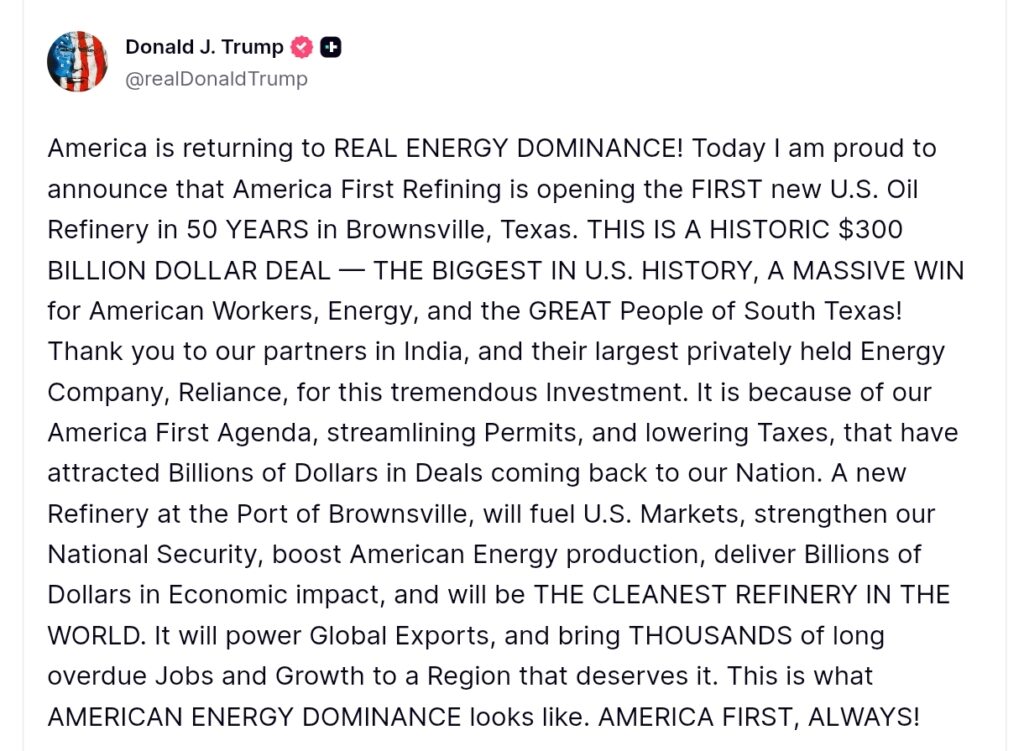
U.S. President Donald Trump announced a major energy investment on Tuesday, revealing plans for what he described as the first new oil refinery in the United States in fifty years. The project will be built in Brownsville, Texas and is expected to involve a total investment of about $300 billion. According to Trump, the refinery will be developed by America First Refining with financial support from India based energy giant Reliance. The project is being presented as a major step toward strengthening U.S. energy production and expanding export capacity.
The announcement comes at a time when global energy markets remain highly sensitive to supply risks and geopolitical tensions. Investors have closely monitored developments in oil producing regions and infrastructure investments that could influence long term supply. A refinery of this scale would significantly expand the United States capacity to process crude oil into refined fuels such as gasoline, diesel, and jet fuel.
Trump framed the investment as a major milestone for the American energy sector and highlighted the economic impact expected from the project. In a public statement he said, “America is returning to real energy dominance. Today I am proud to announce that America First Refining is opening the first new U.S. oil refinery in fifty years in Brownsville, Texas. This is a historic $300 billion dollar deal, the biggest in U.S. history.”
He also thanked India based partners for their role in the project. Trump said, “Thank you to our partners in India and their largest privately held energy company, Reliance, for this tremendous investment.” His remarks suggest that international investment is playing a key role in supporting the large scale infrastructure development.
The refinery is planned for the Port of Brownsville in South Texas, a strategic location near shipping routes and energy export infrastructure along the Gulf Coast. The region already serves as a major hub for oil, natural gas, and petrochemical industries. Building a large refinery in this location could help the United States process more crude domestically and expand exports of refined fuels to global markets.
According to Trump, policy changes focused on reducing taxes and streamlining permits helped attract the investment. He argued that regulatory reforms and pro energy policies are encouraging companies to commit billions of dollars to domestic projects. Investors often view faster permitting and stable tax policies as important factors when evaluating long term infrastructure investments.
The scale of the investment could have significant economic implications for the region. Construction of the refinery is expected to create thousands of jobs while long term operations could provide stable employment in energy processing, logistics, and maintenance. Trump also said the refinery will generate billions of dollars in economic activity and strengthen national energy security.
Energy analysts say new refinery capacity in the United States has been limited for decades. Environmental regulations, high construction costs, and uncertain long term fuel demand have discouraged companies from building new facilities. Instead many companies have focused on upgrading existing refineries rather than building entirely new ones.
If completed, the Brownsville project would represent one of the largest energy infrastructure investments ever announced in the United States. Trump also claimed the refinery would become the cleanest refinery in the world, though detailed environmental plans and regulatory approvals have not yet been publicly released.
The project could also reshape global refined fuel trade flows. Additional U.S. refining capacity would allow the country to export more fuel to Latin America, Europe, and Asia. This could increase competition for refiners in other regions while strengthening the United States position as a leading energy exporter.
For investors, the announcement highlights the continued importance of traditional energy infrastructure even as the global economy gradually transitions toward cleaner energy sources. Oil demand remains strong across transportation, manufacturing, and aviation sectors, keeping refining capacity strategically important.
While the project is still in its early stages, markets will closely monitor regulatory approvals, financing arrangements, and construction timelines. If the refinery proceeds as planned, it could become a defining development for the U.S. energy sector and a major symbol of renewed investment in domestic oil infrastructure.
American Fuel & Refining Secures Major Investment for $4 Billion U.S. Refinery Project
American Fuel & Refining (AFR) said it has secured a nine figure investment from a global energy supermajor for its new refinery project. The facility could cost up to $4 billion and will process about 60 million barrels of American light crude each year. The company has also signed a 20 year offtake agreement for the refined products.
Construction is expected to begin soon. AFR said the project could help improve the US trade balance by about $300 billion. CEO John Calce said the “America First” approach refers to using American shale oil rather than politics, noting that the US currently has 132 refineries, most of which were built decades ago and are designed to process heavier foreign crude.

BBW News Desk is the editorial team of BigBreakingWire, a digital newsroom focused on global finance, markets, geopolitics, trade policy, and macroeconomic developments.
Our editors monitor government decisions, central bank actions, international trade movements, corporate activity, and economic indicators to deliver fast, fact-based reporting for investors, professionals, and informed readers.
The BBW News Desk operates under the editorial standards of BigBreakingWire, prioritizing accuracy, verified information, and timely updates on major global developments.










Be First to Comment