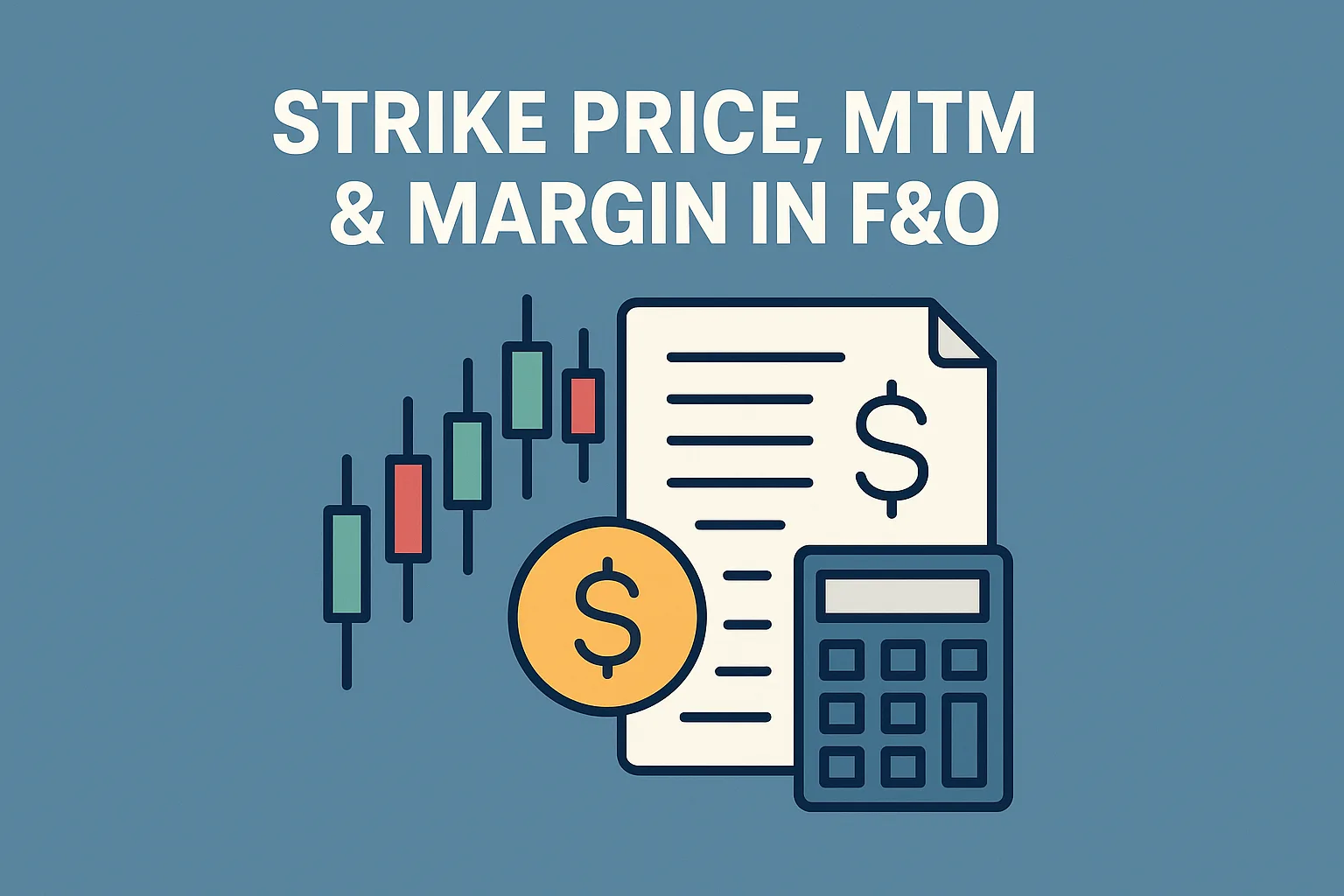
If you are trading in Futures & Options (F&O), you must clearly understand strike price, mark-to-market (MTM), and margin rules.
This guide explains all three concepts in simple with direct answers.
What is Strike Price in Options Trading?
A strike price is the fixed price at which an option contract can be exercised (bought or sold).
In simple words, it is the price you choose while buying or selling a Call Option or Put Option.
Example of Strike Price
If NIFTY is trading at 22,000:
- 22,000 Call Option → Right to buy at 22,000
- 22,000 Put Option → Right to sell at 22,000
The number 22,000 is the strike price.
How to Select Strike Price for Options Trading?
Choosing the right strike price depends on your market view and risk appetite.
At-The-Money (ATM) Strike
- Closest to current market price
- High liquidity and faster price movement
- Best for beginners and intraday traders
In-The-Money (ITM) Strike
- Already profitable if exercised
- Higher premium but lower risk
- Suitable for conservative traders
Out-of-The-Money (OTM) Strike
- Cheaper options
- High risk, high reward
- Used for directional or event-based trades
Quick Tip:
If you expect a strong move, choose ITM or ATM.
If you expect limited movement, OTM selling strategies work better.
What is Mark-to-Market (MTM)?
Mark-to-Market (MTM) means daily settlement of profit or loss in futures contracts.
Your profit or loss is calculated at the end of every trading day based on the closing price.
MTM Example
You buy a futures contract at Rs 1,000.
Market closes at Rs 980.
- Loss = Rs 20 per unit
- This loss is debited from your account the same day
Similarly, profits are credited daily.
Important: MTM applies mainly to Futures, not options buyers.
MTM Settlement in Futures Contracts
MTM settlement ensures:
- Daily risk control
- No accumulation of losses
- Broker and exchange safety
If losses exceed available margin, you may receive a margin call.
What is Margin in F&O?
Margin is the minimum money required to trade in Futures & Options.
It acts as a security deposit to cover potential losses.
Types of Margin in F&O
SPAN Margin
- Calculated using worst-case risk scenarios
- Mandatory as per exchange rules
Exposure Margin
- Additional margin over SPAN
- Protects against sudden volatility
Total Margin = SPAN Margin + Exposure Margin
Peak Margin Rules (SEBI)
SEBI requires brokers to collect 100% upfront margin before trade execution.
Key points:
- No intraday margin benefit
- Peak margin checked multiple times daily
- Penalties if margin is insufficient
Important SEBI Rules for F&O Traders
- Full margin compulsory before trade
- Daily MTM settlement for futures
- No leverage beyond permitted limits
- Margin penalties passed to traders
Frequently Asked Questions (Quick Answers)
Q: Is strike price same as market price?
No. Strike price is fixed, market price keeps changing.
Q: Do options buyers need MTM?
No. MTM mainly applies to futures and option sellers.
Q: Can margin change daily?
Yes. Margin depends on volatility and exchange rules.
Final Takeaway
Understanding strike price, MTM, and margin rules is essential before trading in F&O.
These concepts protect traders, brokers, and the entire market system.
Trade only after understanding the risk.

BBW News Desk is the editorial team of BigBreakingWire, a digital newsroom focused on global finance, markets, geopolitics, trade policy, and macroeconomic developments.
Our editors monitor government decisions, central bank actions, international trade movements, corporate activity, and economic indicators to deliver fast, fact-based reporting for investors, professionals, and informed readers.
The BBW News Desk operates under the editorial standards of BigBreakingWire, prioritizing accuracy, verified information, and timely updates on major global developments.






Be First to Comment