


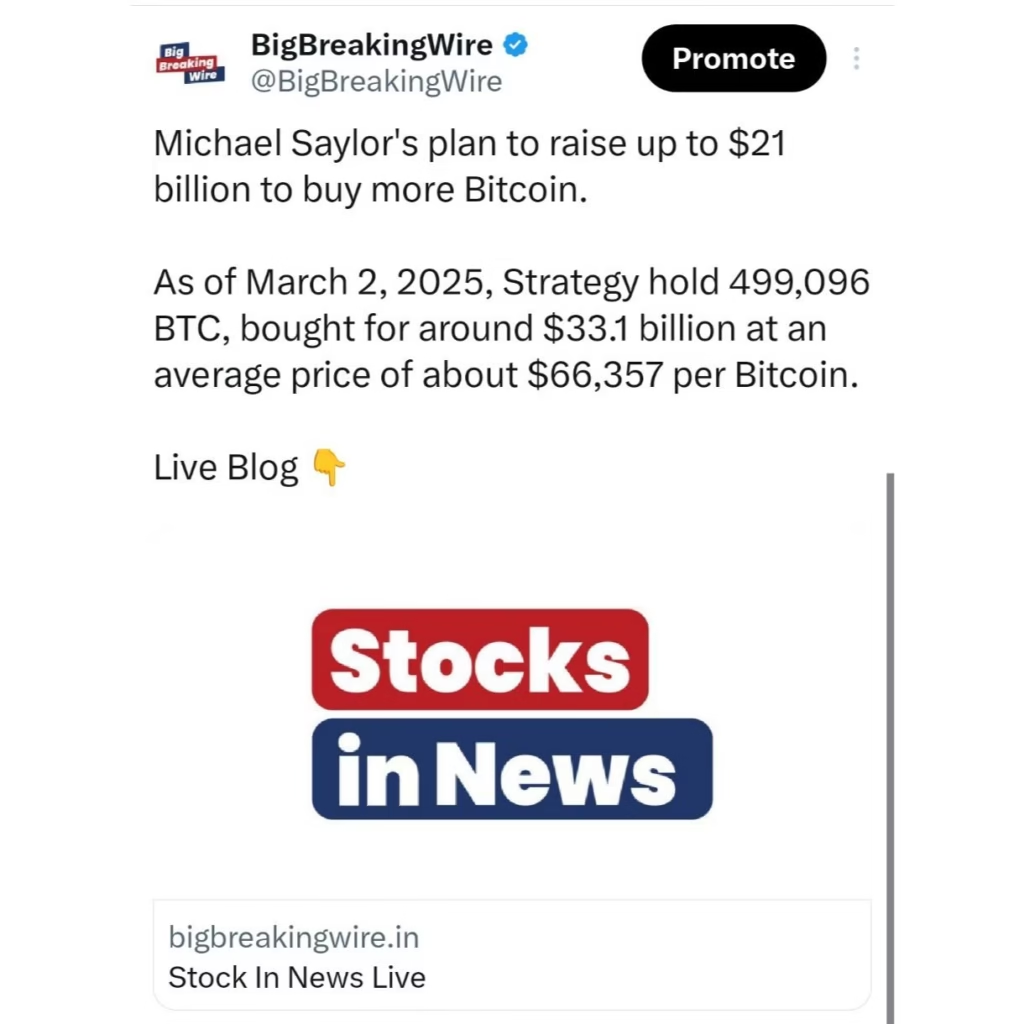
Strategy has revealed plans to raise up to $21.0 billion through the sale of its 8.00% Series A Perpetual Strike Preferred Stock. The company intends to offer these shares under an “At-the-Market” (ATM) Program. The shares, which have a $0.001 par value per share, are convertible by holders into Strategy‘s Class A common stock.
The company plans to sell these shares in a careful and disciplined manner, taking into account market conditions such as the trading price and volume of the perpetual strike preferred stock at the time of sale. This will allow Strategy to raise capital gradually over an extended period, rather than all at once.
Proceeds from this offering will be used for general corporate purposes, including purchasing bitcoin and supporting the company’s working capital needs.
The preferred stock will be sold under an agreement, and the offering will occur according to the terms of an existing automatic shelf registration statement, which was filed with the Securities and Exchange Commission (SEC) on January 27, 2025 (File No. 333-284510). The public offering will be conducted through a prospectus supplement that was filed with the SEC on March 10, 2025.
Context for investors
An at-the-market program lets a company sell new shares into the market over time, usually through a broker, at the going price rather than in one block. It gives the seller control over pace. The trade-off is that sales can keep pressure on the share price for as long as the program runs.
The instrument here is preferred stock, which sits above common shares in the queue for dividends. It carries a stated dividend rate and can be converted by holders into common stock, so it blends features of debt and of equity. The par value is tiny, which is normal for such paper and says little about the market price.
For existing shareholders, the main question is dilution. Every share sold adds to the count, and conversion would add more. The company has said it will sell in a disciplined way, watching trading price and volume, which suggests it wants to avoid pushing stock into a weak market.
The use of proceeds is the other signal. Money raised is meant for general corporate needs, including buying bitcoin and funding working capital. That links the fundraise to the company’s crypto stance, so the stock may trade with bitcoin sentiment as well as with its own results.


