
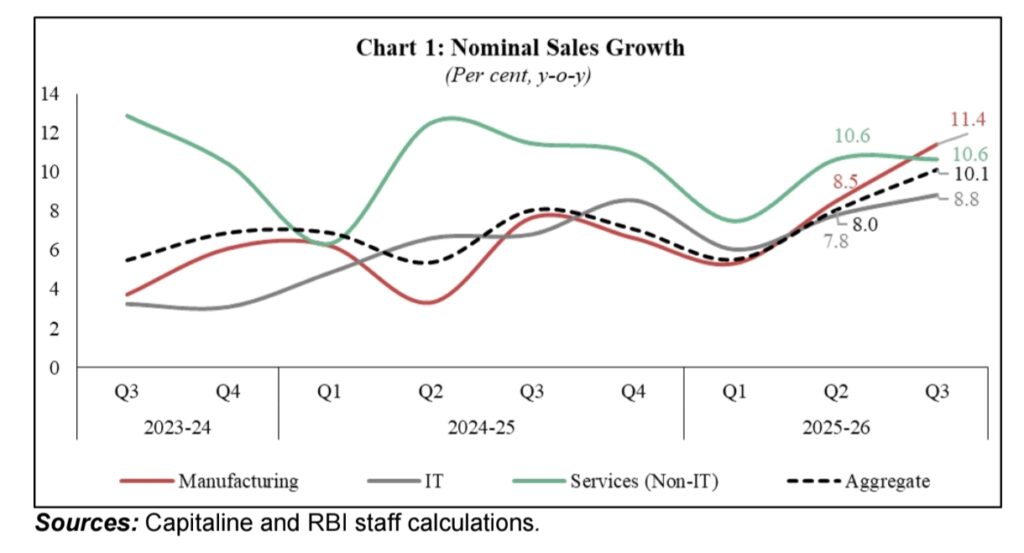
India’s listed private non-financial companies recorded a 10.1% year-on-year sales growth in Q3 FY2025-26, according to Reserve Bank of India data based on 3,188 firms’ quarterly results. This marks the first return to double-digit growth after eleven consecutive quarters of single-digit expansion. The rebound was mainly driven by manufacturing sector acceleration, particularly in automobiles, electrical machinery, and non-ferrous metals.
The data also shows rising input cost pressures, with raw material expenses increasing 12.7% and the raw material-to-sales ratio rising to 57.5%. Meanwhile, operating profit trends remained mixed across sectors, and interest coverage ratios improved due to easing interest expenses.
What Happened in RBI Corporate Sector Performance Report
The Reserve Bank of India released its quarterly assessment of the private corporate business sector for Q3 FY26, covering 3,188 listed non-government non-financial companies. The report compares sequential (Q2 FY26) and annual (Q3 FY26) performance to track trends in sales, costs, profitability, and financial stability.
Aggregate sales growth rose sharply to 10.1% year-on-year, reversing the prolonged phase of muted corporate revenue expansion. Manufacturing companies led this recovery with 11.4% growth, up from 8.5% in the previous quarter, indicating improving industrial demand and sectoral recovery.
| Indicator | Q3 FY26 | Q2 FY26 | Trend |
| Overall Sales Growth (YoY) | 10.1% | Single Digit | Accelerated |
| Manufacturing Sales Growth | 11.4% | 8.5% | Improved |
| IT Sector Sales Growth | 8.8% | 7.8% | Moderate Improvement |
| Non-IT Services Sales Growth | 10.6% | 10.6% | Stable |
Why Did Corporate Sales Growth Accelerate in Q3 FY26
The improvement in corporate performance is closely linked to domestic demand resilience and sector-specific recovery in capital-intensive industries. Automobiles, electrical machinery, and metals witnessed stronger order flows, reflecting both infrastructure spending and steady consumption trends.
Additionally, a gradual normalization in global supply chains and stable commodity prices during the quarter supported production activity. Export-linked sectors, especially manufacturing and IT, also benefited from improving external demand conditions compared to earlier quarters of global slowdown.
Bigger Context Behind India’s Corporate Earnings in Economy and Geopolitics
The rebound in corporate sales comes at a time when global growth remains uneven due to trade tensions, supply chain realignment, and tighter financial conditions in major economies. India’s domestic-driven growth model has helped listed firms maintain revenue momentum despite external volatility.
From a geopolitical standpoint, India’s positioning as an alternative manufacturing hub amid global supply chain diversification has strengthened industrial output. Sectors such as electrical machinery and non-ferrous metals are increasingly linked to global energy transition and infrastructure investments, which are shaping corporate demand cycles.
At the same time, cost pressures signal that global commodity dynamics and imported input prices continue to influence Indian corporate margins. The rise in raw material-to-sales ratio to 57.5% highlights the lingering impact of input inflation on industrial profitability.
How RBI Corporate Data Affects Markets, Companies, Investors, and Economy
For equity markets, the return to double-digit sales growth is a positive signal for earnings outlook, particularly in manufacturing-heavy indices. Stronger revenue growth typically supports valuation stability and investor confidence in cyclical sectors.
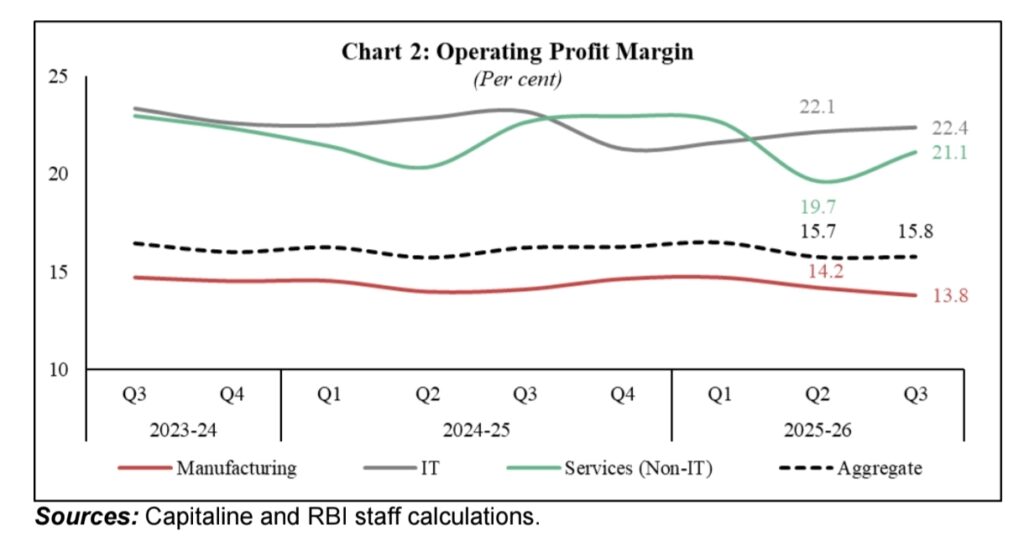
However, rising raw material costs and moderating operating margins in manufacturing indicate margin compression risks if input inflation persists. Operating profit of manufacturing firms grew 11.8% year-on-year, while non-IT services saw slower profit growth of 4.0%, suggesting uneven sectoral earnings quality.
Financial stability indicators improved as interest expenses declined sequentially. Manufacturing firms’ interest coverage ratio rose to 9.0 from 8.6, indicating stronger debt-servicing capacity. Non-IT services ICR improved to 2.3, while IT firms maintained elevated coverage levels despite slight moderation.
| Financial Metric | Q3 FY26 Value | Implication |
| Raw Material Expense Growth | 12.7% | Input cost pressure rising |
| Operating Profit Growth (Manufacturing) | 11.8% | Healthy earnings recovery |
| Interest Coverage Ratio (Manufacturing) | 9.0 | Improved financial stability |
| Staff Cost Growth (Manufacturing) | 12.4% | Wage and expansion costs rising |
What Happens Next in India’s Corporate Sector Outlook
If domestic demand remains stable and infrastructure spending continues, manufacturing-led growth could sustain corporate earnings momentum in the coming quarters. However, margin trends will depend heavily on commodity prices and input cost management.
Monetary policy trajectory and borrowing costs will also be key. Lower interest expenses have already improved financial health, and any further easing in credit conditions could support capex cycles among listed firms.
Sectorally, IT growth may remain moderate due to global tech spending cycles, while non-IT services could face margin pressure if cost growth outpaces revenue expansion. Investors are likely to closely track operating margins and cost ratios rather than topline growth alone.
| Forward Indicator | Expected Trend | Key Risk |
| Corporate Earnings | Gradual Improvement | Input Cost Inflation |
| Manufacturing Growth | Strong | Global Demand Slowdown |
| Profit Margins | Mixed | Rising Raw Material Costs |
Frequently Asked Questions
What does RBI’s Q3 FY26 corporate data show?
It shows listed private non-financial companies recorded 10.1% year-on-year sales growth, led mainly by manufacturing sector recovery.
Which sectors drove the sales growth in Q3 FY26?
Automobiles, electrical machinery, and non-ferrous metals were the key drivers of manufacturing sector expansion.
Did corporate profitability improve in Q3 FY26?
Operating profits improved in manufacturing and IT sectors, but non-IT services saw moderated profit growth and mixed margin trends.
Why is interest coverage ratio important in RBI data?
It measures companies’ ability to service debt, and the rise to 9.0 for manufacturing firms indicates stronger financial resilience.
Conclusion
The RBI’s Q3 FY26 corporate sector data signals a meaningful recovery in India’s listed private companies, driven by manufacturing strength and improved financial stability. However, rising input costs and mixed margin trends suggest that the next phase of corporate growth will depend more on cost control, global demand conditions, and monetary policy direction than purely revenue expansion.

BBW News Desk is the editorial team of BigBreakingWire, a digital newsroom focused on global finance, markets, geopolitics, trade policy, and macroeconomic developments.
Our editors monitor government decisions, central bank actions, international trade movements, corporate activity, and economic indicators to deliver fast, fact-based reporting for investors, professionals, and informed readers.
The BBW News Desk operates under the editorial standards of BigBreakingWire, prioritizing accuracy, verified information, and timely updates on major global developments.










Be First to Comment