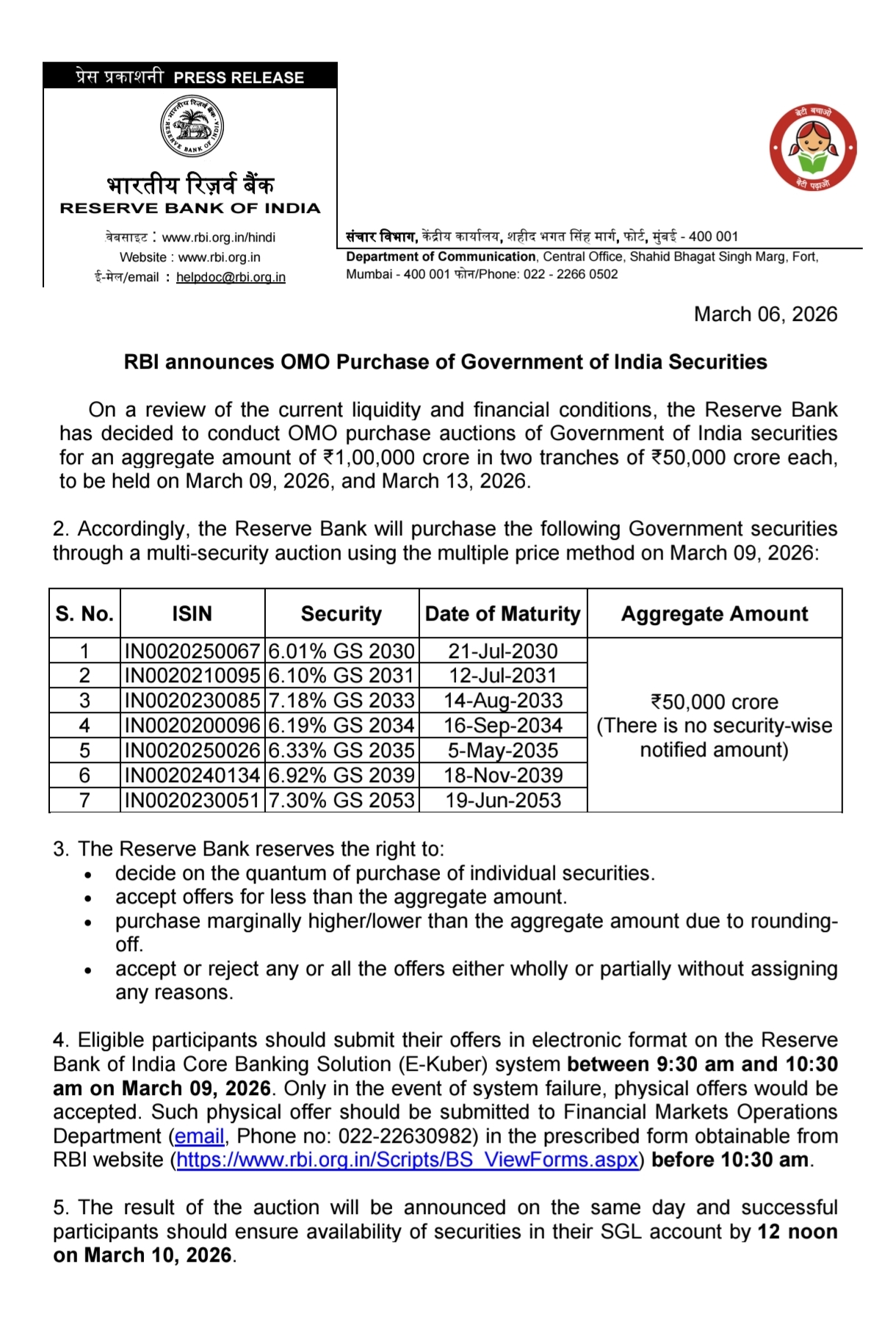
The Reserve Bank of India (RBI) has announced Open Market Operations (OMO) purchases of Government of India securities worth Rs 1,00,000 crore. The purchases will take place in two auctions of Rs 50,000 crore each on March 9, 2026 and March 13, 2026.
The move comes after a review of current liquidity and financial conditions in India’s banking system. By purchasing government bonds from the market, the central bank aims to inject liquidity and stabilize financial conditions.
The policy directly affects banks, bond investors, and financial markets as it influences interest rates, government borrowing costs, and credit availability across the economy.
What Happened in RBI’s Open Market Operations Decision
The Reserve Bank of India announced that it will conduct OMO purchase auctions totaling Rs 1,00,000 crore. The purchases will be executed in two separate tranches of Rs 50,000 crore each.
The first auction will take place on March 9, 2026 through the RBI’s E-Kuber system between 9:30 am and 10:30 am. Market participants such as banks, primary dealers, and financial institutions will submit offers to sell government securities to the central bank.
The bonds targeted in the operation include several benchmark government securities with maturities ranging from 2030 to 2053. These include securities such as the 6.01% GS 2030, 6.10% GS 2031, 7.18% GS 2033, and 7.30% GS 2053.
| Policy Measure | Details |
| Total OMO Purchase | Rs 1,00,000 crore |
| First Auction | March 9, 2026 (Rs 50,000 crore) |
| Second Auction | March 13, 2026 (Rs 50,000 crore) |
| Method | Multi-security auction using multiple price method |
| Settlement Date | March 10, 2026 for first tranche |
Why Did RBI Conduct This OMO Operation
The RBI uses Open Market Operations as a monetary policy tool to manage liquidity in the financial system. When the central bank purchases government bonds, it injects cash into the banking system, increasing liquidity.
In recent months, liquidity conditions in India have tightened due to large government cash balances, tax outflows, and strong credit demand. Such tightening can push short term interest rates above the policy corridor.
By purchasing bonds from the market, the RBI increases the availability of funds for banks and financial institutions. This helps maintain stability in money markets and ensures that interest rates remain aligned with the central bank’s policy stance.
Bigger Context Behind RBI Liquidity Management in Economy and Geopolitics
The RBI’s decision also reflects broader macroeconomic dynamics in India and globally. Central banks worldwide are carefully balancing inflation control with the need to maintain financial stability.
India’s economy is currently navigating a period of strong credit growth, rising infrastructure investment, and elevated government borrowing. The government’s fiscal strategy requires consistent demand for sovereign bonds to finance spending programs.
At the same time, global geopolitical tensions and energy price volatility have increased uncertainty in international financial markets. These factors can influence capital flows into emerging markets like India.
Liquidity management through OMOs allows the RBI to maintain orderly conditions in the government bond market while supporting financial stability during periods of global uncertainty.
How RBI’s OMO Purchase Affects Markets, Companies, Investors, and Economy
The announcement of large OMO purchases typically influences multiple segments of financial markets. Government bond yields may decline as the central bank becomes a large buyer in the market.
Lower bond yields can reduce borrowing costs across the economy. This benefits corporations issuing bonds, banks lending to businesses, and infrastructure developers seeking long term financing.
For equity markets, improved liquidity often supports investor sentiment. When banks have more cash reserves, they can expand lending and investment activity.
The move also stabilizes India’s sovereign debt market by ensuring adequate demand for government securities amid large fiscal borrowing requirements.
| Market Segment | Potential Impact |
| Government Bond Market | Lower yields due to increased demand |
| Banking System | Higher liquidity and lending capacity |
| Corporate Borrowing | Lower financing costs |
| Equity Markets | Improved investor sentiment |
Key Government Securities Included in RBI’s OMO Purchase
| Security | Maturity Date | Coupon Rate |
| GS 2030 | 21 July 2030 | 6.01% |
| GS 2031 | 12 July 2031 | 6.10% |
| GS 2033 | 14 Aug 2033 | 7.18% |
| GS 2034 | 16 Sep 2034 | 6.19% |
| GS 2035 | 5 May 2035 | 6.33% |
| GS 2039 | 18 Nov 2039 | 6.92% |
| GS 2053 | 19 Jun 2053 | 7.30% |
RBI OMO Aims to Support Liquidity Ahead of March Tax Outflows
Market participants say the RBI’s open market operation purchase is mainly meant to add liquidity to the banking system before large tax payments due in March. Advance tax and GST payments could pull nearly Rs 4 trillion out of the system, which may push banking liquidity into deficit.
They also noted that the RBI’s recent intervention in the forex market and the maturity of forex forward sales could further drain rupee liquidity. Currently, banking system liquidity remains in surplus at about Rs 3.02 trillion as of Thursday.
What Happens Next in RBI Liquidity Policy
Financial markets will closely watch the outcome of the March 9 and March 13 auctions to assess investor participation and yield movements.
If liquidity conditions remain tight, the RBI may conduct additional OMOs or liquidity operations such as variable rate repo auctions. Conversely, if liquidity improves significantly, the central bank could slow its bond purchases.
The broader policy direction will also depend on inflation trends, fiscal borrowing requirements, and global financial conditions. With India targeting stable growth and controlled inflation, liquidity management will remain a key tool for the central bank.
Frequently Asked Questions
What is RBI Open Market Operations (OMO)?
OMO refers to the purchase or sale of government securities by the Reserve Bank of India to manage liquidity in the banking system.
Why does RBI buy government bonds?
The central bank buys bonds to inject liquidity into the financial system and stabilize interest rates.
How much liquidity is RBI injecting in March 2026?
The RBI will purchase government securities worth Rs 1,00,000 crore in two auctions of Rs 50,000 crore each.
Who participates in RBI OMO auctions?
Banks, primary dealers, and financial institutions participate by offering government securities for sale to the central bank.
Conclusion
The RBI’s Rs 1 lakh crore OMO purchase highlights the central bank’s proactive approach to maintaining liquidity and stability in India’s financial system. As government borrowing remains high and global market volatility persists, such interventions play a crucial role in keeping bond markets orderly and ensuring credit flows smoothly through the economy.
The outcome of the upcoming auctions will provide an important signal about bond market demand, liquidity conditions, and the direction of monetary policy in the coming months.
RBI OMO Auction: Rs 50,000 Crore Accepted as Bids Reach Rs 88,857 Crore
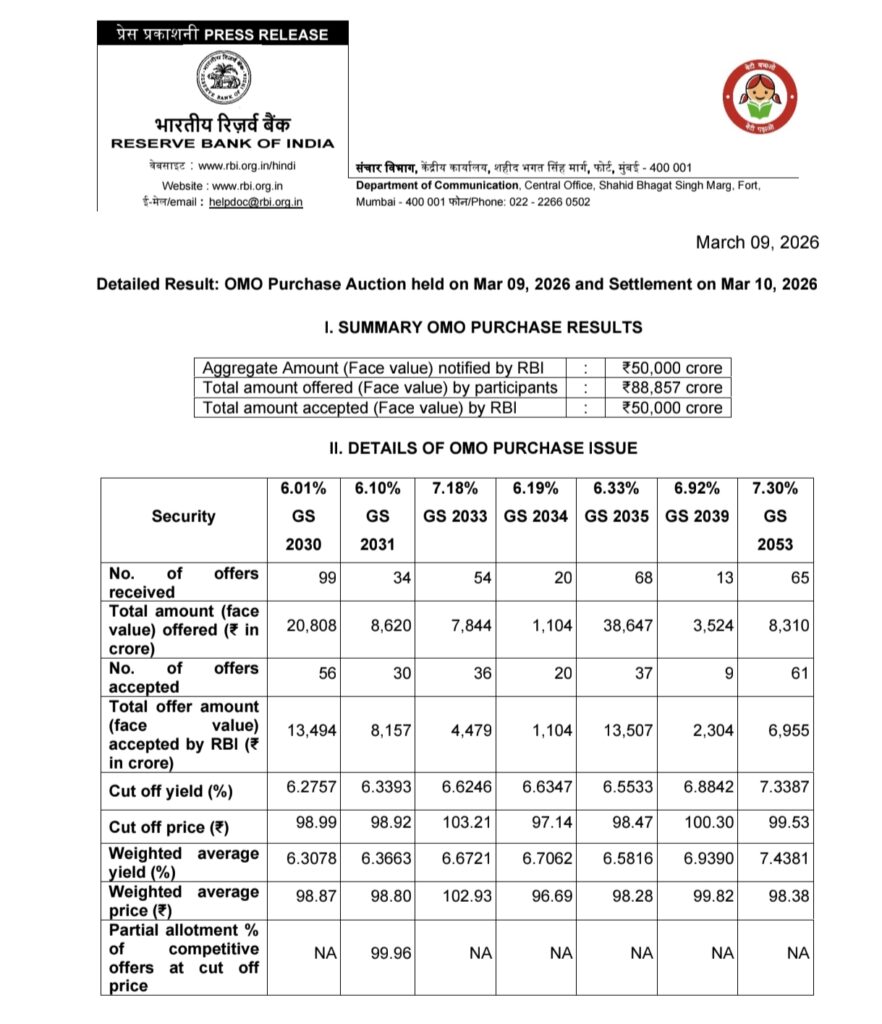
The Reserve Bank of India conducted an OMO purchase auction on March 9, 2026, accepting government bonds worth Rs 50,000 crore. Market participants offered a total of Rs 88,857 crore against the notified amount of Rs 50,000 crore, showing strong demand for RBI liquidity operations.
RBI bought multiple securities including 6.01% GS 2030 (Rs 13,494 crore), 6.10% GS 2031 (Rs 8,157 crore), 7.18% GS 2033 (Rs 4,479 crore), 6.19% GS 2034 (Rs 1,104 crore), 6.33% GS 2035 (Rs 13,507 crore), 6.92% GS 2039 (Rs 2,304 crore), and 7.30% GS 2053 (Rs 6,955 crore).
Cut off yields ranged between 6.2757% and 7.3387%. The lowest cut off yield was 6.2757% for GS 2030, while the highest was 7.3387% for GS 2053. Settlement of the auction will take place on March 10, 2026.

BBW News Desk is the editorial team of BigBreakingWire, a digital newsroom focused on global finance, markets, geopolitics, trade policy, and macroeconomic developments.
Our editors monitor government decisions, central bank actions, international trade movements, corporate activity, and economic indicators to deliver fast, fact-based reporting for investors, professionals, and informed readers.
The BBW News Desk operates under the editorial standards of BigBreakingWire, prioritizing accuracy, verified information, and timely updates on major global developments.











Be First to Comment