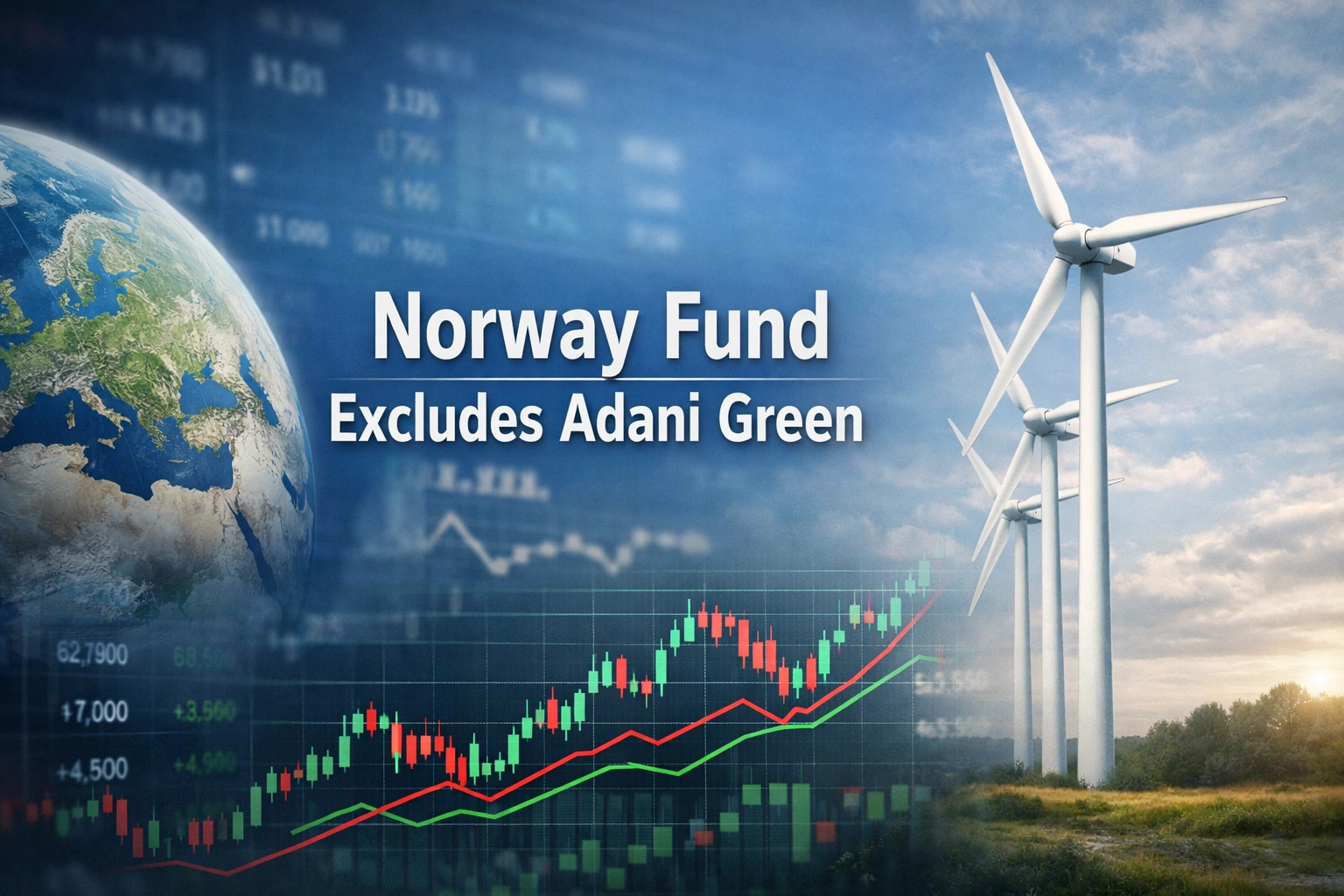
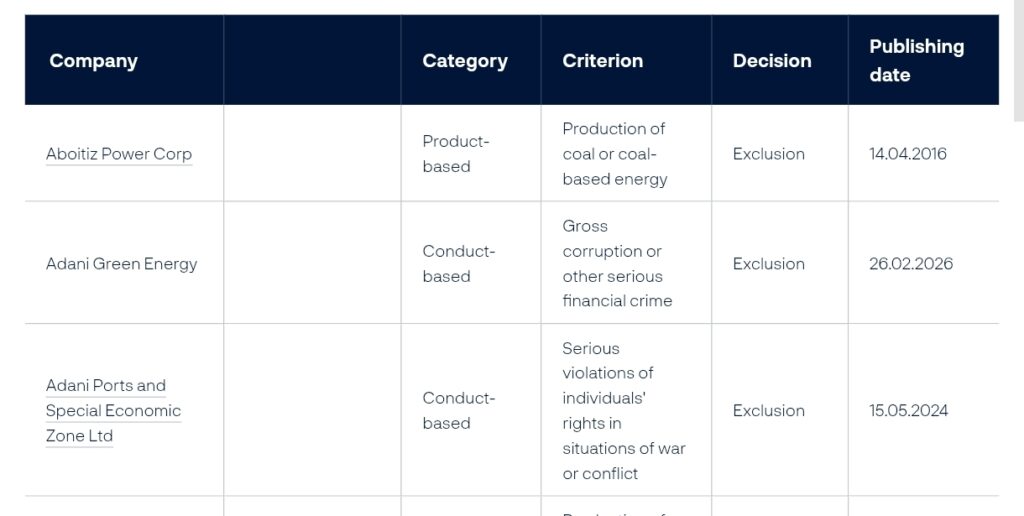
Norway’s Government Pension Fund Global, the world’s largest sovereign wealth fund managing over $2.2 trillion in assets, has excluded Adani Green Energy Ltd (AGEL) from its investment universe, citing “gross corruption or other serious financial crime.”
The fund, which held a 0.23% stake worth about $43.9 million as of 26 August 2025, added the company to its official exclusion list published by Norges Bank Investment Management.
The decision makes Adani Green the second Adani Group firm to be removed after Adani Ports was excluded in May 2024 due to Myanmar-related human rights risk concerns.
The move carries significant implications for ESG investing, global capital flows into Indian renewable energy, and institutional investor sentiment toward emerging market conglomerates.
What Happened in Norway Wealth Fund’s Exclusion Decision
Norges Bank Investment Management, which manages Norway’s sovereign wealth fund, formally placed Adani Green Energy Ltd on its exclusion list, stating concerns linked to “gross corruption or other serious financial crime.” However, the fund did not disclose detailed evidence or case-specific findings behind the decision.
As of August 2025, the fund owned approximately 0.23% of AGEL, valued at $43.9 million. The exclusion indicates that the fund will no longer invest in or hold the company in its benchmark-aligned portfolio under its ethical investment framework.
| Key Parameter | Details |
| Fund Name | Government Pension Fund Global (Norway) |
| Assets Under Management | Over $2.2 trillion |
| Company Excluded | Adani Green Energy Ltd (AGEL) |
| Previous Stake (Aug 2025) | 0.23% worth $43.9 million |
| Exclusion Reason | Alleged gross corruption or serious financial crime risk |
This marks the second Adani Group exclusion after Adani Ports and Special Economic Zone Ltd was removed on 15 May 2024 due to concerns linked to its Myanmar port operations following the military coup.
Why Did the Exclusion Decision Happen
The exclusion aligns with the fund’s ethical investment guidelines established by the Norwegian Parliament, which prohibit investments in companies facing serious governance, corruption, environmental, or human rights risks. The fund follows a risk-based screening model rather than short-term financial triggers.
The decision also comes amid ongoing legal scrutiny of the Adani Group in the United States, where regulators filed a civil complaint in November 2024 alleging undisclosed bribery linked to a 2021 bond offering that raised over $175 million from US investors. The case remains pending in court and has heightened global governance scrutiny.
From an institutional risk perspective, sovereign wealth funds prioritize long-term reputational and compliance risks over short-term returns, especially when allegations involve disclosure standards and cross-border capital markets.
Bigger Context Behind ESG Investing, Sovereign Funds, and Geopolitics
Norway’s sovereign wealth fund owns roughly 1.5% of global listed equities and is widely considered a global benchmark for ESG-driven investing. Its exclusion decisions often influence other pension funds, asset managers, and institutional investors across Europe and North America.
Historically, the fund has excluded companies involved in coal production, tobacco, weapons manufacturing, and severe environmental damage. Several Indian firms such as ONGC, Coal India, NTPC, ITC, Vedanta, and BHEL have also faced exclusion due to sector-specific ethical criteria rather than governance allegations.
| Previously Excluded Indian Firms | Primary Reason |
| Coal India | Coal-based energy exposure |
| NTPC | Coal and environmental risk |
| ITC | Tobacco production |
| Vedanta | Environmental and governance concerns |
Geopolitically, ESG frameworks are increasingly shaping capital allocation into emerging markets, especially in strategic sectors like renewable energy, infrastructure, and logistics. This adds a governance premium to global funding access for large conglomerates.
How the Exclusion Affects Markets, Companies, Investors, and Economy
In the short term, the financial impact of the divestment is limited due to the relatively small holding size. However, the signaling effect is far more significant, as sovereign wealth fund actions influence institutional perception and ESG ratings globally.
Interestingly, domestic mutual funds in India have moved in the opposite direction, increasing their stake in Adani Green nearly tenfold since early 2025 from around 0.3% to nearly 3%, with investments exceeding $500 million. This reflects strong domestic confidence in India’s renewable growth story.
| Market Impact Area | Potential Effect |
| Stock Sentiment | Short-term volatility due to global ESG concerns |
| Institutional Flows | Possible cautious stance from ESG-focused global funds |
| Domestic Investors | Continued accumulation by Indian mutual funds |
| Renewable Sector | Limited structural impact due to strong policy backing |
From a valuation perspective, AGEL’s share price has risen from Rs 341 in July 2020 to around Rs 944–Rs 948 in early 2026, indicating strong market confidence despite governance-related headlines.
What Happens Next in ESG Investing and Adani Group Outlook
Going forward, the key variable will be regulatory developments in ongoing international legal proceedings and any further disclosures by global governance watchdogs or ESG rating agencies. Additional sovereign or pension fund reviews could follow depending on compliance clarity.
For India, the broader renewable energy expansion target of 500 GW non-fossil capacity by 2030 ensures structural demand for green infrastructure investment, which may cushion sector-level impact despite selective institutional divestments.
Market participants will also monitor whether other global ESG funds replicate the exclusion or maintain exposure based on financial performance and project execution metrics.
Frequently Asked Questions
Why did Norway’s sovereign wealth fund exclude Adani Green Energy?
The fund cited concerns related to “gross corruption or other serious financial crime” under its ethical investment guidelines.
Did the fund completely divest its stake in Adani Green?
The fund previously held a 0.23% stake worth $43.9 million, but it did not publicly confirm the exact divestment timeline.
Is this the first Adani Group exclusion by Norges Bank?
No. Adani Ports was excluded in May 2024 due to human rights risk concerns linked to its Myanmar port operations.
Will this impact India’s renewable energy sector?
The sector impact is expected to be limited due to strong domestic institutional investment and long-term policy support.
Conclusion
The exclusion of Adani Green Energy by Norway’s sovereign wealth fund underscores the growing influence of ESG governance standards on global capital allocation. While the direct financial impact remains modest, the reputational and institutional signaling effect could shape future foreign investment flows into Indian infrastructure and renewable firms. The next phase will depend on regulatory outcomes, ESG assessments, and continued domestic investor confidence amid India’s long-term clean energy expansion strategy.

BBW News Desk is the editorial team of BigBreakingWire, a digital newsroom focused on global finance, markets, geopolitics, trade policy, and macroeconomic developments.
Our editors monitor government decisions, central bank actions, international trade movements, corporate activity, and economic indicators to deliver fast, fact-based reporting for investors, professionals, and informed readers.
The BBW News Desk operates under the editorial standards of BigBreakingWire, prioritizing accuracy, verified information, and timely updates on major global developments.









Be First to Comment