


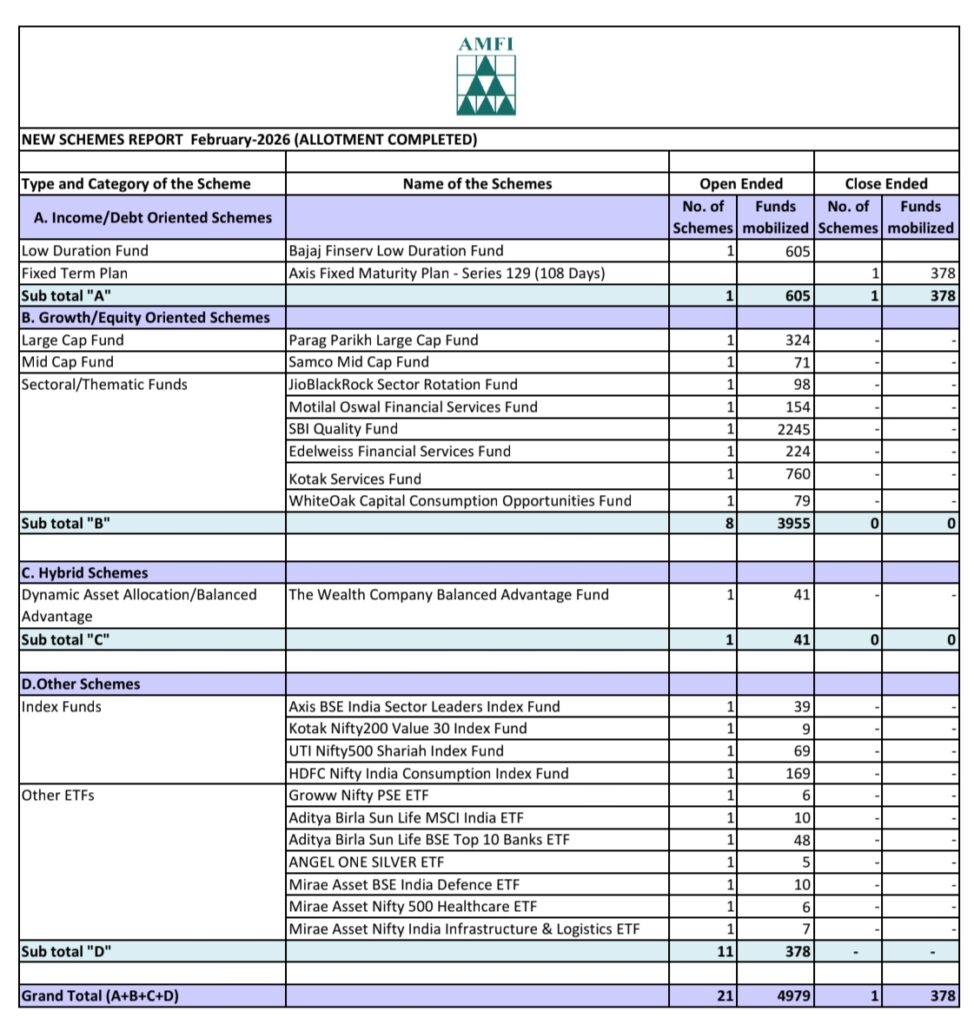
India’s mutual fund industry recorded a strong net inflow of Rs 94,194 crore in February 2026, according to the latest data released by the Association of Mutual Funds in India (AMFI). The total assets under management (AUM) of the industry rose to Rs 82,02,956 crore by the end of the month.
Equity-oriented schemes, hybrid funds, and exchange-traded funds (ETFs) continued attracting fresh investments from retail and institutional investors. The data also shows growing participation through systematic investment plans and passive investment products.
The numbers highlight continued investor confidence in financial markets despite global geopolitical tensions, tightening monetary policies, and volatile commodity prices.
What Happened in India’s Mutual Fund Industry in February 2026
According to AMFI’s monthly industry report, open-ended mutual fund schemes saw net inflows of Rs 94,194 crore during February 2026. Total industry assets climbed above Rs 82 lakh crore, reflecting strong retail participation and rising interest in diversified investment vehicles.
Equity-oriented schemes generated net inflows of Rs 25,977 crore, while hybrid funds attracted Rs 11,983 crore. Passive investment vehicles including index funds and ETFs also recorded robust inflows as investors sought lower-cost market exposure.
Debt-oriented schemes contributed the largest inflows during the month, supported by liquidity demand and short-term investment allocations by institutions.
| Category | Net Inflow (Rs crore) | AUM (Rs crore) |
| Debt / Income Funds | 42,106 | 19,43,688 |
| Equity-Oriented Funds | 25,977 | 35,39,475 |
| Hybrid Funds | 11,983 | 11,13,099 |
| Index Funds & ETFs | 13,879 | 15,23,696 |
| Total Industry | 94,194 | 82,02,956 |
Why Did Mutual Fund Inflows Rise in February 2026
Several structural factors contributed to the strong inflows in the mutual fund industry. Rising financialization of household savings remains one of the biggest drivers. Investors are gradually shifting money away from traditional assets like gold and real estate toward financial instruments.
Stable domestic economic growth and improving corporate earnings outlook also supported investor sentiment. India continues to remain one of the fastest growing large economies, attracting both domestic and foreign capital.
Additionally, digital investment platforms, direct mutual fund investing apps, and systematic investment plans have expanded retail participation across smaller cities and towns.
Bigger Context Behind India’s Expanding Mutual Fund Market
The growth of the Indian mutual fund industry reflects broader changes in the country’s financial ecosystem. Over the past decade, policy reforms, improved market transparency, and regulatory oversight by the Securities and Exchange Board of India (SEBI) have strengthened investor trust.
India’s demographic structure also plays an important role. A young working population with rising disposable income is increasingly participating in financial markets. SIP contributions have become a regular savings channel for millions of households.
Globally, the shift toward passive investing has also influenced Indian markets. Investors are increasingly allocating capital into index funds and ETFs that replicate benchmark indices at lower cost.
| Industry Indicator | February 2026 Data |
| Total Mutual Fund AUM | Rs 82,02,956 crore |
| Total Number of Schemes | 1,937 |
| Total Investor Folios | 27,05,71,455 |
| New Schemes Launched | 22 |
How Rising Mutual Fund Flows Affect Markets, Investors, and the Economy
Higher mutual fund inflows increase liquidity in equity markets and support long-term capital formation. Domestic institutional investors have become a stabilizing force for Indian equities, especially during periods of foreign portfolio investor volatility.
Equity mutual funds channel household savings into listed companies, helping businesses raise capital for expansion, infrastructure investment, and innovation.
Debt funds also play a critical role by providing funding to corporate bonds, government securities, and money markets. This helps improve credit availability in the broader financial system.
| Sector Impact | Effect of Higher Mutual Fund Flows |
| Stock Market Liquidity | Higher domestic institutional buying support |
| Corporate Financing | More capital for listed companies |
| Retail Wealth Creation | Higher participation in long-term investing |
| Government Bond Market | Stable demand for sovereign debt |
What Happens Next in India’s Mutual Fund Industry
Industry experts expect mutual fund assets to continue expanding as India’s financial markets deepen. Regulatory initiatives promoting transparency, investor education, and digital onboarding are likely to increase participation further.
Passive funds, ETFs, and hybrid investment products may see faster growth as investors seek diversified exposure with controlled risk. At the same time, rising global geopolitical tensions and interest rate movements could influence asset allocation patterns across equity and debt schemes.
If the current trajectory continues, India’s mutual fund industry could move closer toward the Rs 100 lakh crore AUM milestone in the coming years.
Frequently Asked Questions
What were the total mutual fund inflows in February 2026?
Total net inflows into mutual funds were Rs 94,194 crore during February 2026 according to AMFI data.
What is the total size of India’s mutual fund industry?
The total assets under management of the mutual fund industry reached Rs 82,02,956 crore by the end of February 2026.
Which category received the highest inflows?
Debt-oriented schemes recorded the highest inflows of Rs 42,106 crore during the month.
How many mutual fund investor accounts exist in India?
The total number of mutual fund investor folios reached approximately 27.05 crore accounts.
Conclusion
The February 2026 data confirms the continued expansion of India’s mutual fund industry as household savings increasingly shift toward financial assets. Strong inflows across debt, equity, and passive investment products highlight growing investor participation and deeper domestic capital markets.
With supportive regulatory policies, expanding retail access, and sustained economic growth, mutual funds are likely to remain a central pillar of India’s long-term investment landscape.

BBW News Desk is the editorial team of BigBreakingWire, a digital newsroom focused on global finance, markets, geopolitics, trade policy, and macroeconomic developments.
Our editors monitor government decisions, central bank actions, international trade movements, corporate activity, and economic indicators to deliver fast, fact-based reporting for investors, professionals, and informed readers.
The BBW News Desk operates under the editorial standards of BigBreakingWire, prioritizing accuracy, verified information, and timely updates on major global developments.


















Be First to Comment