Japan’s financial markets are entering a critical phase as bond yields rise across the curve, investors prepare for the December 19 Bank of Japan (BOJ) policy meeting, and the central bank moves toward unwinding its massive ETF holdings.
1. Japan’s Bond Curve: Clear Upward Shift Across Maturities
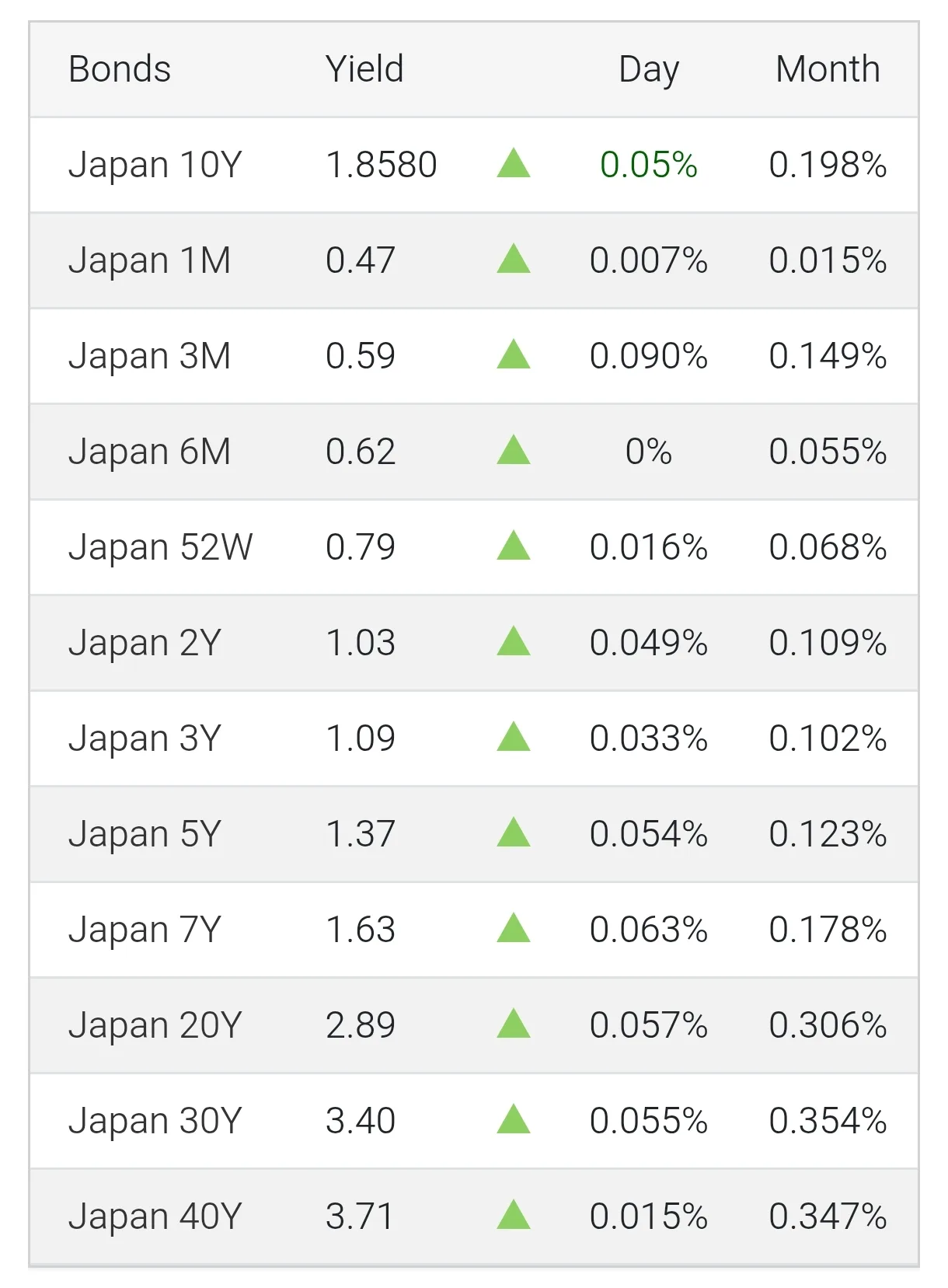
Japan’s bond market is signalling a steady rise in interest rates. Short-term yields start at 0.47% on the 1-month maturity and increase consistently to 1.858% on the 10-year. Longer tenors climb further, touching 3.71% at the 40-year mark. This pattern shows a broad upward shift in borrowing costs across all maturities.
The standout move:
Japan’s 20-year JGB yield jumped 6.2 basis points to 2.895%, the highest level since June 1999.
2. BOJ’s December 19 Decision: Why It Matters
Markets worldwide are closely watching the December 19 BOJ policy meeting. The key concern is whether Japan will continue its tightening path or stay cautious to protect growth.
Why the meeting is important:
- The yen carry trade remains a major global risk.
- Conservative estimates put its size near $3.4 trillion.
- More realistic assessments suggest it could exceed $20 trillion.
For almost 30 years, global investors have borrowed cheap Japanese money to invest in assets like U.S. Treasuries, technology stocks, and even Bitcoin. Any sharp BOJ policy change could unwind these trades, forcing investors to repay yen-funded positions, a move that can shake global markets.
3. BOJ’s ETF Holdings Hit a Record High
By the end of September, the BOJ’s equity ETF holdings surged to a record ¥83.2 trillion (about $532 billion), up 18.5% from a year earlier.
What’s even more striking: The central bank is sitting on ¥46 trillion in unrealized profit, driven by Japan’s strong stock-market rally.
4. BOJ Plans to Start Unwinding ETFs in 2026
The BOJ has announced a gradual plan to begin reducing its ETF and J-REIT holdings.
The central bank aims to sell approximately:
- ¥330 billion per year at book value
- Equivalent to roughly ¥620 billion per year at market value
Most analysts expect these sales to begin in early 2026, once the BOJ finalises the structure and execution strategy to avoid market volatility.
5. Could ETF Selling Pressure Japan’s Equity Market?
Yes, although the BOJ has huge unrealized gains, even a slow unwinding process may create caution among investors. Japan has relied on years of ultra-easy monetary support, and a step back even gradual signals a major regime shift.
Equity markets may experience:
- Mild selling pressure
- Higher volatility during unwinding periods
- A shift from liquidity-driven to fundamentals-driven valuations
6. Key Takeaways (Simple Summary)
- Japan’s yield curve is rising sharply, the 20-year yield is at a 26-year high.
- BOJ’s Dec 19 policy meeting is crucial for global markets.
- The yen carry trade ranges between $3.4T and $20T.
- BOJ’s ETF stash is at a record ¥83.2T with ¥46T profit.
- ETF selling of ¥330B (book) / ¥620B (market) per year expected from 2026.
7. FAQs
Why are Japan’s bond yields rising?
Because markets expect the BOJ to slowly tighten policy and reduce its support for bonds and ETFs.
What is the yen carry trade?
It is a global investment strategy where traders borrow yen at low interest rates and invest in higher-yielding assets.
Will BOJ’s ETF selling crash the market?
No. The BOJ plans slow, predictable selling to avoid sudden shocks, but mild pressure is possible.
When will BOJ start selling ETFs?
Most analysts expect the process to begin in early 2026.
BOJ to Begin Gradual Sale of Massive ETF Holdings
The Bank of Japan is set to start selling its ¥83 trillion ($534 billion) ETF portfolio as early as next month. The central bank plans a slow and steady exit, selling around ¥330 billion worth of ETFs each year based on book value.
At this pace, the process could stretch beyond 100 years. Sumitomo Mitsui Trust Bank will handle the sales, and the BOJ has kept the option open to pause the process if a major financial crisis emerges.

BBW News Desk is the editorial team of BigBreakingWire, a digital newsroom focused on global finance, markets, geopolitics, trade policy, and macroeconomic developments.
Our editors monitor government decisions, central bank actions, international trade movements, corporate activity, and economic indicators to deliver fast, fact-based reporting for investors, professionals, and informed readers.
The BBW News Desk operates under the editorial standards of BigBreakingWire, prioritizing accuracy, verified information, and timely updates on major global developments.




























Be First to Comment