
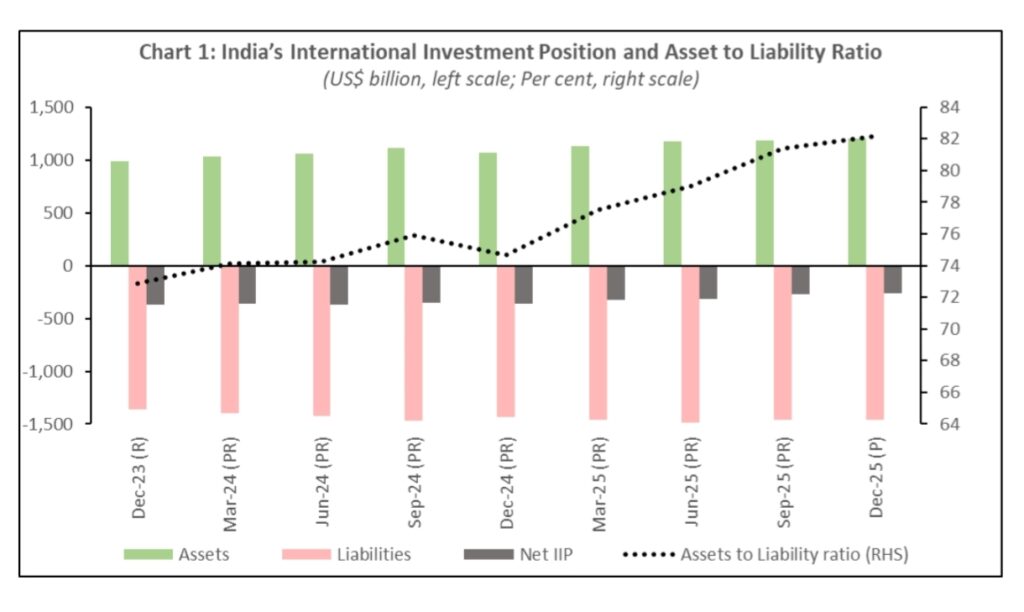
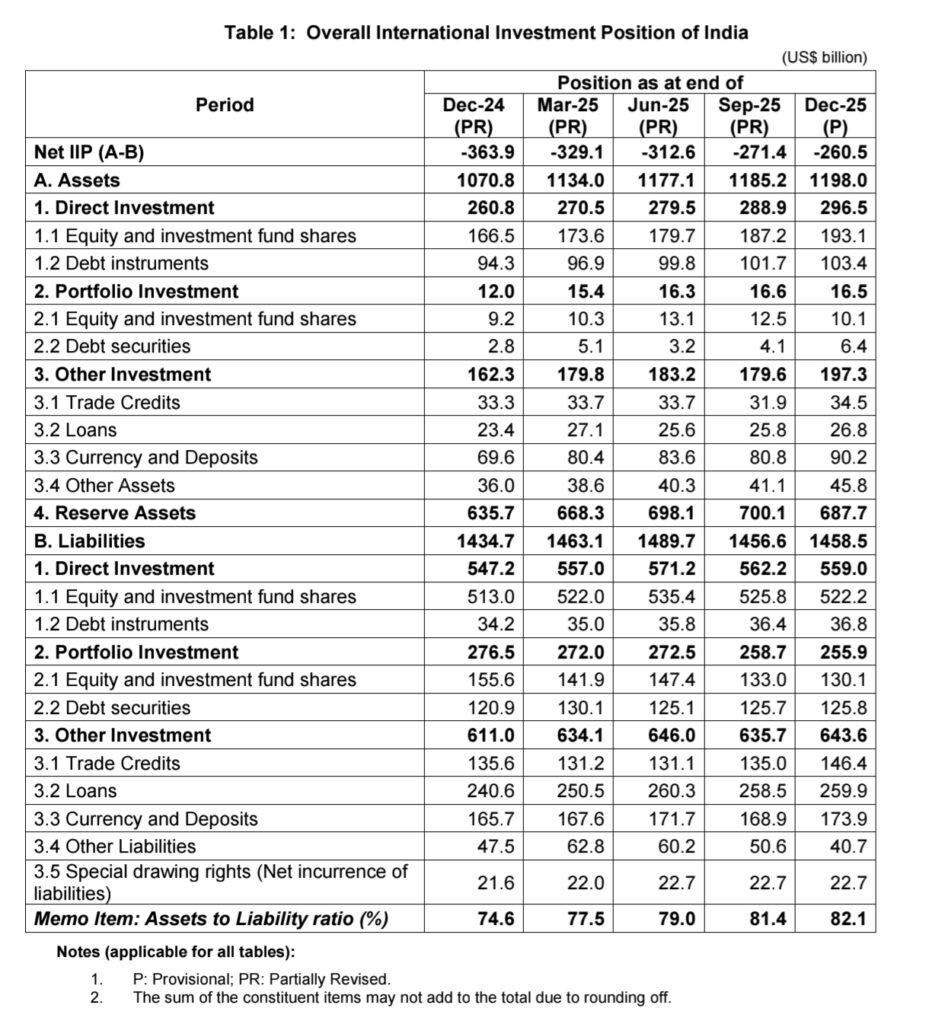
India’s international investment position showed a notable improvement at the end of December 2025, offering a positive signal for investor sentiment and external stability. Data released by the Reserve Bank of India shows that net claims of non residents on India declined to 260.5 billion dollars, down by 10.9 billion dollars from the previous quarter. This shift was mainly driven by a faster rise in overseas assets owned by Indian residents compared to the increase in foreign owned assets in India. The improvement matters at a time when global markets remain sensitive to inflation, interest rates, and crude oil volatility.
From a market perspective, a stronger external balance sheet tends to support the currency and improve confidence in the stock market and bond yields. The rise in India’s overseas assets suggests better resilience against external shocks, which can help stabilize the rupee during periods of global uncertainty. Lower net liabilities also reduce vulnerability to sudden capital outflows, a key concern for investors tracking global markets and central bank policies.
A key highlight of the data is the steady improvement in the assets to liabilities ratio, which rose to 82.1 percent in December 2025 from 81.4 percent in the previous quarter and 74.6 percent a year ago. In simple terms, India is gradually closing the gap between what it owns abroad and what foreigners own in India. This trend signals improving financial strength and could support investor sentiment, especially at a time when interest rates and inflation pressures remain elevated globally.
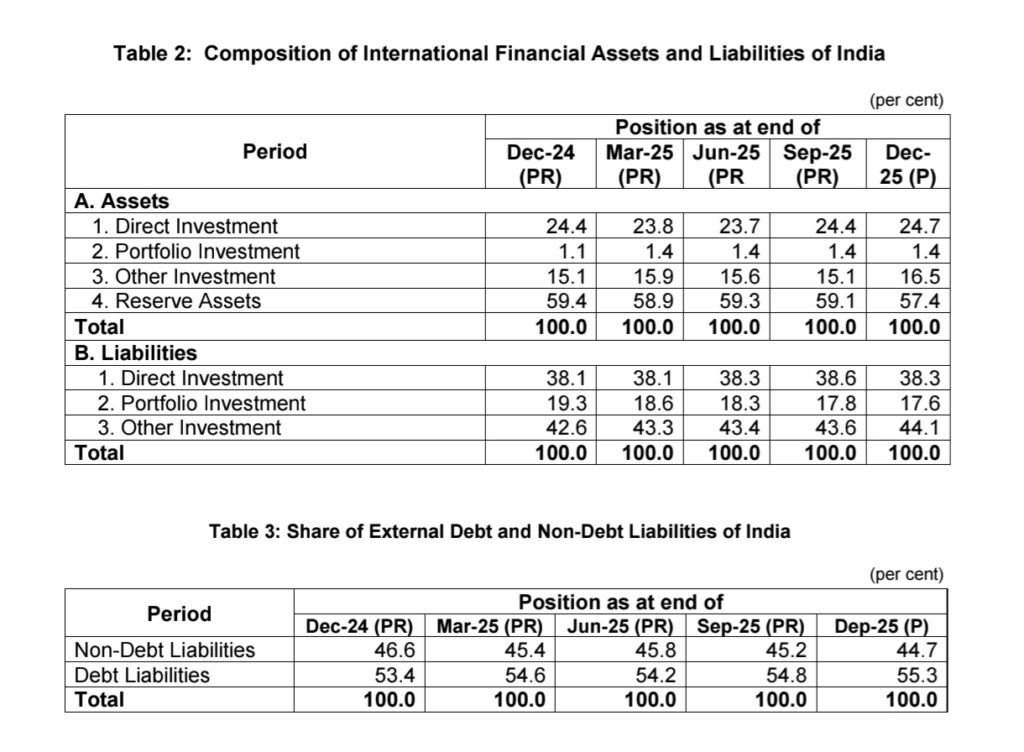
Indian residents’ overseas financial assets increased during the quarter, led by higher outward direct investment and a sharp rise in currency and deposits. Outward direct investment rose by 7.6 billion dollars, while currency and deposits increased by 9.4 billion dollars. However, reserve assets declined by 12.4 billion dollars during the quarter to 687.7 billion dollars. Despite this quarterly drop, reserve assets remain higher on a yearly basis, rising by 8.2 percent, and continue to form the largest share of India’s overseas assets at 57.4 percent.
On the liabilities side, foreign owned assets in India saw only a marginal increase of 0.1 percent during the quarter. This was due to a decline in inward direct investment and portfolio investment, which fell by 3.2 billion dollars and 2.8 billion dollars respectively. The decline was offset by a rise in trade credit under other investment, which increased by 11.4 billion dollars. This mix indicates a shift in the nature of capital flows, with less equity participation and more reliance on debt linked components.
This shift is further reflected in the rising share of debt liabilities, which increased to 55.3 percent of total external liabilities in December 2025 from 54.8 percent in the previous quarter. A higher share of debt in external liabilities can increase sensitivity to global interest rates and bond yields, especially in an environment where central banks across the world are maintaining tight monetary conditions to control inflation.
For broader context, the international investment position tracks the difference between a country’s external financial assets and liabilities. A lower negative net position indicates improving external strength. India has historically been a net debtor economy, but the current trend suggests gradual strengthening as overseas asset accumulation accelerates.
Looking ahead, investors will closely monitor how these trends evolve alongside movements in crude oil prices, global interest rates, and capital flows. While the improving asset position supports stability, the rising share of debt liabilities could pose risks if global borrowing costs remain high. The trajectory of reserve assets will also be crucial for currency stability. Overall, the data points to improving fundamentals, but global market conditions will continue to play a key role in shaping investor sentiment and financial market direction.

BBW News Desk is the editorial team of BigBreakingWire, a digital newsroom focused on global finance, markets, geopolitics, trade policy, and macroeconomic developments.
Our editors monitor government decisions, central bank actions, international trade movements, corporate activity, and economic indicators to deliver fast, fact-based reporting for investors, professionals, and informed readers.
The BBW News Desk operates under the editorial standards of BigBreakingWire, prioritizing accuracy, verified information, and timely updates on major global developments.













Be First to Comment