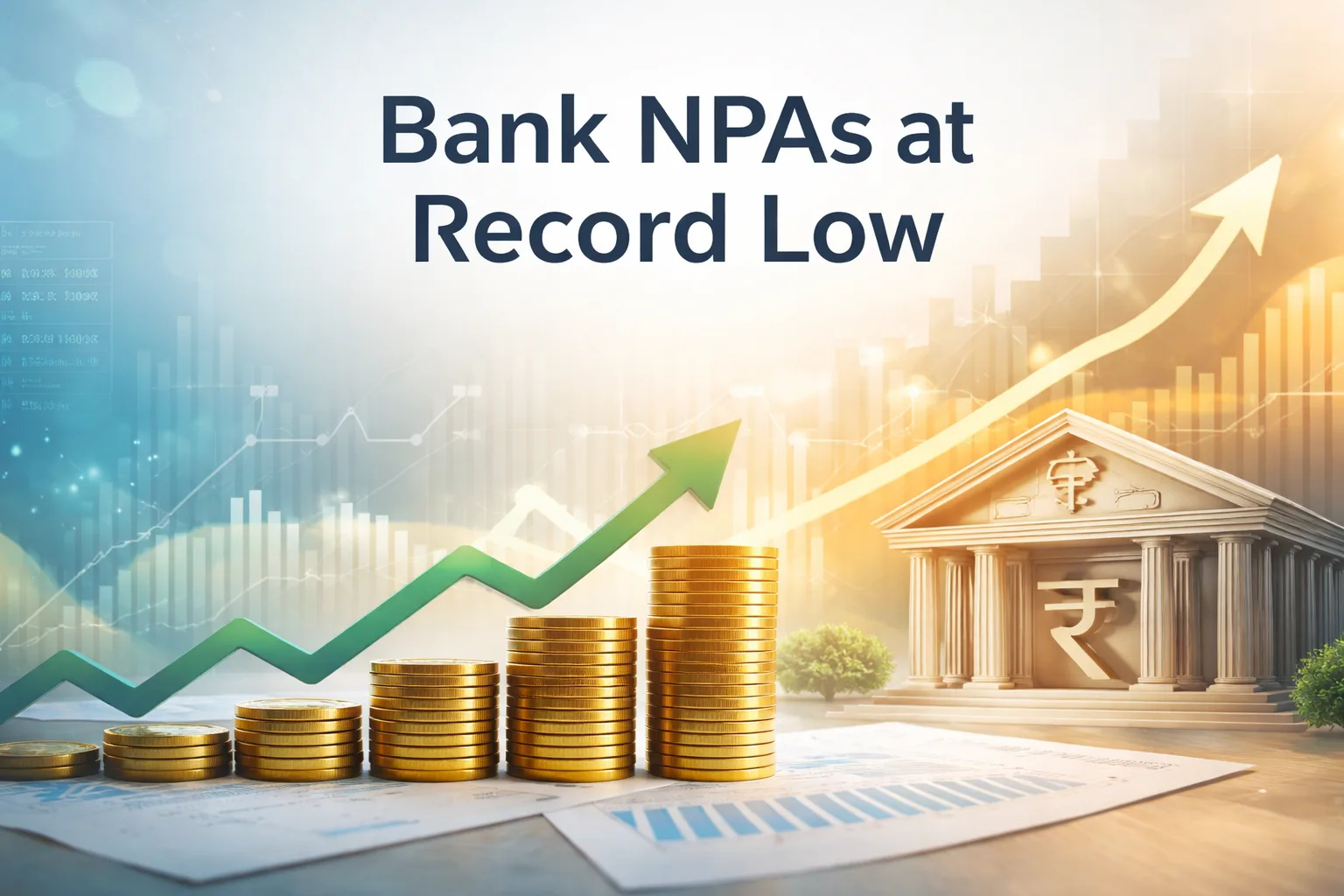
India’s banking system has reached its strongest asset quality position in more than a decade. Gross non-performing assets (NPAs) of Scheduled Commercial Banks fell to a historic low of 2.15% in September 2025. This marks a major improvement in the health of bank balance sheets.
Lower NPAs mean banks have fewer bad loans. This improves profits, strengthens capital, and allows more lending to businesses and individuals. The update was shared by the government through PIB.
What Happened
Gross NPAs of Scheduled Commercial Banks for domestic operations dropped to 2.15% as of 30 September 2025. This is the lowest level in over 10 years and below the 2010 to 2011 level.
Public Sector Banks reported NPAs of 2.50%. Private Sector Banks stood at 1.73%, while Foreign Banks had just 0.80%.
The slippage ratio of Public Sector Banks improved to 0.8%, lower than Private Banks at 1.8%. Slippage ratio measures fresh bad loans.
Why Did It Happen
The turnaround began after RBI’s Asset Quality Review in 2015 forced banks to recognize hidden stress. This was followed by the government’s 4R strategy: recognition, resolution, recovery, and recapitalisation.
The Insolvency and Bankruptcy Code changed loan recovery rules from “debtor in control” to “creditor in control”. By March 2025, over 30,000 cases involving ₹13.78 lakh crore were settled even before formal admission.
Stronger recovery laws, early warning systems with 80 stress triggers, better monitoring of large borrowers, and recapitalisation of public banks also reduced fresh defaults.
What Is the Bigger Context or Concern
India faced a severe bad loan crisis between 2014 and 2018. NPAs had crossed 11% at one stage. Banks struggled with capital shortages and weak lending.
The sharp fall now shows structural repair in the banking system. However, risks remain from global slowdown, high interest rates, and sector-specific stress such as MSMEs or real estate.
RBI does not collect NPA data monthly, so future trends will depend on quarterly disclosures and economic conditions.
How Does This Affect Markets, Companies, or People
Lower NPAs reduce the need for banks to set aside money for bad loans. This improves profitability and return ratios.
Stronger bank balance sheets support higher credit growth. Businesses may find it easier to borrow. Retail borrowers may benefit from stable lending conditions.
Investors view falling NPAs as a positive signal for bank stocks, especially Public Sector Banks that earlier had heavy stress.
What Happens Next
The government and RBI are continuing reforms to prevent future loan stress. More amendments to recovery laws and faster insolvency processes are under consideration.
Focus will remain on early detection of stressed loans, digital monitoring tools, and faster resolution timelines.
The update was presented in Parliament by Minister of State for Finance Pankaj Chaudhary in a written reply in the Lok Sabha.
Frequently Asked Questions
What is the current Gross NPA ratio of Indian banks?
It is 2.15% as of September 30, 2025.
Which banks have the lowest NPAs?
Foreign Banks have the lowest at 0.80%, followed by Private Banks at 1.73%.
Why are NPAs falling?
Due to RBI reforms, insolvency law changes, better recovery systems, and early stress detection.
Why does low NPA matter?
It boosts bank profits, strengthens balance sheets, and supports more lending.
Conclusion
India’s banking system has moved from crisis to stability. The sharp fall in bad loans shows lasting improvement in loan quality. Sustaining this trend will be key for long-term credit growth and economic stability.
US Dollar Loses Ground as Gold Emerges as Key Global Reserve

BBW News Desk is the editorial team of BigBreakingWire, a digital newsroom focused on global finance, markets, geopolitics, trade policy, and macroeconomic developments.
Our editors monitor government decisions, central bank actions, international trade movements, corporate activity, and economic indicators to deliver fast, fact-based reporting for investors, professionals, and informed readers.
The BBW News Desk operates under the editorial standards of BigBreakingWire, prioritizing accuracy, verified information, and timely updates on major global developments.























Be First to Comment