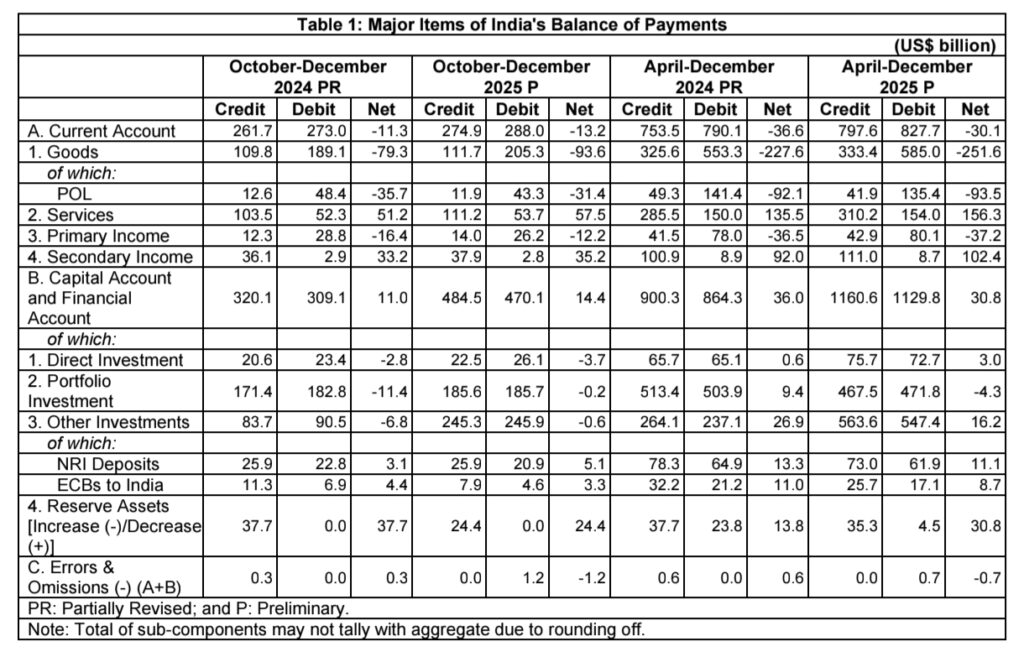
India’s current account deficit (CAD) widened to $13.2 billion or 1.3% of GDP in Q3 FY26 (October–December 2025), up from $11.3 billion a year ago. The rise was driven mainly by a higher merchandise trade deficit of $93.6 billion, even as services exports and remittances remained strong. Foreign exchange reserves fell by $24.4 billion on a BoP basis during the quarter. The data signals growing external sector pressure amid global trade volatility and capital flow shifts.
What Happened in India’s Balance of Payments Q3 FY26
Preliminary balance of payments data shows that India’s external account faced a moderate deterioration in Q3 FY26 due to a widening goods trade gap. Merchandise trade deficit rose sharply to $93.6 billion compared to $79.3 billion in Q3 FY25, reflecting higher imports and uneven global demand.
However, the services sector remained a key stabilizer. Net services receipts increased to $57.5 billion from $51.2 billion a year ago, supported by strong exports in computer services and other business services. Personal remittances also rose to $36.9 billion, indicating sustained overseas income inflows from the Indian diaspora.
| Indicator | Q3 FY25 | Q3 FY26 |
| Current Account Deficit | $11.3 billion (1.1% of GDP) | $13.2 billion (1.3% of GDP) |
| Merchandise Trade Deficit | $79.3 billion | $93.6 billion |
| Net Services Receipts | $51.2 billion | $57.5 billion |
| Remittances (Personal Transfers) | $35.1 billion | $36.9 billion |
Why Did India’s Current Account Deficit Rise in Q3 FY26
The primary reason behind the higher CAD was the widening merchandise trade deficit, which reflects India’s structural dependence on energy, electronics, and capital goods imports. Global commodity price fluctuations and resilient domestic demand increased import bills during the quarter.
At the same time, net outgo on the primary income account fell to $12.2 billion from $16.4 billion, partially cushioning the deficit. This decline suggests relatively lower investment income payments abroad, likely due to moderated profit repatriation and stable external liabilities.
On the financial account side, foreign direct investment (FDI) recorded a net outflow of $3.7 billion, higher than the $2.8 billion outflow last year, indicating cautious global investor sentiment toward emerging markets amid geopolitical and monetary policy uncertainty.
Bigger Context Behind India’s External Sector in Economy and Geopolitics
India’s BoP trends in FY26 reflect broader global macroeconomic conditions, including slower global trade growth, ongoing geopolitical tensions in energy corridors, and tighter global liquidity due to prolonged higher interest rates in advanced economies.
Strong services exports highlight India’s strategic positioning in global digital and outsourcing supply chains. Growth in IT and business services exports continues to offset weaknesses in goods exports, reinforcing the structural shift of India’s external earnings toward knowledge-based sectors.
Geopolitically, remittance resilience also underscores India’s labor linkage with the Middle East, North America, and Europe. Stable remittance flows act as a counter-cyclical buffer during global economic volatility, strengthening India’s external stability compared to many emerging markets.
How the BoP Trends Affect Markets, Companies, Investors, and Economy
A widening current account deficit typically increases pressure on the Indian rupee and may influence the Reserve Bank of India’s (RBI) foreign exchange management strategy. The $24.4 billion reserve depletion in Q3 FY26 indicates active intervention to manage currency volatility.
For investors, mixed capital flows are a key signal. While foreign portfolio investment (FPI) outflows narrowed significantly to $0.2 billion from $11.4 billion last year, continued FDI outflows suggest global corporations remain selective in long-term investments.
Corporate sectors dependent on imports, including oil marketing companies, electronics manufacturers, and infrastructure firms, may face cost pressures if the trade deficit remains elevated. Conversely, IT services, fintech, and outsourcing companies benefit from strong services export momentum.
| Financial Account Component | Q3 FY26 Trend | Economic Signal |
| FDI | Net Outflow: $3.7 billion | Weak long-term capital sentiment |
| FPI | Net Outflow: $0.2 billion | Stabilizing portfolio flows |
| NRI Deposits | Net Inflow: $5.1 billion | Confidence in banking system |
| ECBs | Net Inflow: $3.3 billion | Moderate external borrowing |
April–December 2025 Trend: A Moderating External Deficit
Despite the quarterly rise, India’s current account deficit moderated to $30.1 billion or 1.0% of GDP during April–December 2025, compared to $36.6 billion (1.3% of GDP) in the same period last year. Higher net invisibles receipts of $221.5 billion, driven by services and remittances, significantly improved the overall balance.
Net FDI inflows rose to $3.0 billion during April–December 2025 from $0.6 billion a year earlier, indicating selective long-term capital stability. However, FPI recorded net outflows of $4.3 billion against inflows of $9.4 billion last year, reflecting global risk reallocation.
| April–December Indicator | 2024 | 2025 |
| Current Account Deficit | $36.6 billion (1.3% of GDP) | $30.1 billion (1.0% of GDP) |
| Net Invisibles | $191.0 billion | $221.5 billion |
| Forex Reserve Change (BoP Basis) | – $13.8 billion | – $30.8 billion |
What Happens Next in India’s Balance of Payments Outlook
Going forward, India’s external stability will depend on oil prices, global demand recovery, and sustained services export growth. If merchandise imports remain elevated while exports grow slowly, the CAD could stay above 1% of GDP in the near term.
Policy focus is likely to remain on strengthening export competitiveness, boosting manufacturing under industrial policies, and attracting stable FDI inflows. The RBI may continue active forex reserve management to prevent excessive currency volatility amid global capital flow shifts.
Frequently Asked Questions
What is India’s current account deficit in Q3 FY26?
India’s CAD stood at $13.2 billion or 1.3% of GDP in October–December 2025.
Why did the trade deficit increase in Q3 FY26?
The trade deficit widened to $93.6 billion due to higher imports and global demand fluctuations.
Did services exports help offset the deficit?
Yes, net services receipts rose to $57.5 billion, supported by strong IT and business services exports.
How did forex reserves change during the quarter?
Foreign exchange reserves declined by $24.4 billion on a BoP basis in Q3 FY26.
Conclusion
India’s Q3 FY26 balance of payments data shows a resilient yet pressured external sector. Strong services exports and remittances continue to anchor stability, but the rising merchandise trade deficit and reserve depletion highlight ongoing global economic headwinds. The trajectory of oil prices, capital flows, and export diversification will be crucial in shaping India’s external balance and macroeconomic stability in the coming quarters.

BBW News Desk is the editorial team of BigBreakingWire, a digital newsroom focused on global finance, markets, geopolitics, trade policy, and macroeconomic developments.
Our editors monitor government decisions, central bank actions, international trade movements, corporate activity, and economic indicators to deliver fast, fact-based reporting for investors, professionals, and informed readers.
The BBW News Desk operates under the editorial standards of BigBreakingWire, prioritizing accuracy, verified information, and timely updates on major global developments.











Be First to Comment