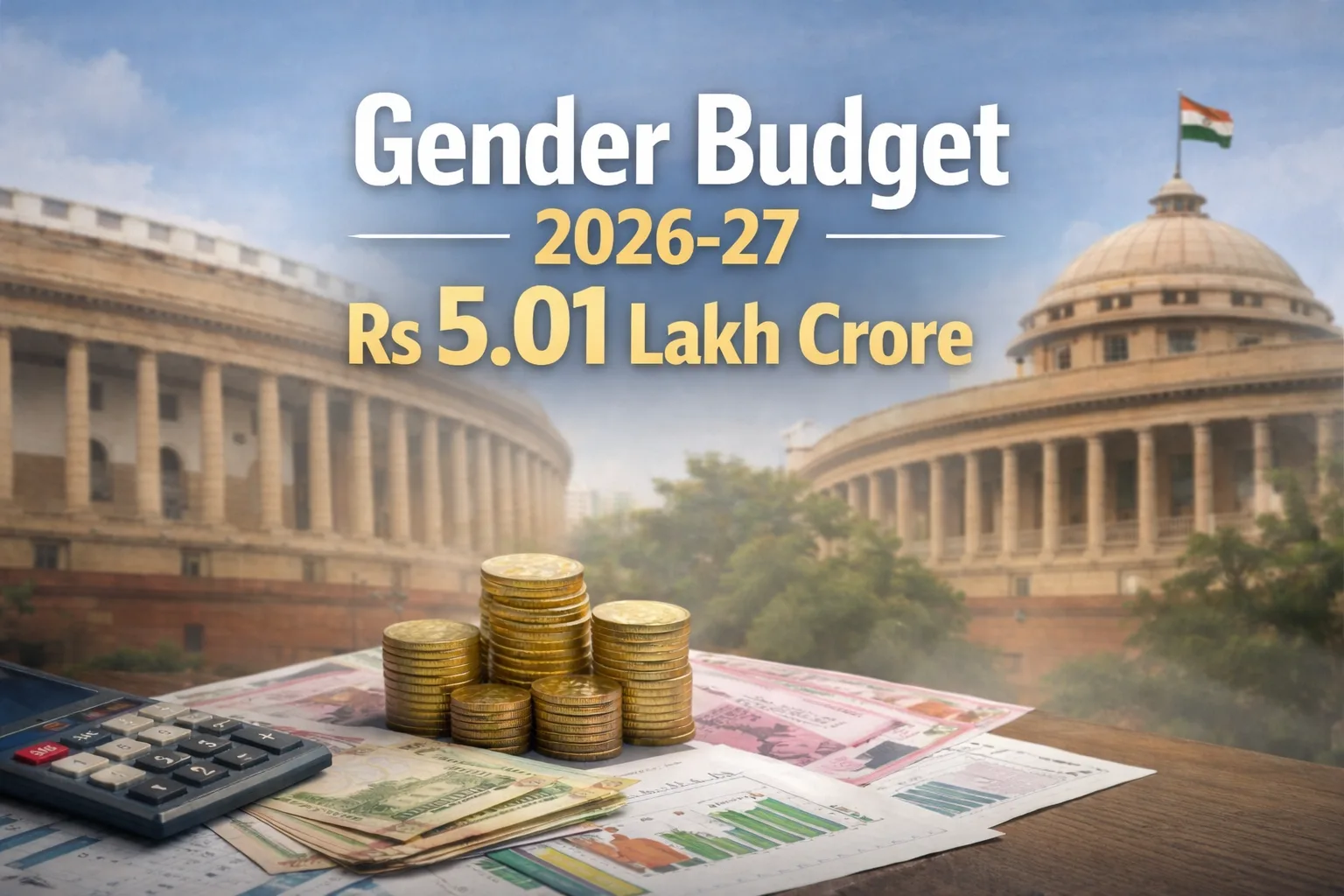
India has increased its gender budget allocation to Rs 5.01 lakh crore in FY 2026-27, marking an 11.55% rise from Rs 4.49 lakh crore in FY 2025-26. The share of the Gender Budget in the total Union Budget has also climbed to 9.37%, up from 8.86% last year. The move signals stronger policy focus on welfare schemes for women and girls across ministries and departments. This directly impacts social welfare programs, rural development, health, education, and women-centric schemes nationwide.
What Happened in India’s Gender Budget Allocation FY 2026-27
Finance Minister Nirmala Sitharaman presented the Union Budget 2026-27 on February 1, 2026, where the Gender Budget Statement (GBS) showed a significant increase in allocation for women and girls. The total allocation reported under the GBS stands at Rs 5.01 lakh crore.
This represents an 11.55% increase compared to the Rs 4.49 lakh crore allocation in FY 2025-26. The gender budget now accounts for 9.37% of the total Union Budget, reflecting a gradual policy shift toward inclusive and gender-focused spending.
| Fiscal Year | Gender Budget Allocation | Share in Total Budget | YoY Growth |
|---|---|---|---|
| FY 2025-26 | Rs 4.49 lakh crore | 8.86% | — |
| FY 2026-27 | Rs 5.01 lakh crore | 9.37% | +11.55% |
Why Did the Gender Budget Allocation Increase in Union Budget 2026-27
The increase in allocation is driven by higher spending on women-focused welfare schemes, rural development programs, healthcare, education, and social protection initiatives. The government is expanding gender-inclusive budgeting to ensure targeted benefits reach women across economic and social sectors.
Additionally, more ministries and departments are now formally reporting gender-specific allocations, improving transparency and policy tracking. This expansion indicates deeper institutional integration of gender budgeting across governance.
Bigger Context Behind Gender Budget Expansion in India
For FY 2026-27, a total of 53 Ministries/Departments and 5 Union Territories reported allocations under the Gender Budget Statement. This is higher than 49 Ministries/Departments and 5 UTs in FY 2025-26, making it the highest participation since the inception of the Gender Budget framework.
Notably, four new Ministries and Departments have reported allocations this year, showing wider adoption of gender-responsive budgeting across policy sectors.
| Category | FY 2025-26 | FY 2026-27 |
|---|---|---|
| Reporting Ministries/Departments | 49 | 53 |
| Union Territories Reporting | 5 | 5 |
| New Ministries Added | — | 4 |
Breakdown of Gender Budget Statement (GBS) Allocation Structure
The Gender Budget Statement is divided into three parts based on the extent of allocation directed toward women-specific schemes. The majority of funds fall under Part B, which includes schemes where 30–99% of allocations benefit women.
| GBS Category | Allocation (Rs crore) | Share of Total GBS | Coverage Type |
|---|---|---|---|
| Part A | 1,07,688.42 | 21.50% | 100% women-specific schemes |
| Part B | 3,63,412.37 | 72.54% | 30–99% allocation for women |
| Part C | 29,777.94 | 5.95% | Below 30% allocation for women |
Top Ministries Driving Gender Budget Allocation in FY 2026-27
Several key ministries reported more than 30% of their total allocations under the Gender Budget, indicating strong sectoral focus on women-centric spending.
The Ministry of Women & Child Development leads with 81.73% of its allocation under the Gender Budget, followed by the Department of Rural Development at 69.92%. Other major contributors include the Department of Health and Family Welfare, Ministry of New & Renewable Energy, and Department of Higher Education.
Departments related to sanitation, food distribution, and education also reported substantial allocations, showing a multi-sector approach toward women’s welfare and empowerment.
How the Gender Budget Increase Affects Women, Welfare Schemes, and the Economy
The higher allocation is expected to strengthen funding for healthcare, education, nutrition, sanitation, and livelihood programs targeting women and girls. This can improve financial inclusion, workforce participation, and social security coverage.
In rural areas, schemes under rural development, drinking water, and sanitation will see stronger funding support. In urban sectors, education and skill programs for women may receive expanded resources.
From an economic perspective, higher gender-focused spending can support long-term human capital growth and inclusive development, which are key indicators for sustainable economic expansion.
What Happens Next for Gender Budget Policy in India
Going forward, the focus is likely to remain on expanding gender-responsive budgeting across more ministries and states. Policymakers may also increase monitoring of scheme-level outcomes to ensure efficient fund utilization.
With the Gender Budget share now at 9.37% of the total Union Budget, future budgets could see further structural integration of gender-focused allocations as part of inclusive growth strategy.
Frequently Asked Questions (FAQs)
What is India’s Gender Budget for FY 2026-27?
India’s Gender Budget allocation for FY 2026-27 is Rs 5.01 lakh crore, as reported in the Gender Budget Statement.
How much did the Gender Budget increase in 2026-27?
The allocation increased by 11.55% from Rs 4.49 lakh crore in FY 2025-26 to Rs 5.01 lakh crore in FY 2026-27.
What share of the total Union Budget is the Gender Budget?
The Gender Budget accounts for 9.37% of the total Union Budget in FY 2026-27, up from 8.86% in the previous fiscal year.
Which ministries contribute the most to the Gender Budget?
Key contributors include the Ministry of Women & Child Development, Department of Rural Development, Health and Family Welfare, and Departments related to education and sanitation.
Conclusion
The increase in India’s Gender Budget to Rs 5.01 lakh crore in FY 2026-27 reflects a clear policy shift toward inclusive and women-focused development. With higher participation from ministries and a rising share in the total budget, gender-responsive spending is becoming a core pillar of India’s long-term social and economic policy framework.

BBW News Desk is the editorial team of BigBreakingWire, a digital newsroom focused on global finance, markets, geopolitics, trade policy, and macroeconomic developments.
Our editors monitor government decisions, central bank actions, international trade movements, corporate activity, and economic indicators to deliver fast, fact-based reporting for investors, professionals, and informed readers.
The BBW News Desk operates under the editorial standards of BigBreakingWire, prioritizing accuracy, verified information, and timely updates on major global developments.









Be First to Comment