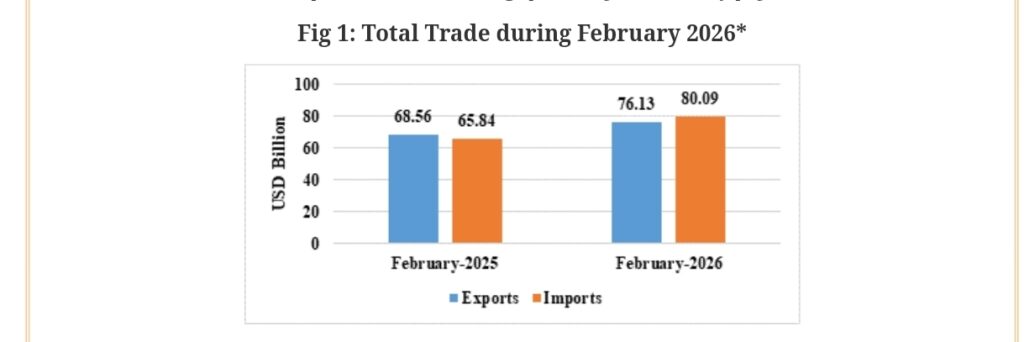
India’s combined exports of goods and services reached $76.13 billion in February 2026, marking an 11.05% increase compared with February 2025, according to official trade data released by the government.
However, imports surged faster, rising 21.64% year-on-year to $80.09 billion. As a result, India recorded a trade deficit of $3.96 billion during the month.
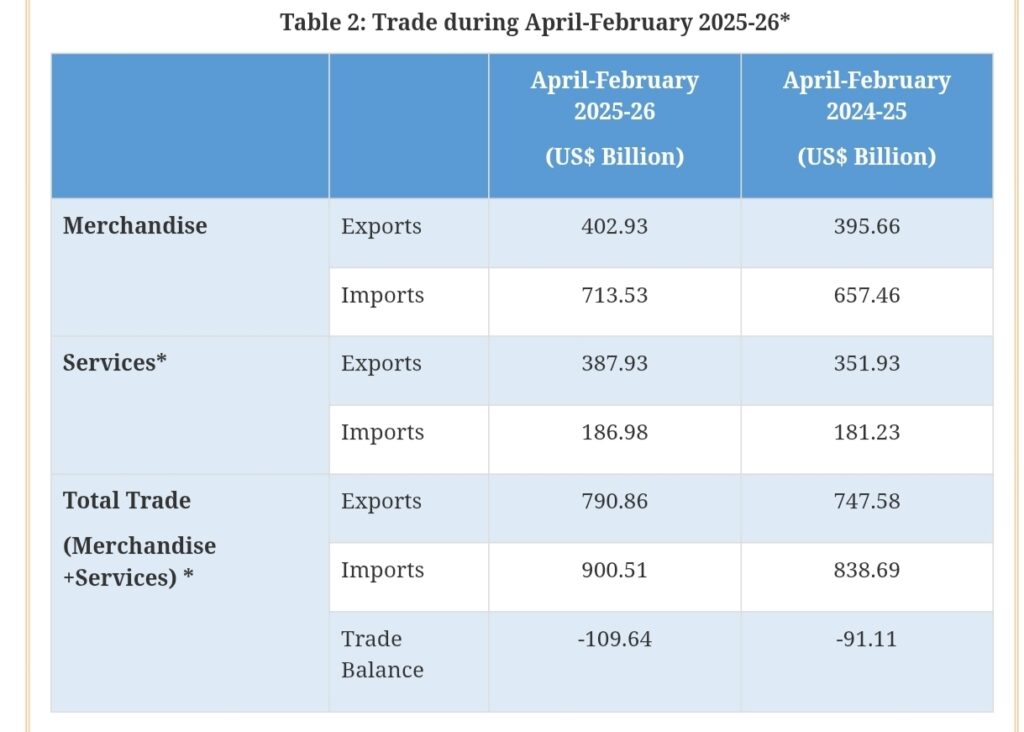
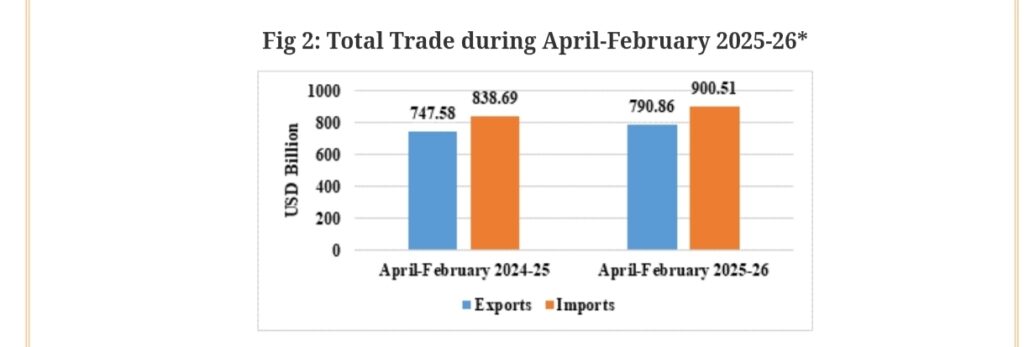
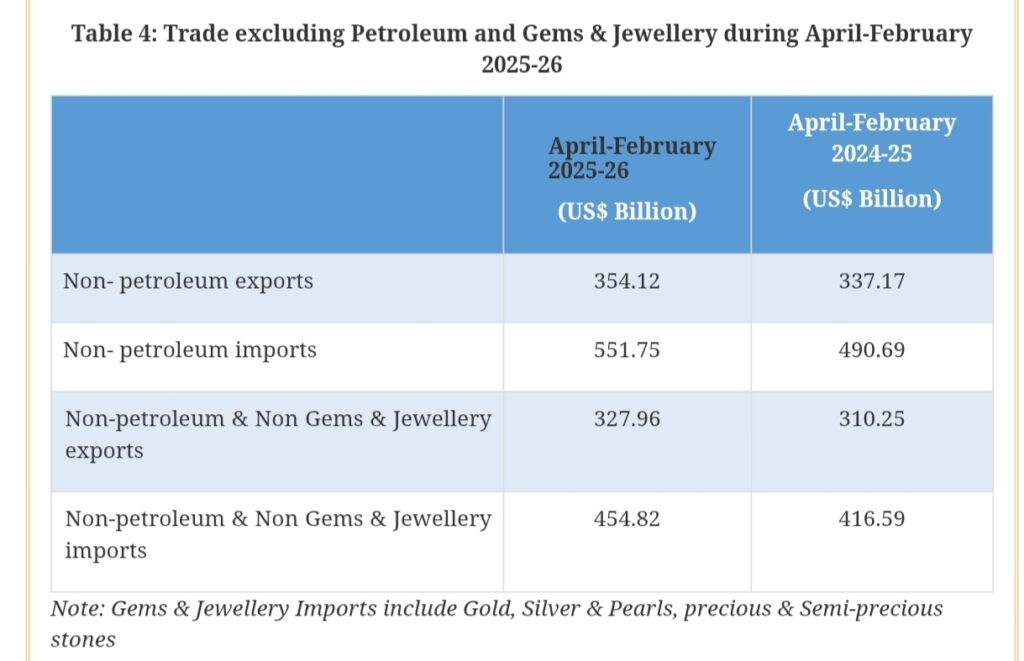
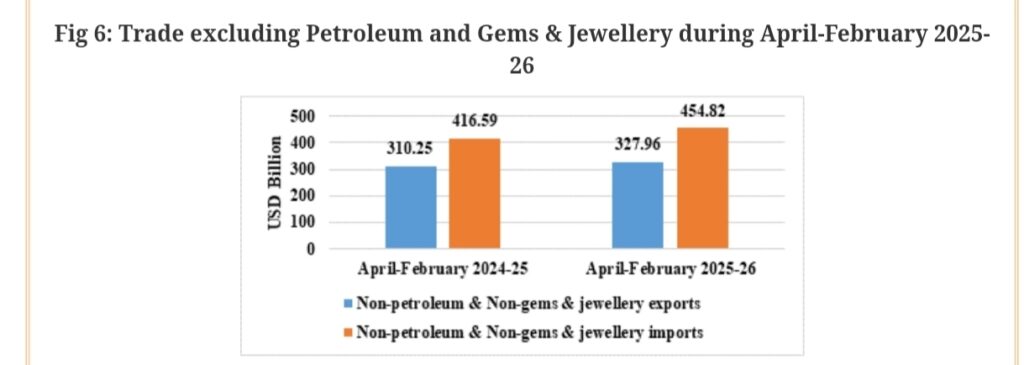
For the financial year so far, cumulative exports during April to February 2025–26 stood at $790.86 billion, up 5.79% from the previous year. Imports during the same period rose to $900.51 billion, widening the overall trade deficit to $109.64 billion.
The data highlights a complex picture for the Indian economy: exports are expanding steadily in key sectors such as engineering goods, electronics and chemicals, but rising imports of commodities and industrial inputs continue to pressure the trade balance.
What Happened in India’s February 2026 Trade Data
India’s latest trade report shows moderate export growth alongside a faster increase in imports. Goods exports remained stable, while services exports delivered the strongest growth during the month.
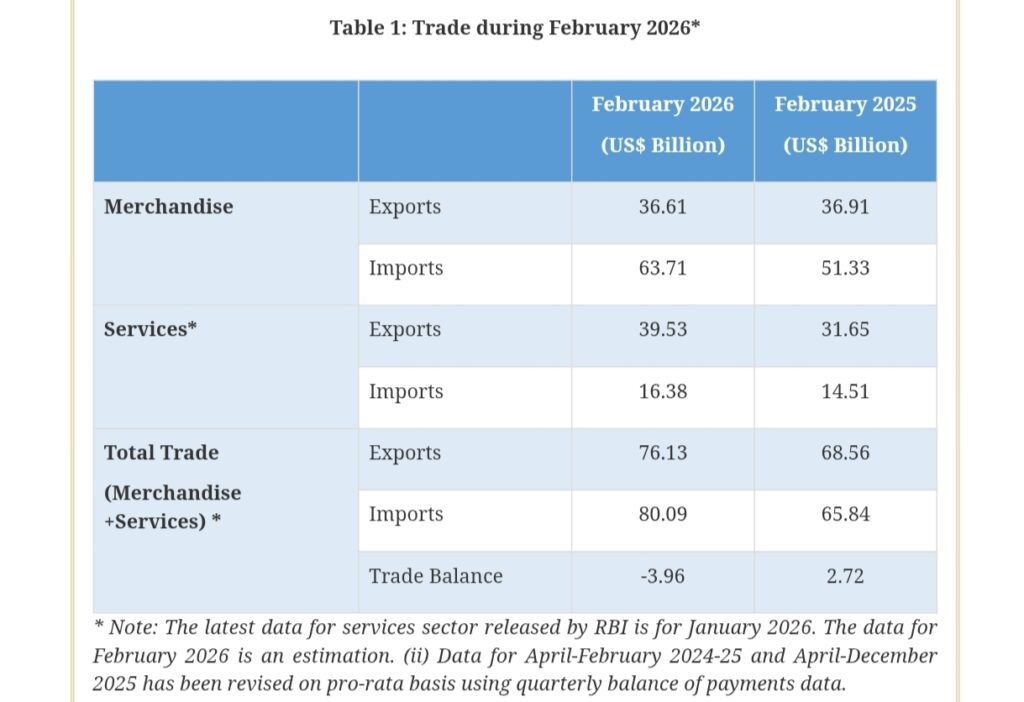
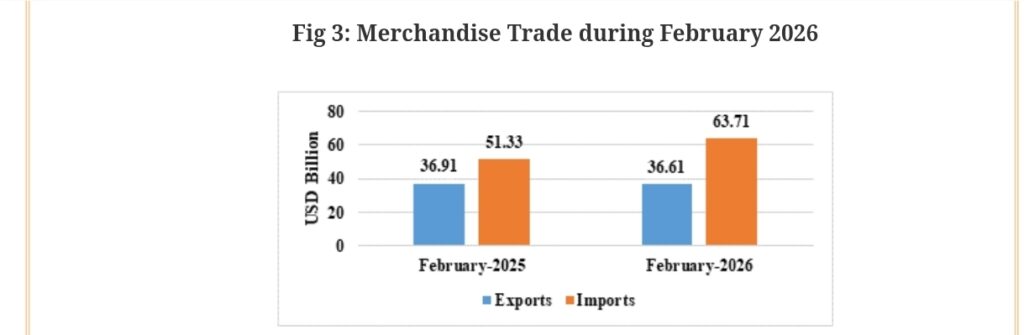
Merchandise exports in February 2026 were recorded at $36.61 billion, slightly lower than $36.91 billion in February 2025. At the same time, merchandise imports climbed sharply to $63.71 billion compared with $51.33 billion a year earlier.
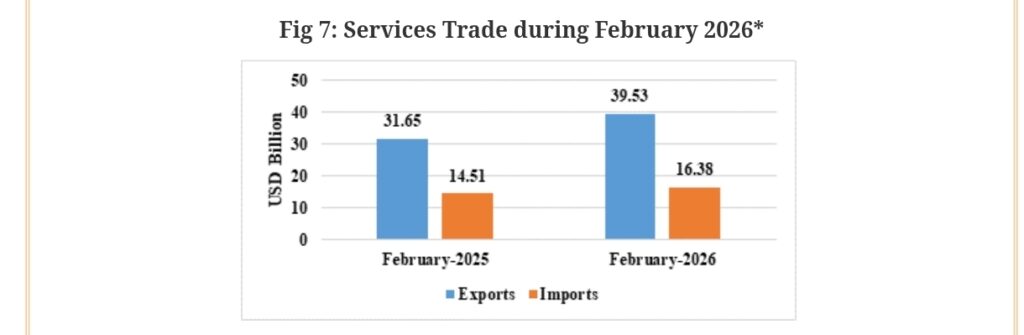
Services trade provided a strong offset. Services exports rose to $39.53 billion, compared with $31.65 billion in the same month last year. Services imports increased moderately to $16.38 billion.
| Trade Category | February 2026 ($ Billion) | February 2025 ($ Billion) |
| Merchandise Exports | 36.61 | 36.91 |
| Merchandise Imports | 63.71 | 51.33 |
| Services Exports | 39.53 | 31.65 |
| Services Imports | 16.38 | 14.51 |
| Total Exports | 76.13 | 68.56 |
| Total Imports | 80.09 | 65.84 |
Why Did Export Growth Happen
The expansion in exports was driven by several manufacturing and industrial sectors that are benefiting from global supply chain diversification and stronger demand for specialized goods.
Engineering goods exports rose 12.9% year-on-year to $10.36 billion in February. Electronics exports also increased by 10.37%, reflecting rising shipments of mobile phones, semiconductors and consumer electronics.
Chemicals exports grew 6.85%, while gems and jewellery exports increased 4.08%. The fastest growth came from meat, dairy and poultry products, which surged 22.66% compared with the previous year.
| Key Export Growth Sectors | Growth Rate | Export Value Feb 2026 |
| Engineering Goods | 12.9% | $10.36 Billion |
| Electronic Goods | 10.37% | $4.18 Billion |
| Chemicals | 6.85% | $2.38 Billion |
| Gems and Jewellery | 4.08% | $2.64 Billion |
| Meat, Dairy and Poultry | 22.66% | $0.55 Billion |
The strong growth in electronics and engineering goods reflects India’s ongoing push to become a manufacturing hub under the government’s production-linked incentive programs.
Bigger Context Behind India’s Trade Position in the Global Economy
India’s trade structure continues to show a familiar pattern: strong services exports offsetting a persistent goods trade deficit. This trend has been consistent for more than a decade.
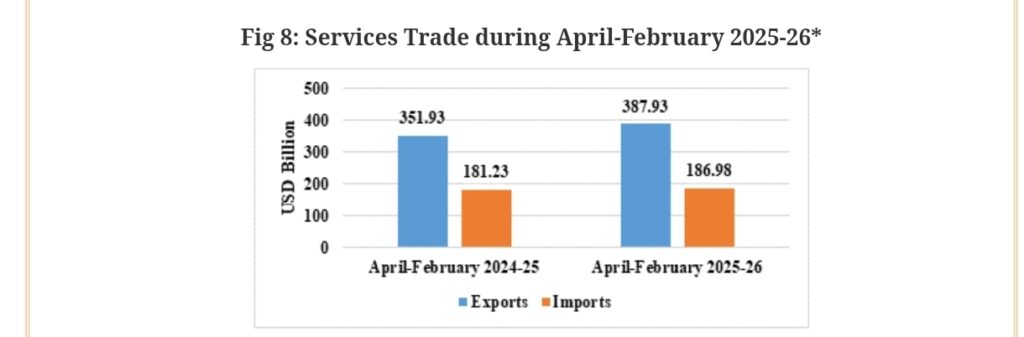
The services sector, especially IT services, consulting, digital infrastructure support and financial services, remains India’s biggest export strength. During April to February 2025–26, services exports reached $387.93 billion.
In contrast, India remains dependent on imports of crude oil, electronics components, machinery and precious metals. These imports rise sharply during periods of strong domestic demand or rising commodity prices.
Another structural factor is the global reconfiguration of supply chains. Many multinational companies are diversifying production away from China. India has benefited from this shift, particularly in electronics manufacturing, chemicals and pharmaceuticals.
However, India still imports large volumes of intermediate goods needed for manufacturing, which explains why imports often rise even when exports grow.
| India Trade (April–February) | 2025–26 ($ Billion) | 2024–25 ($ Billion) |
| Total Exports | 790.86 | 747.58 |
| Total Imports | 900.51 | 838.69 |
| Trade Balance | -109.64 | -91.11 |
How Trade Trends Affect Markets, Companies, and the Economy
Trade data plays an important role in shaping investor expectations about currency stability, inflation pressures and industrial growth.
Higher imports can increase pressure on the Indian rupee because companies need more dollars to pay for foreign goods. This dynamic can affect currency markets and foreign exchange reserves.
However, rising exports in sectors such as engineering goods and electronics signal strengthening manufacturing capacity. For investors, this trend supports long term growth in capital goods companies, industrial exporters and electronics manufacturers.
Services exports also remain a key stabilizing factor for India’s current account balance. The services sector generated a surplus of $200.96 billion during April to February 2025–26.
For policymakers, the challenge is to expand high value manufacturing exports while reducing dependence on imported industrial inputs.
What Happens Next in India’s Trade Outlook
India’s trade outlook will depend heavily on global economic conditions during 2026. Slower growth in Europe and China could limit export demand, while rising commodity prices could push import costs higher.
The government is also focusing on new trade agreements and supply chain partnerships to expand exports. Negotiations with several major economies are expected to shape the next phase of India’s trade strategy.
At the same time, domestic manufacturing incentives, infrastructure investment and logistics reforms are designed to make Indian exports more competitive in global markets.
If manufacturing exports accelerate and services growth continues, India could gradually reduce its structural trade deficit over the coming years.
Frequently Asked Questions
What was India’s total trade in February 2026?
India recorded total exports of $76.13 billion and total imports of $80.09 billion in February 2026.
Why did India record a trade deficit in February 2026?
Imports increased faster than exports, mainly due to higher demand for commodities, industrial inputs and precious metals.
Which sectors drove India’s export growth?
Engineering goods, electronics, chemicals and agricultural products such as meat and dairy showed strong export growth.
How large is India’s trade deficit in 2025–26 so far?
The cumulative trade deficit during April to February 2025–26 reached $109.64 billion.
Conclusion
India’s latest trade data reflects a mixed but structurally evolving economic picture. Export growth in high value sectors such as engineering goods and electronics shows improving manufacturing competitiveness, while services exports remain a major global strength.
At the same time, rising imports highlight the country’s dependence on foreign energy, commodities and industrial inputs. The balance between expanding exports and managing import growth will remain a key economic policy challenge as India continues positioning itself as a major global manufacturing and services hub.

Bringing you the latest updates on finance, economies, stocks, bonds, and more. Stay informed with timely insights.










[…] indicating sustained investment momentum across sectors. The survey shows estimated aggregate CAPEX of Rs 11,43,879 crore for FY2025-26 and forward investment intentions of Rs 9,55,281 crore for […]
[…] of regulatory and structural reforms to strengthen the governance of cooperative banks, with the Reserve Bank of India and NABARD playing a central role in enhancing transparency, accountability, and depositor […]
[…] India’s total exports of goods and services reached $714.73 billion during April–January FY 2025–26, marking a 5.26% increase from $679.02 billion in the same period last year. The growth comes despite persistent geopolitical tensions and supply chain disruptions. […]
[…] offering a positive signal for investor sentiment and external stability. Data released by the Reserve Bank of India shows that net claims of non residents on India declined to 260.5 billion dollars, down by 10.9 […]