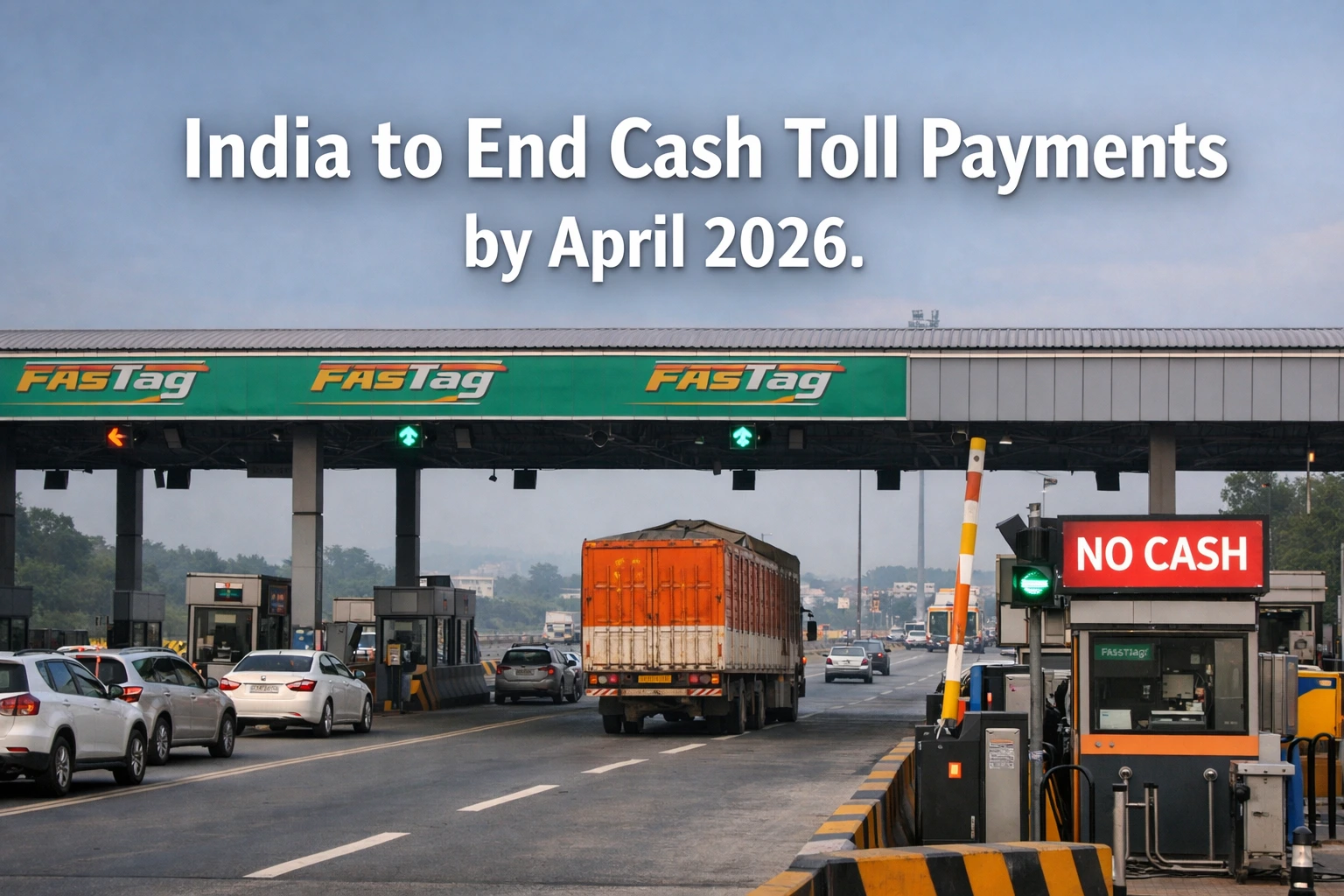
India’s National Highways Authority (NHAI) is planning to discontinue cash payments at National Highway toll plazas from 1 April 2026, shifting fully to FASTag and UPI-based digital tolling. The move will impact over 1,150 toll plazas and millions of daily highway users across the country. Officials say over 98% of toll transactions are already digital, making a complete transition operationally feasible. The policy aims to reduce congestion, improve traffic flow, and strengthen transparency in toll collection.
What Happened in India’s Digital Tolling Policy Decision
According to an official release dated 20 February 2026, NHAI is contemplating a complete discontinuation of cash transactions at National Highway fee plazas nationwide starting 1 April 2026. After implementation, toll payments will be processed exclusively through FASTag or Unified Payments Interface (UPI).
FASTag, an RFID-enabled electronic toll collection system, already dominates highway transactions, with penetration exceeding 98% across vehicles. Currently, vehicles without a valid FASTag are charged double the user fee if they pay in cash, while UPI payments attract a 1.25 times fee under existing National Highway rules.
| Policy Element | Details |
| Policy Authority | National Highways Authority of India (NHAI) |
| Implementation Date | 1 April 2026 (proposed) |
| Payment Modes Allowed | FASTag and UPI only |
| Cash Payment Status | Likely to be discontinued |
| Total Toll Plazas Affected | 1,150+ across National Highways and Expressways |
Why Did India Move Toward Fully Digital Toll Collection
The primary driver behind the decision is operational efficiency and congestion management. Cash transactions significantly slow lane throughput, especially during peak traffic hours, leading to long queues and disputes at toll booths.
India’s broader digital payments push, led by UPI’s rapid adoption and government-backed fintech infrastructure, has made cashless tolling a logical next step. Policymakers are also aiming to reduce revenue leakages and improve real-time toll reconciliation across highway networks.
From a fiscal standpoint, digital tolling enhances audit trails and reduces manual handling costs, which improves the financial sustainability of highway infrastructure projects funded through public-private partnerships.
Bigger Context Behind Digital Tolling in Economy and Geopolitics
The shift aligns with India’s long-term strategy of building a technology-driven logistics and transport ecosystem. Efficient highways are critical for supply chains, freight mobility, and industrial competitiveness, especially as India positions itself as a global manufacturing hub amid shifting global supply chains.
Globally, countries such as the United States, Singapore, and several EU nations have already adopted electronic toll collection systems to optimize transport infrastructure. India’s transition reflects a geopolitical push toward digitization-led infrastructure governance and reduced cash dependency in public systems.
The policy also complements India’s Digital Public Infrastructure (DPI) model, where UPI, Aadhaar, and FASTag form an integrated framework that supports scalable economic formalization and transparency in large-scale public services.
How Cashless Tolling Affects Markets, Companies, Investors, and Economy
The decision is structurally positive for digital payment ecosystems, fintech companies, and banking networks linked to FASTag and UPI processing. Increased digital transaction volumes could boost payment gateway revenues and strengthen fintech infrastructure demand.
For logistics firms and transport companies, faster toll clearance reduces fuel costs, idle time, and operational delays, directly improving efficiency margins. This is particularly relevant for India’s freight sector, which accounts for a major share of highway usage.
| Sector | Expected Impact |
| Fintech & Digital Payments | Higher transaction volumes and infrastructure demand |
| Logistics & Transport | Lower delays and improved cost efficiency |
| Infrastructure Operators | Better revenue tracking and reduced leakages |
| Fuel Consumption | Potential decline due to reduced waiting time |
For investors, the policy signals continued government focus on digital infrastructure and smart mobility, which may support long-term growth narratives in infrastructure, mobility tech, and payment service providers.
What Happens Next in India’s Tolling Policy and Transport System
Implementation will likely involve phased operational adjustments, including enhanced UPI integration at toll plazas and stricter enforcement against non-FASTag vehicles. Authorities may also introduce awareness campaigns to ensure nationwide compliance before April 2026.
Over time, the government could expand toward GPS-based tolling and barrier-free toll systems, which are already under pilot discussions. This would further reduce physical toll booths and transform highway monetization models.
| Future Development | Timeline Outlook |
| Full Digital Toll Enforcement | FY2026 |
| Advanced GPS Tolling (Potential) | Medium-Term Policy Direction |
| Smart Highway Infrastructure | Ongoing under national infrastructure push |
Frequently Asked Questions
Will cash payments be completely banned at toll plazas?
Yes, NHAI is planning to discontinue cash payments and shift entirely to FASTag and UPI from 1 April 2026.
How many toll plazas will be affected by the policy?
More than 1,150 National Highway and Expressway toll plazas across India will be covered under the digital-only payment system.
What happens if a vehicle does not have FASTag?
Currently, such vehicles are charged double the toll fee if paying in cash, but under the new system, digital payment will be mandatory.
Why is the government pushing digital toll collection?
To reduce congestion, improve transparency, increase operational efficiency, and strengthen India’s digital infrastructure ecosystem.
Conclusion: Strategic Shift Toward Digital Infrastructure Governance
The proposed elimination of cash toll payments marks a structural shift in India’s highway monetization and transport efficiency strategy. By aligning toll systems with digital public infrastructure, the government is reinforcing transparency, operational speed, and logistics competitiveness.
If implemented as planned in April 2026, the policy could significantly reduce congestion costs, enhance supply chain efficiency, and further integrate India’s transport network into a technology-driven economic framework with long-term implications for infrastructure, fintech, and mobility sectors.

BBW News Desk is the editorial team of BigBreakingWire, a digital newsroom focused on global finance, markets, geopolitics, trade policy, and macroeconomic developments.
Our editors monitor government decisions, central bank actions, international trade movements, corporate activity, and economic indicators to deliver fast, fact-based reporting for investors, professionals, and informed readers.
The BBW News Desk operates under the editorial standards of BigBreakingWire, prioritizing accuracy, verified information, and timely updates on major global developments.









Be First to Comment