
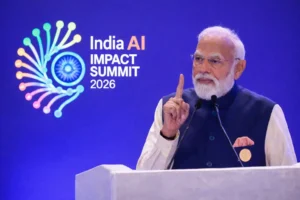
India and Sweden signed a Statement of Intent on February 25, 2026, to launch the Sweden–India Technology and Artificial Intelligence Corridor (SITAC) during the India AI Impact Summit 2026 in New Delhi. The agreement was signed between the IndiaAI Mission and Business Sweden to strengthen bilateral AI collaboration, digital trade, and investment flows.
The partnership aims to accelerate real-world deployment of artificial intelligence across industries while connecting startups, investors, researchers, and policymakers from both countries. The initiative is expected to influence the technology sector, digital economy, and cross-border innovation ecosystems.
SITAC will act as a flagship institutional platform to align India’s expanding AI ecosystem with Sweden’s advanced industrial innovation and responsible AI development model.
What Happened in the India-Sweden AI Partnership Agreement
On the sidelines of the India AI Impact Summit 2026, the IndiaAI Mission and Business Sweden formalized a strategic cooperation framework focused on artificial intelligence and digital technologies. The Statement of Intent outlines structured collaboration in AI development, application, deployment, and innovation exchange.
The SITAC programme will include conferences, workshops, ecosystem exchanges, innovation hub visits, and direct engagement between companies, investors, and academic institutions. The framework also promotes joint innovation platforms and bilateral investment corridors in emerging technologies.
| Key Detail | Information |
| Announcement Date | 25 February 2026 |
| Framework Name | Sweden–India Technology and Artificial Intelligence Corridor (SITAC) |
| Institutions Involved | IndiaAI Mission and Business Sweden |
| Core Focus Areas | AI innovation, trade, investment, digital technologies |
| Platform Objective | Government, industry, startups, and academic collaboration |
Why Did the India–Sweden AI Collaboration Happen
The agreement comes at a time when artificial intelligence is becoming a key pillar of economic growth, technological sovereignty, and geopolitical influence. India is rapidly building its national AI infrastructure through policy initiatives such as the IndiaAI Mission, focusing on compute access, data ecosystems, and talent development.
Sweden, on the other hand, has strong capabilities in industrial AI, research and development, and responsible technology governance. By combining India’s scale and digital market with Sweden’s innovation depth, both countries aim to create a balanced and trusted AI collaboration model.
The partnership also reflects a broader global trend where nations are forming strategic technology alliances to reduce reliance on single-country tech ecosystems and strengthen secure digital supply chains.
Bigger Context Behind AI Cooperation in Economy and Geopolitics
Artificial intelligence is increasingly central to global economic competitiveness, with governments treating AI infrastructure similar to critical national assets. Major economies including the US, EU, and China are investing billions of dollars annually in AI research, semiconductor supply chains, and digital innovation policies.
India’s AI market is projected to grow at a double-digit rate over the next decade, supported by strong digital adoption, a large developer base, and government-backed digital public infrastructure. Strategic partnerships with European economies like Sweden help India integrate into global innovation networks while maintaining policy alignment on ethical and responsible AI.
From a geopolitical perspective, the SITAC corridor strengthens India–Europe tech diplomacy and complements ongoing technology dialogues between India and EU partners on data governance, AI ethics, and digital trade frameworks.
| Global Factor | Strategic Impact |
| AI Global Competition | Rising investments in AI by major economies |
| Digital Trade Expansion | Growth in cross-border tech investments and services |
| Innovation Alliances | Countries forming tech corridors and research partnerships |
| Policy Alignment | Focus on ethical and responsible AI governance |
How the AI Partnership Affects Markets, Companies, Investors, and Economy
The SITAC framework is expected to create new opportunities for AI startups, IT service firms, and deep-tech companies by enabling access to international research collaboration and funding channels. Indian technology firms may benefit from increased entry into European AI markets and industrial automation projects.
Investors could see long-term growth potential in sectors such as AI software, cloud computing, robotics, healthcare technology, and smart manufacturing. Enhanced bilateral engagement may also improve venture capital flows into AI innovation and digital infrastructure projects.
For the broader economy, the collaboration supports high-value job creation, digital exports, and productivity gains. AI-led innovation can strengthen India’s position in global value chains while supporting sustainable industrial growth and technological modernization.
| Sector | Expected Economic Impact |
| AI Startups | Higher funding access and global collaboration |
| IT & Digital Services | Expansion of AI-driven export opportunities |
| Manufacturing | Adoption of industrial automation and AI solutions |
| Investors | Long-term exposure to AI growth sectors |
What Happens Next in the India–Sweden AI Corridor
The next stage of the SITAC initiative is expected to focus on joint pilot projects, innovation exchange programmes, and sector-specific AI deployment across healthcare, sustainability, fintech, and industrial technology. Governments and institutions will likely formalize operational roadmaps and funding frameworks in the coming months.
Over the medium term, the corridor could evolve into a broader digital trade and technology partnership, supporting cross-border startups, research commercialization, and scalable AI solutions. This aligns with India’s long-term goal of becoming a global AI hub while strengthening trusted technology partnerships with advanced innovation economies.
Frequently Asked Questions
What is SITAC?
SITAC is the Sweden–India Technology and Artificial Intelligence Corridor, a bilateral platform for AI collaboration, innovation, and digital trade engagement launched in 2026.
Which institutions signed the AI agreement?
The Statement of Intent was signed between the IndiaAI Mission and Business Sweden during the India AI Impact Summit 2026.
How will SITAC impact the economy?
It is expected to boost AI innovation, digital investments, tech exports, and cross-border startup collaboration between India and Sweden.
Why is this partnership geopolitically important?
It strengthens strategic tech alliances, supports digital sovereignty, and enhances India–Europe cooperation in AI governance and innovation.
Conclusion
The India–Sweden SITAC framework signals a strategic shift toward structured AI diplomacy and innovation-led economic cooperation. As artificial intelligence becomes a core driver of global growth and geopolitical influence, such technology corridors are likely to shape future digital trade, investment patterns, and policy alignment. The partnership positions both nations to leverage AI for sustainable growth, industrial competitiveness, and long-term technological leadership.

BBW News Desk is the editorial team of BigBreakingWire, a digital newsroom focused on global finance, markets, geopolitics, trade policy, and macroeconomic developments.
Our editors monitor government decisions, central bank actions, international trade movements, corporate activity, and economic indicators to deliver fast, fact-based reporting for investors, professionals, and informed readers.
The BBW News Desk operates under the editorial standards of BigBreakingWire, prioritizing accuracy, verified information, and timely updates on major global developments.








Be First to Comment