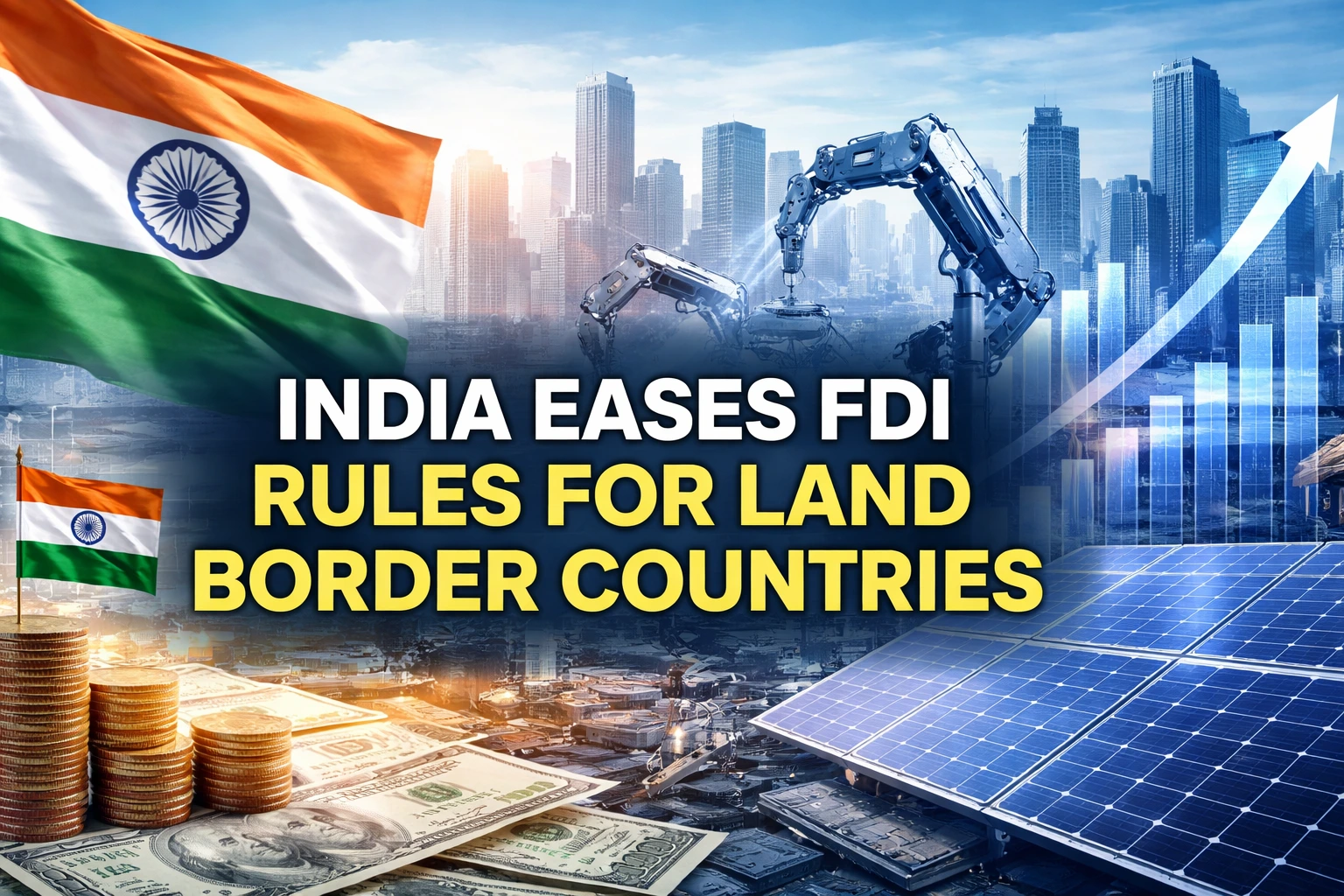
The Union Cabinet chaired by Prime Minister Narendra Modi has approved key changes to India’s Foreign Direct Investment policy governing investments from countries sharing a land border with India.
The revised policy introduces a clear definition of “Beneficial Ownership”, allows limited non controlling ownership under the automatic route, and establishes a 60 day decision timeline for investments in certain manufacturing sectors.
The move modifies parts of Press Note 3 issued in April 2020, which required government approval for all investments from land bordering countries. The changes aim to unlock investment flows into sectors such as electronics components, capital goods manufacturing, and solar supply chains.
The decision is expected to improve ease of doing business, support domestic manufacturing expansion, and attract global venture capital and private equity investments into Indian startups and deep technology companies.
What Happened in India’s Revised FDI Policy
India introduced Press Note 3 in April 2020 during the Covid 19 pandemic to prevent opportunistic acquisitions of Indian companies when market valuations had collapsed. Under that rule, investors from countries sharing land borders with India including China could invest in Indian companies only through the government approval route.
The Cabinet has now refined these rules by introducing a clear framework for determining beneficial ownership and by allowing limited non controlling stakes to bypass the approval process.
| Policy Change | New Provision |
| Beneficial Ownership Definition | Aligned with Prevention of Money Laundering Rules 2005 |
| Automatic Route Limit | Up to 10% non controlling beneficial ownership allowed |
| Approval Timeline | 60 days for investments in specific manufacturing sectors |
| Strategic Control Rule | Majority ownership must remain with Indian residents |
The beneficial ownership test will be applied at the investor entity level, providing greater regulatory clarity for global funds that often have multiple international investors.
In addition, proposals involving investors from land bordering countries in sectors such as electronic components, capital goods manufacturing, polysilicon production, and wafer manufacturing will now be processed within a fixed 60 day timeline.
Why Did India Change the FDI Rules
The original Press Note 3 rules created significant friction for foreign capital flows, particularly for venture capital and private equity funds that include investors from multiple countries.
Many global investment funds have small Chinese or other land border country investors as limited partners. Under the previous rules, even a minor ownership stake triggered the need for government approval, slowing deal timelines and discouraging investment.
By allowing non controlling beneficial ownership of up to 10% under the automatic route, India aims to remove unnecessary regulatory bottlenecks without compromising national security concerns.
The new policy also aligns with India’s broader strategy of attracting high technology investments and accelerating domestic manufacturing capabilities.
Bigger Context Behind India’s FDI Policy and Supply Chain Strategy
The policy adjustment reflects India’s evolving position in global supply chains at a time when geopolitical tensions and economic fragmentation are reshaping international trade.
Over the past five years, multinational companies have been diversifying supply chains away from concentrated manufacturing hubs. India has positioned itself as a key alternative manufacturing destination through initiatives such as Production Linked Incentive schemes and infrastructure expansion.
Sectors like electronics components, semiconductor materials, and solar manufacturing are particularly important because they sit at the core of global technology supply chains.
India currently imports a large portion of critical electronics components and semiconductor materials. Encouraging foreign investment in domestic production could reduce import dependence while strengthening industrial capabilities.
| Strategic Sector | Why It Matters |
| Electronic Components | Critical for smartphones, computers, and telecom infrastructure |
| Capital Goods | Supports manufacturing equipment and industrial expansion |
| Polysilicon and Wafer | Key materials for solar and semiconductor industries |
| Solar Manufacturing | Supports India’s renewable energy transition goals |
The changes also reflect India’s attempt to balance national security concerns with economic competitiveness in attracting foreign capital.
How the Policy Change Affects Markets, Companies, and Investors
The policy shift could have direct implications for India’s startup ecosystem, technology manufacturing sector, and foreign investment landscape.
Global venture capital and private equity funds often invest in Indian startups across sectors such as artificial intelligence, deep technology, fintech, and semiconductor design. The previous regulatory uncertainty around beneficial ownership created delays in funding rounds.
By providing a clear definition and threshold, the new framework could accelerate funding decisions and improve capital availability for technology companies.
| Stakeholder | Potential Impact |
| Startups | Easier access to global venture capital funding |
| Manufacturers | Faster approvals for joint ventures and technology partnerships |
| Investors | Greater regulatory clarity for cross border funds |
| Government | Higher FDI inflows and stronger supply chain integration |
The 60 day approval timeline is also significant for industrial collaborations, where delays in regulatory approvals can derail technology transfer agreements and manufacturing partnerships.
What Happens Next in India’s FDI Policy Evolution
The government may further refine sector specific investment rules as India pushes to become a global manufacturing hub for electronics, renewable energy equipment, and advanced technologies.
The Cabinet Secretary led Committee of Secretaries will have the authority to revise the list of sectors eligible for the accelerated approval mechanism.
If implemented effectively, the revised policy could lead to stronger participation by global investment funds in India’s technology ecosystem while maintaining safeguards for strategic industries.
For investors and multinational companies, the policy signals that India is attempting to strike a balance between economic openness and national security concerns in an increasingly complex geopolitical environment.
Frequently Asked Questions
What is Press Note 3 in India’s FDI policy?
Press Note 3 introduced in April 2020 requires government approval for investments from countries that share land borders with India to prevent opportunistic takeovers of Indian companies.
What is the new automatic route limit for beneficial ownership?
Investments with non controlling beneficial ownership from land bordering countries of up to 10% can now proceed through the automatic route subject to sectoral caps.
Which sectors will receive faster investment approvals?
Manufacturing sectors such as electronic components, electronic capital goods, capital goods manufacturing, polysilicon production, and wafer manufacturing will receive decisions within 60 days.
Why is India encouraging investment in these sectors?
These sectors are critical to building domestic supply chains in electronics, semiconductors, and renewable energy manufacturing.
Conclusion
The revision of India’s FDI rules for land bordering countries represents a calibrated shift in investment policy. By introducing clearer ownership definitions and faster approval timelines, the government is attempting to unlock foreign capital while maintaining strategic safeguards.
If the framework successfully attracts global funds and technology partnerships, it could strengthen India’s manufacturing ecosystem and deepen its integration into global supply chains over the coming decade.

BBW News Desk is the editorial team of BigBreakingWire, a digital newsroom focused on global finance, markets, geopolitics, trade policy, and macroeconomic developments.
Our editors monitor government decisions, central bank actions, international trade movements, corporate activity, and economic indicators to deliver fast, fact-based reporting for investors, professionals, and informed readers.
The BBW News Desk operates under the editorial standards of BigBreakingWire, prioritizing accuracy, verified information, and timely updates on major global developments.










Be First to Comment