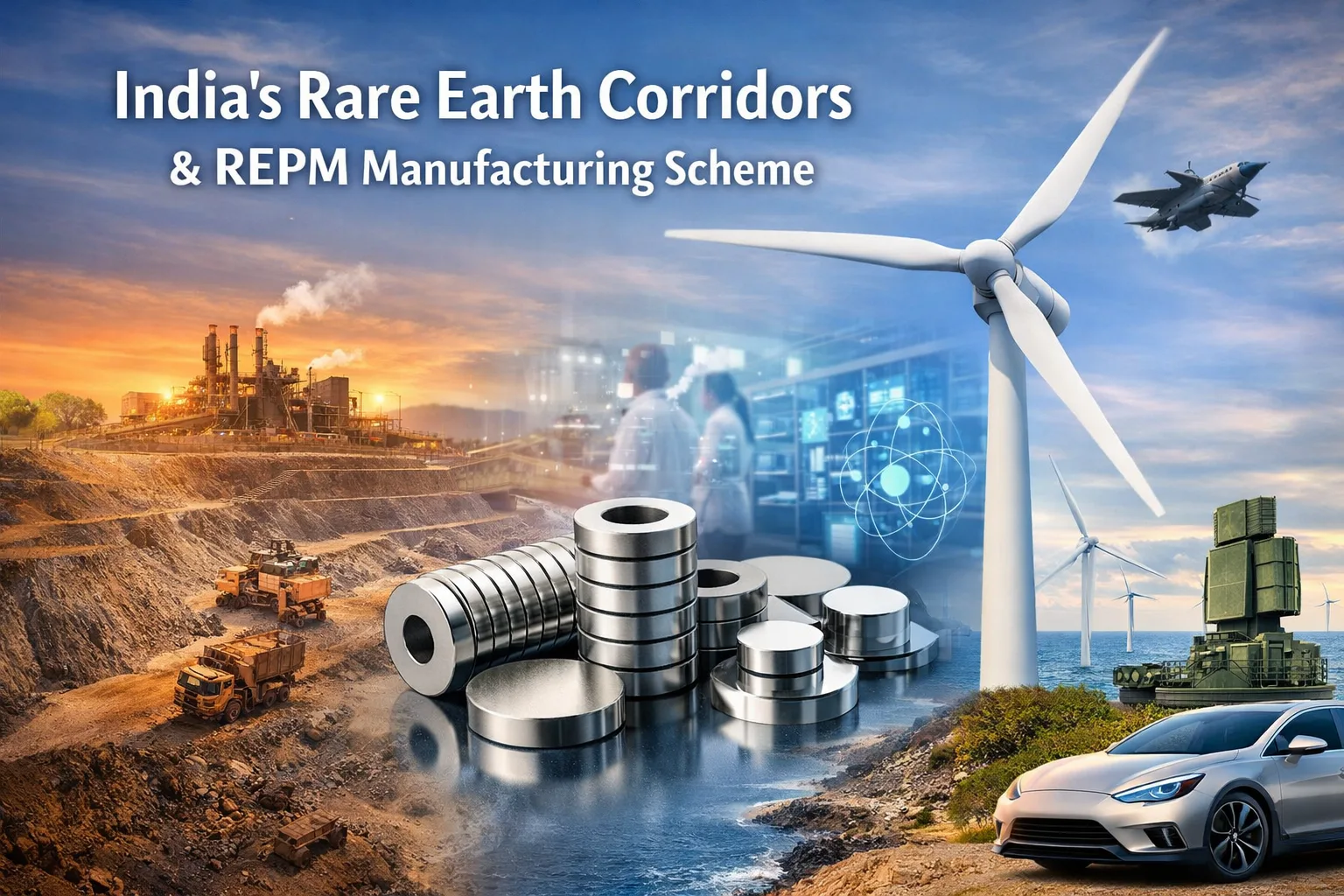
India is building a strong domestic ecosystem for Rare Earth Permanent Magnets REPMs, which are critical for electric vehicles, wind turbines, electronics, aerospace, and defence. Under the Union Budget 2026 to 27 and earlier approvals, the government has launched a major push to reduce import dependence and make India self reliant in rare earth based technologies.
What are Rare Earth Permanent Magnets REPMs?
Rare Earth Permanent Magnets are high performance magnets known for very strong magnetic power in small sizes. They are essential in:
- Electric vehicle motors
- Wind turbine generators
- Consumer and industrial electronics
- Aerospace systems
- Defence equipment
- Precision sensors
Why are REPMs important for India?
India is expanding in clean energy, advanced mobility, electronics manufacturing, and defence. A stable domestic supply of REPMs helps India:
- Reduce import dependence
- Strengthen national security
- Support electric mobility and renewable energy
- Improve position in global advanced materials value chains
What did the Union Budget 2026 to 27 announce?
The Union Budget 2026 to 27 announced Dedicated Rare Earth Corridors in the following states:
- Odisha
- Kerala
- Andhra Pradesh
- Tamil Nadu
These corridors will focus on:
- Mining of rare earth minerals
- Processing and refining
- Research and development
- Manufacturing of rare earth based products including REPMs
What is the Rs 7,280 crore REPM Manufacturing Scheme?
On 26 November 2025, the government approved a major scheme to build domestic REPM manufacturing capacity.
- Total outlay: Rs 7,280 crore
- Target capacity: 6,000 MTPA integrated REPM manufacturing
- Incentives: Rs 6,450 crore sales linked incentives over 5 years
- Capital subsidy: Rs 750 crore for advanced facilities
- Beneficiaries: Up to 5 companies selected through global competitive bidding
- Timeline: 2 year setup period plus 5 years of production linked incentives
The goal is to create a full value chain from rare earth oxides to finished magnets within India.
How much rare earth resource does India have?
India has a strong raw material base for rare earths.
- Monazite deposits: 13.15 million tonnes
- Estimated rare earth oxides REO in monazite: 7.23 million tonnes
- Additional in situ REO in Gujarat and Rajasthan: 1.29 million tonnes
- GSI identified rare earth ore resources: 482.6 million tonnes across 34 exploration projects
These resources are found in Odisha, Kerala, Andhra Pradesh, Tamil Nadu, West Bengal, Gujarat, Maharashtra, and Jharkhand, mainly in beach sands, red sands, and alluvial areas.
Why does India need to invest more in REPMs?
Between 2022 and 25, India imported most of its permanent magnets, mainly from China:
- 60 to 80 percent by value
- 85 to 90 percent by quantity
Demand for REPMs is expected to double by 2030 due to growth in electric vehicles, renewable energy, electronics, and defence. Domestic capacity is essential for long term supply security.
Which company supports India’s rare earth processing?
IREL India Limited, under the Department of Atomic Energy, plays a major role. It operates:
- A Rare Earth Extraction Plant in Odisha
- A Rare Earth Refining Unit at Aluva in Kerala
- Total mineral processing capacity of about 10 lakh tonnes per year
Its existing infrastructure supports the new Rare Earth Corridors.
How does this align with India’s national goals?
- Atmanirbhar Bharat: Reduces import dependence in critical materials
- Net Zero 2070: Supports EVs and wind power through magnet supply
- National security: Secures materials for defence and aerospace
- Viksit Bharat 2047: Builds advanced manufacturing capabilities
Is India also working internationally on critical minerals?
Yes, India has agreements with countries like Australia, Argentina, Zambia, Mozambique, Peru, Zimbabwe, Malawi, and Côte D’Ivoire for critical minerals. India is also part of global platforms focused on securing mineral supply chains.
Conclusion
The Rare Earth Corridors and the Rs 7,280 crore REPM Manufacturing Scheme together form a complete strategy covering mining, processing, research, and manufacturing. With strong domestic resources and policy support, India is positioning itself as a key global player in rare earth based advanced materials.

BBW News Desk is the editorial team of BigBreakingWire, a digital newsroom focused on global finance, markets, geopolitics, trade policy, and macroeconomic developments.
Our editors monitor government decisions, central bank actions, international trade movements, corporate activity, and economic indicators to deliver fast, fact-based reporting for investors, professionals, and informed readers.
The BBW News Desk operates under the editorial standards of BigBreakingWire, prioritizing accuracy, verified information, and timely updates on major global developments.



















Be First to Comment