
What Happened in India’s CAPEX Survey
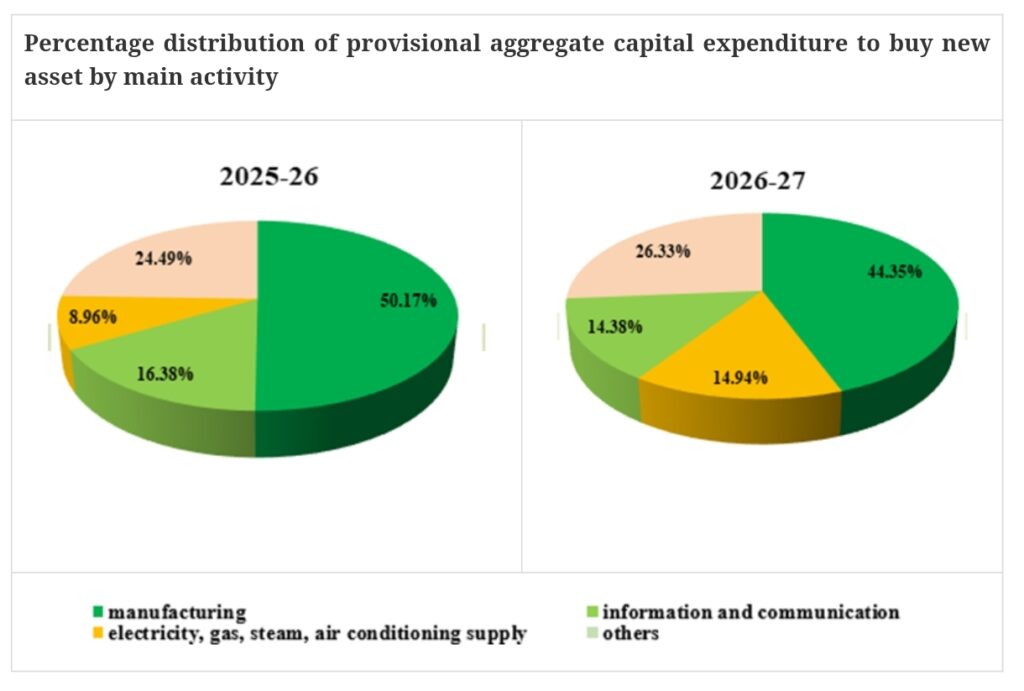
India’s National Statistics Office (NSO) released its latest forward-looking survey on private corporate capital expenditure, indicating sustained investment momentum across sectors. The survey shows estimated aggregate CAPEX of Rs 11,43,879 crore for FY2025-26 and forward investment intentions of Rs 9,55,281 crore for FY2026-27.
Actual spending in FY2024-25 reached Rs 173.5 crore per enterprise versus planned Rs 180.2 crore, implying a high realization ratio of 96.3%. The survey covered over 5,366 enterprises, with 78.3% reporting forward investment plans.
| Metric | Value |
| FY2025-26 CAPEX | Rs 11,43,879 crore |
| FY2026-27 Intentions | Rs 9,55,281 crore |
| Realisation Ratio FY25 | 96.3% |
| Enterprises Surveyed | 5,366 |
Why Did Investment Momentum Strengthen
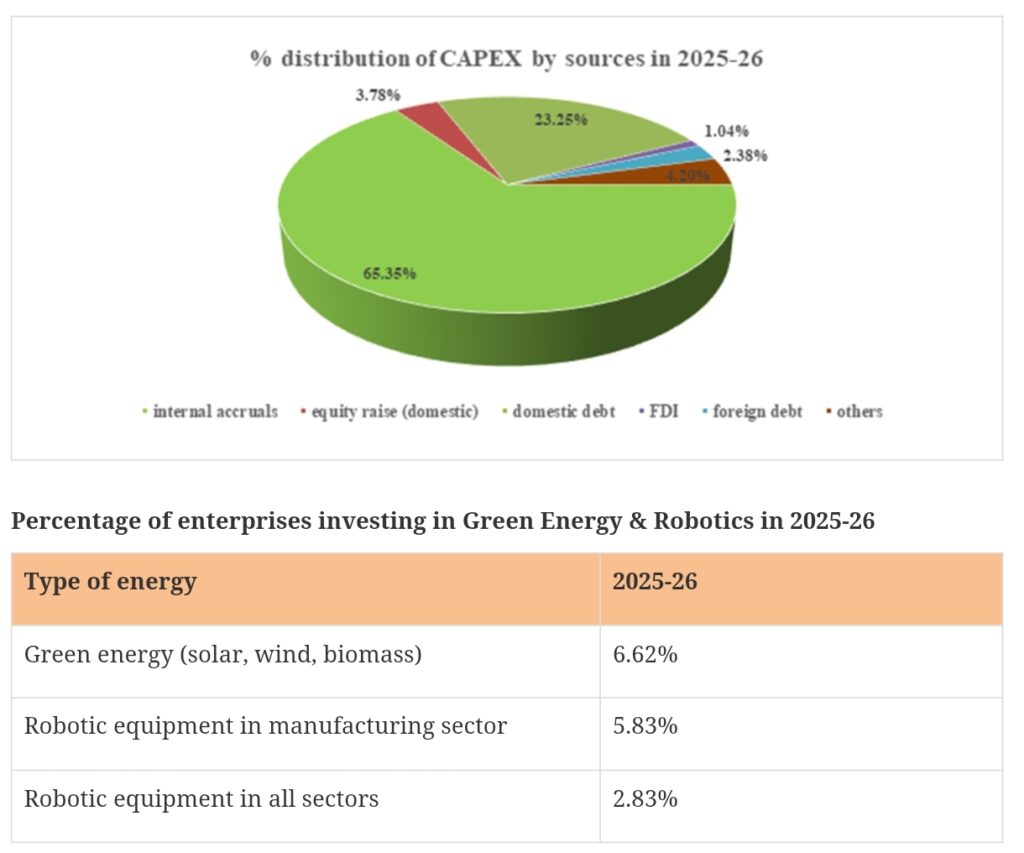
The rise in private CAPEX reflects improving corporate balance sheets, driven by stronger earnings cycles post-pandemic and deleveraging trends supported by lower credit stress. With internal accruals accounting for 65.35% of funding, firms are increasingly relying on retained profits rather than external borrowing.
India’s macro stability, including controlled inflation and steady GDP growth above 6%, has improved visibility for long-term projects. Policy continuity under initiatives like Production Linked Incentive (PLI) schemes and infrastructure push has also reduced execution risk.
Additionally, global supply chain realignment away from China has positioned India as an alternative manufacturing hub, encouraging capacity expansion in sectors such as electronics, chemicals, and capital goods.
| Funding Source | Share (%) |
| Internal Accruals | 65.35% |
| Domestic Debt | 23.25% |
| Equity (Domestic) | 3.78% |
| FDI | 1.04% |
| Foreign Debt | 2.38% |
Bigger Context in Economy and Geopolitics
The investment cycle revival aligns with India’s broader ambition to become a $5 trillion economy and a global manufacturing base. As geopolitical tensions reshape trade routes, countries are diversifying supply chains, benefiting emerging markets like India.
Compared to previous cycles, the current CAPEX expansion is less leveraged and more earnings-driven, reducing systemic financial risk. This shift is critical as global interest rates remain elevated due to tighter monetary policies by central banks such as the US Federal Reserve.
India’s domestic demand resilience, supported by urban consumption and government infrastructure spending exceeding Rs 10 lakh crore annually, provides a strong base for private investment.
Impact on Markets, Companies, and Economy
Higher CAPEX typically supports sectors such as capital goods, infrastructure, cement, steel, and industrial manufacturing. Companies in engineering and construction are likely to see improved order books over FY2025-27.
For equity markets, sustained private investment signals earnings visibility, which can support valuations in cyclical sectors. Banking and NBFC stocks may also benefit from credit demand, even though internal funding remains dominant.
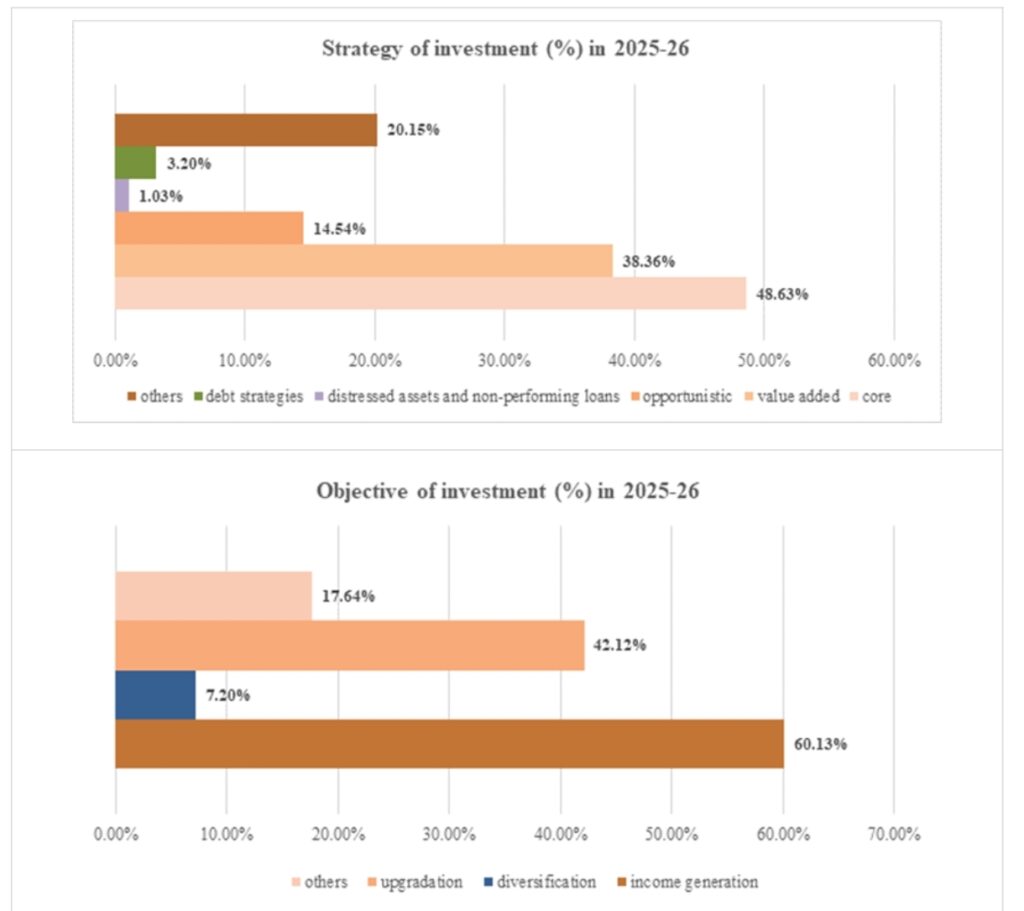
The focus on core asset creation, reported by 48.63% of firms, indicates long-term capacity building rather than speculative investments, which is positive for productivity and GDP growth.
| Investment Strategy | Share (%) |
| Core Assets | 48.63% |
| Value Addition | 38.36% |
| Opportunistic Assets | 14.54% |
| Debt-related Strategy | <4% |
| Distressed Assets | ~1% |
What Happens Next
Investment momentum is expected to remain steady into FY2026-27, although global uncertainties such as commodity price volatility and geopolitical tensions could influence execution timelines.
If corporate profitability sustains and policy support continues, India could enter a multi-year private CAPEX cycle, reinforcing growth above 6–7%. However, a slowdown in global demand or tightening financial conditions could moderate future investment intentions.
The key monitorables include credit growth trends, export demand, and policy signals from the Reserve Bank of India (RBI) on interest rates.
Frequently Asked Questions
What is the total CAPEX estimated for FY2025-26?
It is estimated at Rs 11,43,879 crore by NSO.
How much CAPEX is expected in FY2026-27?
Investment intentions are estimated at Rs 9,55,281 crore.
What is the main source of CAPEX funding?
Internal accruals contribute 65.35% of total CAPEX financing.
Why is the high realization ratio important?
A 96.3% ratio indicates strong execution capability and alignment between plans and actual spending.
Conclusion
The NSO CAPEX survey indicates a structurally improving investment cycle driven by corporate earnings strength and policy stability. If sustained, this trend could enhance India’s industrial capacity, strengthen supply chain positioning, and support long-term economic expansion.

BBW News Desk is the editorial team of BigBreakingWire, a digital newsroom focused on global finance, markets, geopolitics, trade policy, and macroeconomic developments.
Our editors monitor government decisions, central bank actions, international trade movements, corporate activity, and economic indicators to deliver fast, fact-based reporting for investors, professionals, and informed readers.
The BBW News Desk operates under the editorial standards of BigBreakingWire, prioritizing accuracy, verified information, and timely updates on major global developments.










Be First to Comment