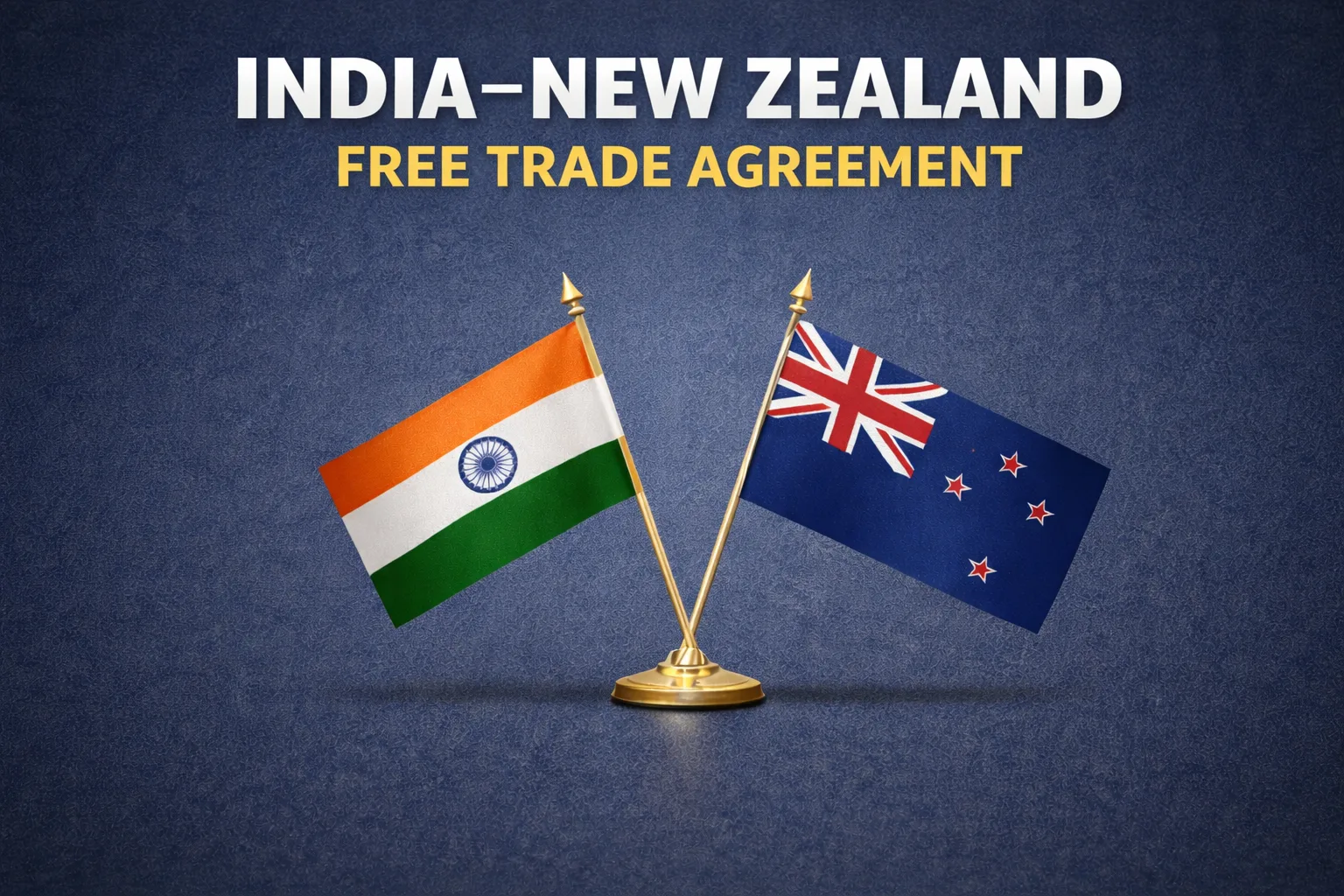
India and New Zealand have officially concluded negotiations for a comprehensive and future-ready Free Trade Agreement (FTA), marking a major milestone in India’s Indo-Pacific economic strategy.
Fast-Tracked Negotiations and Strategic Vision
The negotiations were formally launched on 16 March 2025 and concluded after five formal rounds along with multiple in-person and virtual intersession meetings. The agreement focuses on people-centric growth, job creation, trade expansion, investment, agricultural productivity and talent mobility.
This FTA aims to strengthen employment opportunities, MSME participation, innovation-led growth and long-term economic resilience for both countries.
Zero-Duty Access for Indian Exports
Under the agreement, New Zealand has eliminated tariffs on 100% of its tariff lines, providing duty-free market access for all Indian exports. This significantly boosts the competitiveness of India’s labour-intensive sectors such as:
- Textiles and apparel
- Leather and footwear
- Gems and jewellery
- Handicrafts
- Engineering goods and automobiles
- Marine and agricultural products
On its part, India has offered tariff liberalisation on 70% of tariff lines, covering nearly 95% of bilateral trade with New Zealand.
Strong Protection for Indian Farmers
To safeguard domestic agriculture, India has clearly excluded sensitive sectors from market access. These include:
- Dairy products
- Coffee, milk, cream, cheese and yoghurts
- Whey and caseins
- Onions, sugar and spices
- Edible oils and rubber
This ensures that Indian farmers and domestic industries remain protected while benefiting from productivity-focused cooperation.
Agricultural Productivity Partnerships
The FTA establishes dedicated Agricultural Productivity Partnerships through Centres of Excellence for apples, kiwifruit and honey. These initiatives focus on:
- Improved planting material
- Research and technology transfer
- Capacity building for farmers
- Post-harvest and supply chain improvements
- Food safety and quality standards
Market access for these products is carefully regulated through quotas and minimum import prices, ensuring knowledge transfer without harming domestic producers.
Best-Ever Services Offer by New Zealand
New Zealand has extended its most ambitious services offer ever to India, covering 118 services sectors and Most-Favoured Nation (MFN) commitments in about 139 sub-sectors.
Key sectors include:
- IT and computer-related services
- Professional and business services
- Telecommunications
- Audio-visual services
- Construction
- Tourism and travel-related services
Boost to Student Mobility and Skilled Professionals
The agreement significantly enhances mobility for Indian students and professionals. Key highlights include:
- No numerical caps on student mobility
- Post-study work rights of up to 3 years for STEM graduates
- Up to 4 years post-study work for doctoral scholars
- 5,000 Temporary Employment Entry visas for professionals
- 1,000 Work and Holiday visas
The Temporary Employment Entry pathway covers sectors such as IT, engineering, healthcare, education, construction, as well as professions like yoga instructors, AYUSH practitioners, Indian chefs and music teachers.
$20 Billion Investment Commitment
New Zealand has committed to facilitate investments worth USD 20 billion in India over the next 15 years. These investments are expected to support:
- Manufacturing
- Infrastructure
- Services and innovation
- Employment generation under Make in India
Pharma, Medical Devices and Regulatory Cooperation
The FTA provides faster regulatory access for Indian pharmaceutical and medical device exports by allowing acceptance of GMP and GCP inspection reports from globally recognised regulators. This will:
- Reduce compliance costs
- Avoid duplicate inspections
- Speed up product approvals
Geographical Indications and Cultural Cooperation
New Zealand has committed to amend its laws to facilitate registration of Indian Geographical Indications, including wines, spirits and other goods. Cooperation has also been agreed in:
- AYUSH and wellness
- Fisheries and forestry
- Horticulture
- Audio-visual tourism
- Traditional knowledge systems
Growing India–New Zealand Trade
India–New Zealand economic engagement has shown steady growth. Bilateral merchandise trade reached USD 1.3 billion in 2024–25, while total trade in goods and services stood at approximately USD 2.4 billion. Services trade alone touched USD 1.24 billion, led by travel, IT and business services.
New Zealand FM Slams India-NZ FTA as “Unfair”
New Zealand Foreign Minister Winston Peters has sharply criticised the newly announced India-New Zealand Free Trade Agreement, calling it “neither free nor fair” and warning that his party, New Zealand First, will oppose the deal in Parliament.
Peters said the agreement gives away too much—especially on immigration—while delivering limited benefits for New Zealand, particularly by failing to secure tariff cuts from India on key dairy exports. He argued it would be “impossible to defend” the outcome to farmers and rural communities.
He added that this would be New Zealand’s first trade agreement to exclude major dairy products such as milk, cheese, and butter. Dairy exports were worth about $13.94 billion in the year to November 2025, making up nearly 30% of New Zealand’s total goods exports.

BBW News Desk is the editorial team of BigBreakingWire, a digital newsroom focused on global finance, markets, geopolitics, trade policy, and macroeconomic developments.
Our editors monitor government decisions, central bank actions, international trade movements, corporate activity, and economic indicators to deliver fast, fact-based reporting for investors, professionals, and informed readers.
The BBW News Desk operates under the editorial standards of BigBreakingWire, prioritizing accuracy, verified information, and timely updates on major global developments.




















Be First to Comment