
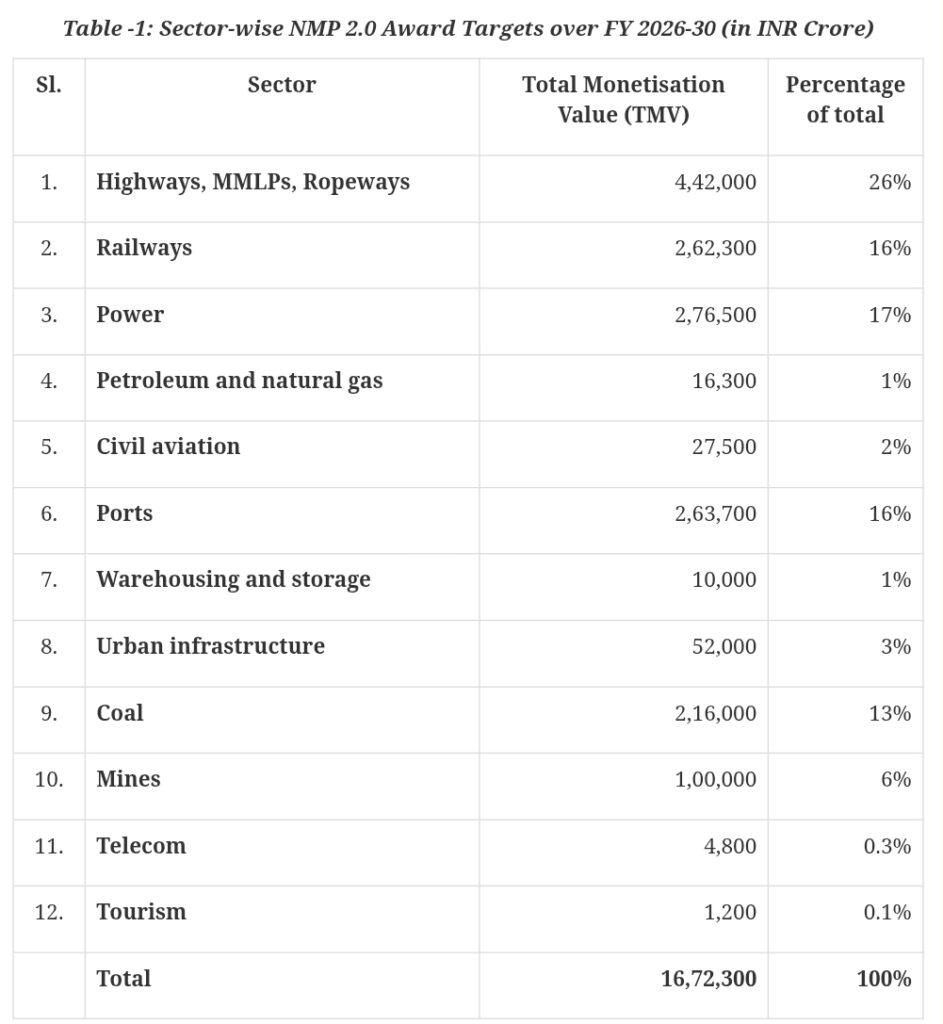
The Government of India has launched the National Monetisation Pipeline 2.0 (NMP 2.0) with an estimated monetisation potential of Rs 16.72 lakh crore for FY2026–FY2030. The policy was unveiled by Finance Minister Nirmala Sitharaman on February 23, 2026, as part of the Viksit Bharat infrastructure strategy.
The pipeline targets operational public infrastructure assets across highways, railways, power, ports, and coal, with private sector investment expected to contribute around Rs 5.8 lakh crore. The programme aims to recycle public assets to fund new capital expenditure without increasing fiscal burden.
The move directly affects infrastructure investors, public sector entities, private developers, and capital markets, as monetisation instruments like InvITs, PPP concessions, and strategic auctions are expected to accelerate over the next five years.
What Happened in National Monetisation Pipeline 2.0 Launch
The Union Finance Ministry, in coordination with NITI Aayog and multiple infrastructure ministries, launched NMP 2.0 as a five-year roadmap for asset monetisation from FY26 to FY30. The aggregate monetisation value is pegged at Rs 16,72,300 crore, more than 2.6 times higher than the first pipeline.
The programme includes monetisation of brownfield assets owned by central ministries and public sector enterprises, allowing private participation through lease models, securitisation of cash flows, and market instruments such as Infrastructure Investment Trusts (InvITs).
| Key Metric | Value |
| Total Monetisation Potential | Rs 16.72 lakh crore |
| Time Period | FY2026–FY2030 |
| Private Sector Investment Component | Rs 5.8 lakh crore |
| Monitoring Authority | Core Group of Secretaries on Asset Monetisation |
Why Did National Monetisation Pipeline 2.0 Happen
The launch of NMP 2.0 is driven by India’s rising infrastructure financing needs and fiscal discipline requirements. Instead of increasing public borrowing, the government is opting to unlock value from existing operational assets to fund new infrastructure projects.
India’s capital expenditure push has expanded significantly post-pandemic, and asset monetisation offers a non-tax revenue channel that supports fiscal consolidation while sustaining infrastructure growth. The government also achieved nearly 90% of its Rs 6 lakh crore target under NMP 1.0, strengthening policy confidence.
The policy also aligns with the Viksit Bharat vision, which focuses on accelerating logistics efficiency, energy infrastructure, and multimodal connectivity to boost long-term GDP growth.
Bigger Context Behind Asset Monetisation in Economy and Geopolitics
Globally, asset monetisation has become a key tool for governments facing high infrastructure spending needs and constrained fiscal space. Countries like Australia and Canada have used similar models to recycle infrastructure capital while attracting pension funds and sovereign investors.
For India, the strategy carries geopolitical importance as well. Improving logistics, ports, and power infrastructure strengthens supply chain resilience and enhances India’s competitiveness in global manufacturing amid shifting trade dynamics and China+1 diversification.
The emphasis on highways (26%), power (17%), and ports (16%) reflects India’s strategic focus on trade corridors, energy security, and export competitiveness. This also supports initiatives like PM Gati Shakti and National Infrastructure Pipeline.
| Top Sectors Under NMP 2.0 | Monetisation Value (Rs Crore) | Share (%) |
| Highways, MMLPs, Ropeways | 4,42,000 | 26% |
| Power | 2,76,500 | 17% |
| Ports | 2,63,700 | 16% |
| Railways | 2,62,300 | 16% |
| Coal | 2,16,000 | 13% |
How NMP 2.0 Affects Markets, Companies, Investors, and Economy
NMP 2.0 is structurally positive for infrastructure companies, InvIT platforms, EPC contractors, and institutional investors. Listed infrastructure firms in roads, power transmission, and ports could see higher asset recycling opportunities and improved balance sheets.
For capital markets, increased monetisation through InvITs and PPP concessions may deepen India’s infrastructure investment ecosystem and attract long-term global capital, including sovereign wealth funds and pension funds.
From a macroeconomic perspective, the programme supports sustained CAPEX without widening the fiscal deficit, which is critical for maintaining sovereign credit stability and controlling inflationary borrowing pressures.
| Stakeholder | Impact |
| Government | Non-tax revenue and fiscal space for CAPEX |
| Investors | New long-term yield assets via InvITs and concessions |
| Infrastructure Companies | Asset recycling and capital unlocking opportunities |
| Economy | Boost to infrastructure growth and logistics efficiency |
What Happens Next in India’s Asset Monetisation Strategy
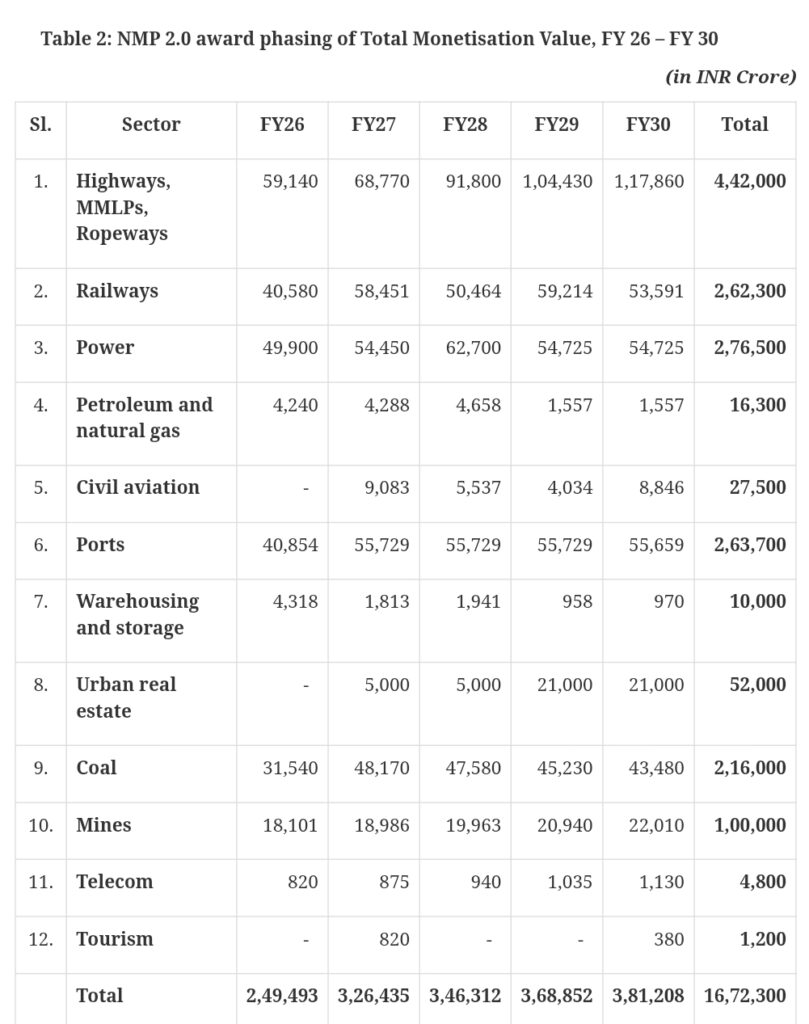
The monetisation rollout will be phased annually, with total award targets rising from Rs 2,49,493 crore in FY26 to Rs 3,81,208 crore by FY30. This indicates a front-loaded infrastructure funding strategy aligned with long-term growth planning.
The Core Group of Secretaries on Asset Monetisation will monitor execution, while ministries such as Road Transport, Railways, Power, and Coal will lead sector-specific transactions. Market conditions, investor appetite, and regulatory clarity will be key determinants of actual monetisation outcomes.
Looking ahead, successful execution of NMP 2.0 could significantly reduce infrastructure financing gaps, accelerate private sector participation, and strengthen India’s position as a global infrastructure investment destination.
Frequently Asked Questions
What is NMP 2.0?
National Monetisation Pipeline 2.0 is a government roadmap to monetise operational public infrastructure assets worth Rs 16.72 lakh crore between FY2026 and FY2030.
Which sectors have the highest monetisation targets?
Highways, power, ports, and railways account for the majority of the monetisation pipeline, contributing over 75% of the total value.
How does asset monetisation benefit the economy?
It unlocks capital from existing assets and reinvests it into new infrastructure projects without increasing government borrowing.
Will private companies participate in NMP 2.0?
Yes, private sector investment of around Rs 5.8 lakh crore is expected through PPP models, InvITs, and strategic asset leasing.
Conclusion
NMP 2.0 marks a major shift in India’s infrastructure financing model, emphasizing asset recycling over debt-led spending. With a Rs 16.72 lakh crore pipeline, the policy strengthens fiscal sustainability, boosts private capital inflows, and supports long-term economic growth. Its execution will be critical in shaping India’s infrastructure competitiveness, investment climate, and geopolitical economic positioning in the coming decade.

BBW News Desk is the editorial team of BigBreakingWire, a digital newsroom focused on global finance, markets, geopolitics, trade policy, and macroeconomic developments.
Our editors monitor government decisions, central bank actions, international trade movements, corporate activity, and economic indicators to deliver fast, fact-based reporting for investors, professionals, and informed readers.
The BBW News Desk operates under the editorial standards of BigBreakingWire, prioritizing accuracy, verified information, and timely updates on major global developments.








Be First to Comment