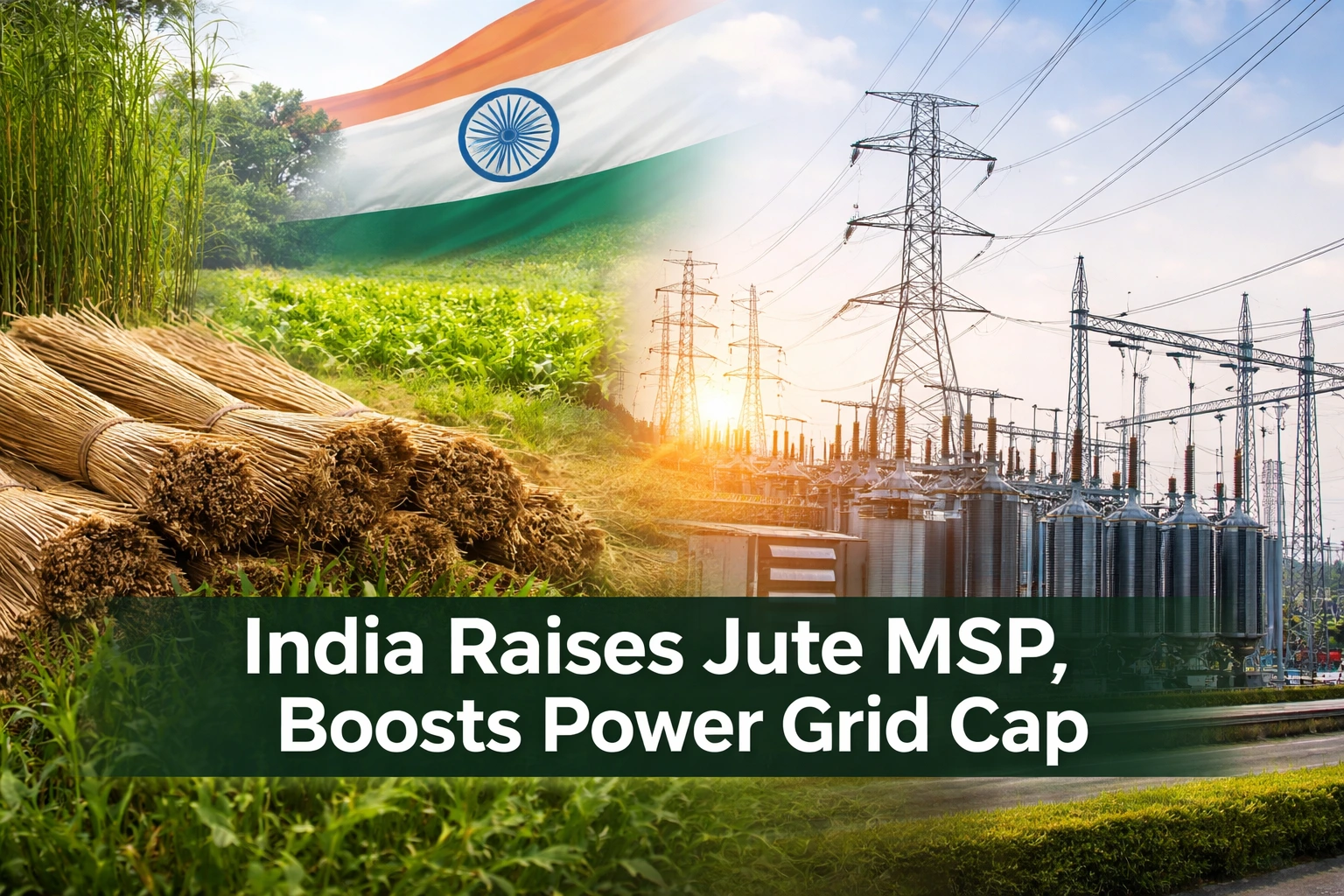
The Indian government has approved a Minimum Support Price (MSP) of Rs 5,925 per quintal for raw jute (TD-3 grade) for the 2026-27 marketing season, marking a Rs 275 increase from the previous year. The Cabinet Committee on Economic Affairs (CCEA), chaired by Prime Minister Narendra Modi, also raised POWERGRID’s equity investment ceiling per subsidiary from Rs 5,000 crore to Rs 7,500 crore. The MSP decision ensures a 61.8% return over the weighted average cost of production, directly impacting jute farmers, agri-markets, and rural income stability. Meanwhile, the enhanced investment delegation to POWERGRID signals a strategic push toward renewable energy transmission and infrastructure expansion.
What Happened in India’s MSP and POWERGRID Policy Decisions
The CCEA formally approved the MSP for raw jute at Rs 5,925 per quintal for the 2026-27 season, continuing the policy framework introduced in the Union Budget 2018-19 that mandates MSP at least 1.5 times the all-India weighted average cost of production. This is a steady increase from Rs 5,650 per quintal in 2025-26 and a significant rise from Rs 2,400 per quintal in 2014-15.
Simultaneously, the Cabinet cleared enhanced financial delegation for Power Grid Corporation of India Limited (POWERGRID), a Maharatna CPSE, allowing equity investment up to Rs 7,500 crore per subsidiary, up from the previous Rs 5,000 crore limit, while maintaining the cap at 15% of net worth.
| Policy Measure | New Approval (2026) | Previous Level |
| Raw Jute MSP (TD-3) | Rs 5,925 per quintal | Rs 5,650 per quintal (2025-26) |
| Return Over Cost | 61.8% | Above 1.5x cost benchmark |
| POWERGRID Equity Investment Limit | Rs 7,500 crore per subsidiary | Rs 5,000 crore |
The Jute Corporation of India (JCI) will remain the nodal agency for price support operations, with the central government fully reimbursing operational losses, ensuring procurement stability during price fluctuations.
Why Did These Policy Decisions Happen
The MSP increase reflects a broader rural income stabilization strategy ahead of volatile commodity cycles and inflation pressures in agricultural inputs. Jute farmers, primarily concentrated in West Bengal, Assam, and Bihar, are highly sensitive to price swings, making MSP a key policy lever to protect farm earnings.
On the infrastructure side, raising POWERGRID’s investment cap aligns with India’s aggressive renewable energy target of 500 GW non-fossil fuel capacity. Transmission bottlenecks remain a major constraint in scaling solar and wind installations, especially in resource-rich but grid-poor regions.
The dual policy approach indicates coordinated fiscal and infrastructure planning: supporting farm incomes domestically while accelerating capital deployment in strategic energy assets.
Bigger Context Behind MSP and Energy Infrastructure in Economy and Geopolitics
India’s MSP policy has evolved into a structural rural demand support mechanism, especially as global agricultural markets face climate shocks and supply chain disruptions. With global natural fiber demand rising due to sustainability regulations in Europe and Asia, higher jute MSP also supports India’s positioning as a key supplier of eco-friendly packaging materials.
Between 2014-15 and 2025-26, MSP payments to jute farmers reached Rs 1,342 crore, compared to Rs 441 crore in the decade before 2014, highlighting a sharp expansion in state-backed procurement support.
Geopolitically, strengthening domestic jute production also reduces dependence on synthetic packaging imports and aligns with India’s environmental commitments under climate frameworks. At the same time, upgrading transmission infrastructure through POWERGRID is critical for energy security and reducing fossil fuel reliance amid global energy transition pressures.
| Strategic Area | Economic Significance | Geopolitical Relevance |
| Jute MSP Policy | Rural income and agri stability | Sustainable packaging exports |
| Transmission Investments | Power sector growth | Energy transition leadership |
| Renewable Grid Expansion | Lower energy costs long-term | Climate commitments and energy security |
How the Decisions Affect Markets, Companies, Investors, and Economy
The MSP hike is expected to support rural consumption by improving farmer cash flows, which indirectly benefits FMCG, fertilizer, and agri-input companies. Stable jute pricing can also help domestic packaging and textile industries manage raw material volatility.
For capital markets, the enhanced delegation to POWERGRID could accelerate bidding for ultra-high voltage AC (UHVAC) and high voltage direct current (HVDC) projects. This signals higher capital expenditure visibility in the power transmission sector, which is closely tracked by infrastructure investors and sovereign funds.
The policy also improves competition in Tariff Based Competitive Bidding (TBCB) for large transmission projects, potentially lowering tariffs and improving long-term power affordability. Investors in renewable energy developers may see reduced grid evacuation risks, a major bottleneck in project execution.
From a fiscal perspective, reimbursing JCI’s procurement losses indicates continued government commitment to price stabilization, though it adds to subsidy pressures in the agriculture budget.
What Happens Next in India’s MSP and Power Infrastructure Policy
Going forward, the MSP trajectory suggests continued incremental hikes aligned with cost-of-production benchmarks, especially if inflation in farm inputs persists. Policymakers may also expand procurement operations in eastern India to ensure effective MSP transmission to farmers.
In the energy sector, the higher equity investment threshold will likely fast-track large-scale grid modernization projects needed to integrate renewable energy corridors. This could lead to increased project announcements in HVDC and interstate transmission networks over the next 12–24 months.
Overall, the combined policy moves indicate a dual economic strategy: safeguarding rural incomes while strengthening infrastructure for long-term energy transition and industrial growth.
Frequently Asked Questions
What is the MSP for raw jute for 2026-27?
The MSP for raw jute (TD-3 grade) has been fixed at Rs 5,925 per quintal for the 2026-27 marketing season.
How much has the MSP increased from last year?
The MSP has increased by Rs 275 per quintal compared to the 2025-26 season.
Why was POWERGRID’s investment limit increased?
The limit was raised to Rs 7,500 crore per subsidiary to enable participation in capital-intensive transmission and renewable energy grid projects.
Who conducts jute procurement under MSP operations?
The Jute Corporation of India (JCI) acts as the nodal agency for procurement and price support operations.
Conclusion
India’s decision to raise raw jute MSP and expand POWERGRID’s investment authority reflects a synchronized policy push toward rural income stability and energy infrastructure expansion. The moves are likely to support agricultural earnings, accelerate renewable grid integration, and strengthen India’s long-term economic resilience amid global commodity volatility and energy transition pressures.

BBW News Desk is the editorial team of BigBreakingWire, a digital newsroom focused on global finance, markets, geopolitics, trade policy, and macroeconomic developments.
Our editors monitor government decisions, central bank actions, international trade movements, corporate activity, and economic indicators to deliver fast, fact-based reporting for investors, professionals, and informed readers.
The BBW News Desk operates under the editorial standards of BigBreakingWire, prioritizing accuracy, verified information, and timely updates on major global developments.









Be First to Comment