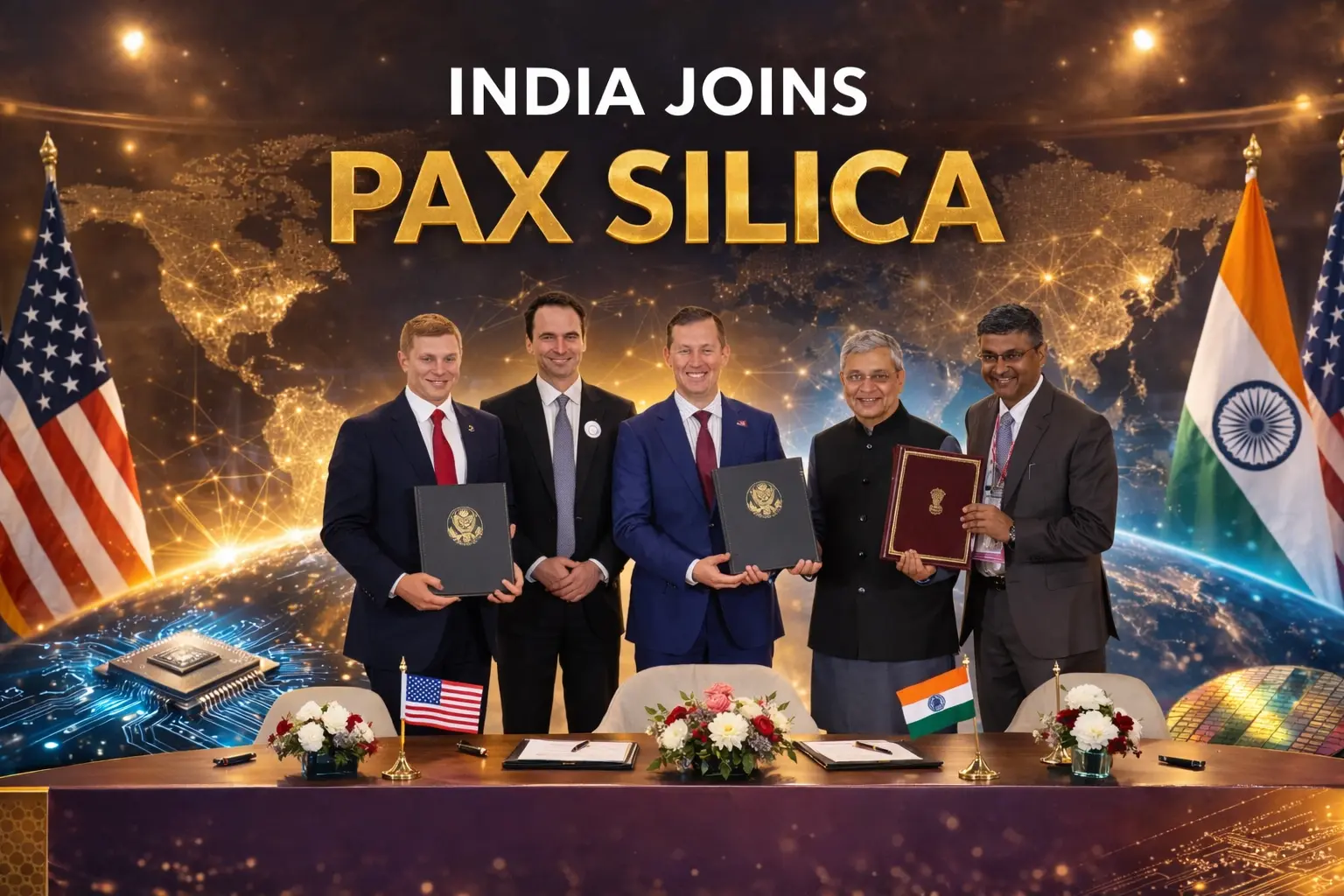
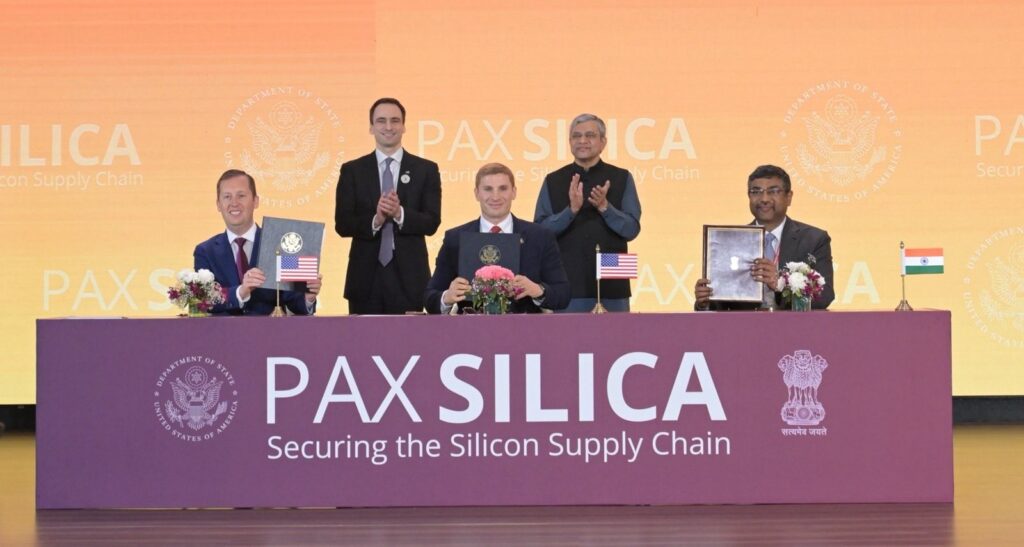
India officially joined the Pax Silica coalition at the India AI Impact Summit 2026, marking a major step in strategic technology cooperation with the United States. The initiative focuses on securing the global silicon stack, including critical minerals, semiconductor manufacturing, AI systems, and deployment infrastructure. This move directly impacts the global tech supply chain, semiconductor industry, and AI ecosystem.
The agreement signals a deeper India-US partnership in advanced technology governance and supply chain resilience. Policymakers, semiconductor firms, AI companies, and global investors are among the key stakeholders affected by this development.
The coalition aims to reduce supply chain overdependence, prevent economic coercion, and ensure democratic control over emerging technologies that will power the AI-driven global economy.
What Happened in the Pax Silica Initiative at India AI Impact Summit 2026
On February 20, 2026, India formally signed the Pax Silica declaration during the fifth day of the India AI Impact Summit in New Delhi. Senior government officials from India and the United States participated in the signing ceremony, highlighting a shared commitment to building secure and resilient technology supply chains.
Pax Silica is designed as a strategic coalition of trusted nations that will govern and secure the entire silicon stack, ranging from mining of critical minerals to semiconductor fabrication, advanced AI computing, and data infrastructure.
| Key Element | Details |
|---|---|
| Event | India AI Impact Summit 2026 |
| Date | 20 February 2026 |
| Initiative | Pax Silica Coalition |
| Core Focus | Semiconductors, AI, Critical Minerals, Supply Chains |
| Key Partners | India and United States |
Minister of Electronics and IT Ashwini Vaishnaw stated that India is not just participating in a summit but actively shaping the future technology ecosystem, especially in semiconductors and artificial intelligence.
Why Did India Join the Pax Silica Technology and Semiconductor Coalition
The primary reason behind India’s entry into Pax Silica is to secure long-term access to semiconductor supply chains and emerging AI infrastructure. Global chip shortages and geopolitical tensions have exposed risks of overconcentrated supply chains, especially in critical semiconductor regions.
The coalition also aims to prevent economic coercion and weaponized dependency in technology supply networks. US officials described the declaration as a roadmap for shared economic and technological security.
Jacob Helberg, US Under Secretary of State for Economic Growth, emphasized that economic security is now directly linked to national security, especially in AI and semiconductor domains.
| Strategic Objective | Purpose |
|---|---|
| Supply Chain Diversification | Reduce dependence on single-region chip manufacturing |
| AI Infrastructure Security | Protect future AI deployment systems |
| Critical Minerals Access | Secure raw materials for semiconductor production |
| Democratic Tech Governance | Ensure open and transparent technology control |
Bigger Context Behind Global Silicon Stack Security and AI Geopolitics
The Pax Silica initiative comes at a time when AI adoption and semiconductor demand are accelerating globally. Advanced chip production, including 2-nanometer designs, is becoming central to economic growth and technological leadership.
India highlighted that its engineers are already contributing to the design of next-generation semiconductor chips. The government also estimates that the semiconductor sector will require nearly 1 million skilled professionals in the coming years.
This aligns with India’s broader push across AI development, semiconductor manufacturing, and critical mineral supply chains to position itself as a key player in the global tech ecosystem.
| Technology Layer | Role in Pax Silica |
|---|---|
| Critical Minerals | Foundation for chip manufacturing |
| Semiconductor Fabs | Chip production and processing |
| AI Systems | Advanced computing and intelligence deployment |
| Data Centres | AI infrastructure and large-scale compute |
Industry leaders including Micron CEO Sanjay Mehrotra and Tata Electronics CEO Randhir Thakur also emphasized resilient semiconductor supply chains as a “win-win ecosystem” for AI growth.
How Pax Silica Affects Global Tech Companies, Semiconductor Industry, and Investors
The coalition is expected to directly benefit semiconductor companies, AI firms, and data infrastructure providers. Firms involved in chip design, fabrication, and AI computing may see increased collaboration opportunities between India and the US.
Companies like Micron Technology and Tata Electronics, which are expanding semiconductor investments in India, could gain from stronger policy alignment and supply chain stability.
For investors, the move signals India’s long-term commitment to becoming a semiconductor and AI hub, potentially attracting foreign direct investment, tech partnerships, and advanced manufacturing projects.
It also strengthens India’s strategic position in global tech supply chains, especially as nations increasingly focus on secure and trusted technology ecosystems.
What Happens Next for Pax Silica, India-US Tech Cooperation, and AI Ecosystem
Following the signing, high-level discussions between MeitY Secretary S. Krishnan, US Ambassador Sergio Gor, and industry leaders focused on resilient collaboration and trusted technology partnerships.
Officials indicated that the AI revolution is already underway, not a future event. This suggests faster policy alignment, semiconductor investments, and AI infrastructure development in the coming years.
Future steps may include joint semiconductor projects, critical mineral partnerships, AI research collaboration, and secure data infrastructure expansion under the Pax Silica framework.
Frequently Asked Questions
What is Pax Silica?
Pax Silica is a strategic coalition of trusted nations aimed at securing the global silicon stack, including semiconductors, AI systems, and critical mineral supply chains.
Why is India’s entry into Pax Silica important?
It strengthens India-US technology cooperation, boosts semiconductor ambitions, and improves supply chain resilience for AI and advanced technologies.
How does Pax Silica impact the semiconductor industry?
It supports secure chip manufacturing, diversified supply chains, and long-term investments in semiconductor design, fabrication, and AI infrastructure.
Will Pax Silica affect global AI development?
Yes, the initiative aims to ensure that AI technologies are developed and governed by democratic and open technology ecosystems.
Conclusion
India’s decision to join the Pax Silica coalition marks a strategic shift in global technology alignment. By focusing on semiconductors, AI systems, and secure supply chains, India is positioning itself as a key pillar in the future AI-driven global economy. The initiative is likely to accelerate tech investments, deepen India-US cooperation, and strengthen resilient technology governance in the years ahead.

BBW News Desk is the editorial team of BigBreakingWire, a digital newsroom focused on global finance, markets, geopolitics, trade policy, and macroeconomic developments.
Our editors monitor government decisions, central bank actions, international trade movements, corporate activity, and economic indicators to deliver fast, fact-based reporting for investors, professionals, and informed readers.
The BBW News Desk operates under the editorial standards of BigBreakingWire, prioritizing accuracy, verified information, and timely updates on major global developments.







Be First to Comment