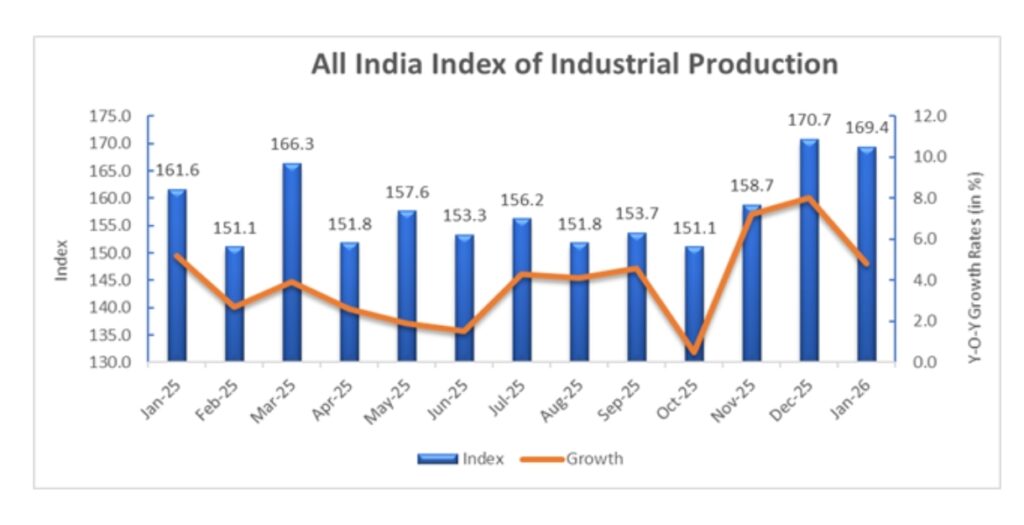
India’s Index of Industrial Production (IIP) grew 4.8% year-on-year in January 2026, down from 7.8% in December 2025, signaling a moderation in industrial momentum. The growth was supported by Manufacturing at 4.8% and Electricity at 5.1%, while Mining expanded 4.3%. The IIP index rose to 169.4 compared to 161.6 in January 2025, reflecting steady but uneven industrial expansion.
The data, released as a Quick Estimate by the Ministry of Statistics and Programme Implementation (MoSPI), affects policymakers, investors, manufacturers, and global markets tracking India’s growth trajectory. The slowdown comes at a time when infrastructure demand and capital spending remain strong, but consumer demand shows signs of weakness.
Notably, Infrastructure and Construction Goods surged 13.7%, while Consumer Non-Durables contracted by 2.7%, highlighting a structural divergence in India’s industrial demand pattern.
What Happened in India’s Industrial Production Data
The latest IIP data for January 2026 shows industrial output growth of 4.8%, primarily driven by manufacturing and electricity output. Manufacturing, which carries the highest weight in the index, expanded 4.8%, indicating continued industrial activity despite global economic uncertainty.
Electricity generation rose 5.1%, reflecting higher power demand from infrastructure projects and industrial usage. Mining output grew 4.3%, suggesting stable raw material production aligned with ongoing infrastructure and construction cycles.
| Sector | January 2026 Growth (YoY) | Index Level |
| Mining | 4.3% | 157.2 |
| Manufacturing | 4.8% | 167.2 |
| Electricity | 5.1% | 212.1 |
| Overall IIP | 4.8% | 169.4 |
Out of 23 manufacturing industry groups, 14 recorded positive growth, with basic metals, motor vehicles, and non-metallic mineral products emerging as key contributors.
Why Did Industrial Growth Moderate in January 2026
The moderation from 7.8% in December 2025 to 4.8% in January 2026 suggests base effect normalization and uneven consumption trends. December often benefits from festive demand and year-end production cycles, which tend to ease in January.
Another structural factor is weak consumer non-durable output, which fell 2.7%, indicating cautious rural and urban consumption. This aligns with persistent inflation concerns and global economic uncertainty impacting discretionary spending.
At the same time, strong growth in infrastructure goods at 13.7% reflects continued government-led capital expenditure and public investment in roads, construction, and core industries.
Bigger Context Behind India’s Industrial Output in Economy and Geopolitics
India’s industrial performance is increasingly tied to global supply chain realignments and geopolitical shifts, including manufacturing diversification away from China. Rising production in basic metals and auto components indicates India’s growing role in global manufacturing networks.
Government infrastructure push under capital expenditure programs and production-linked incentive (PLI) schemes is reshaping industrial demand toward heavy industries and construction-linked sectors. This explains the strong growth in cement, steel, and infrastructure goods.
Geopolitically, stable electricity growth and manufacturing resilience strengthen India’s position as a strategic alternative manufacturing hub amid global trade tensions and supply chain disruptions.
How IIP Data Affects Markets, Companies, Investors, and the Economy
The IIP slowdown to 4.8% could influence Reserve Bank of India (RBI) policy expectations, especially regarding interest rates and growth forecasts. A balanced but slower industrial growth trend may support a cautious monetary stance.
Infrastructure, capital goods, and metal companies are likely to benefit the most, given strong demand in construction and intermediate goods. Meanwhile, FMCG and consumer-driven sectors may face pressure due to declining non-durable output.
| Use-Based Category | Growth Rate (YoY) | Economic Signal |
| Infrastructure/Construction Goods | 13.7% | Strong capex cycle |
| Intermediate Goods | 6.0% | Industrial activity stable |
| Capital Goods | 4.3% | Investment demand steady |
| Consumer Durables | 6.3% | Urban demand resilient |
| Consumer Non-Durables | -2.7% | Consumption weakness |
For equity markets, steady IIP growth supports earnings visibility in manufacturing, infrastructure, and energy sectors, while signaling selective sectoral divergence rather than broad industrial slowdown.
What Happens Next in India’s Industrial Growth Outlook
Industrial growth is expected to remain range-bound in the coming months, supported by government spending and infrastructure expansion ahead of fiscal targets. However, sustained recovery in consumption will be crucial for broader industrial acceleration.
The next IIP release scheduled for 30 March 2026 will be closely monitored by policymakers, global investors, and rating agencies to assess whether India’s growth trajectory is stabilizing or entering a cyclical moderation phase.
If infrastructure-led growth continues while consumer demand recovers, India’s industrial sector could maintain a stable 5%–6% growth range in FY2026 despite global economic headwinds.
Frequently Asked Questions
What is the IIP growth rate for January 2026?
India’s IIP grew 4.8% year-on-year in January 2026.
Which sector contributed the most to IIP growth?
Manufacturing and Infrastructure/Construction Goods were the largest contributors to industrial growth.
Why did IIP growth slow from December 2025?
The slowdown was due to base effects, weaker consumer demand, and normalization after festive production cycles.
How does IIP impact the Indian economy?
IIP reflects industrial activity, influencing GDP growth, RBI policy decisions, investment trends, and stock market sector performance.
Conclusion: India’s 4.8% IIP growth in January 2026 signals stable but moderating industrial momentum driven by infrastructure and manufacturing strength. The divergence between strong capex-led sectors and weak consumption will remain a key policy focus for the government and RBI as India navigates global economic uncertainty and supply chain realignments.

BBW News Desk is the editorial team of BigBreakingWire, a digital newsroom focused on global finance, markets, geopolitics, trade policy, and macroeconomic developments.
Our editors monitor government decisions, central bank actions, international trade movements, corporate activity, and economic indicators to deliver fast, fact-based reporting for investors, professionals, and informed readers.
The BBW News Desk operates under the editorial standards of BigBreakingWire, prioritizing accuracy, verified information, and timely updates on major global developments.










Be First to Comment