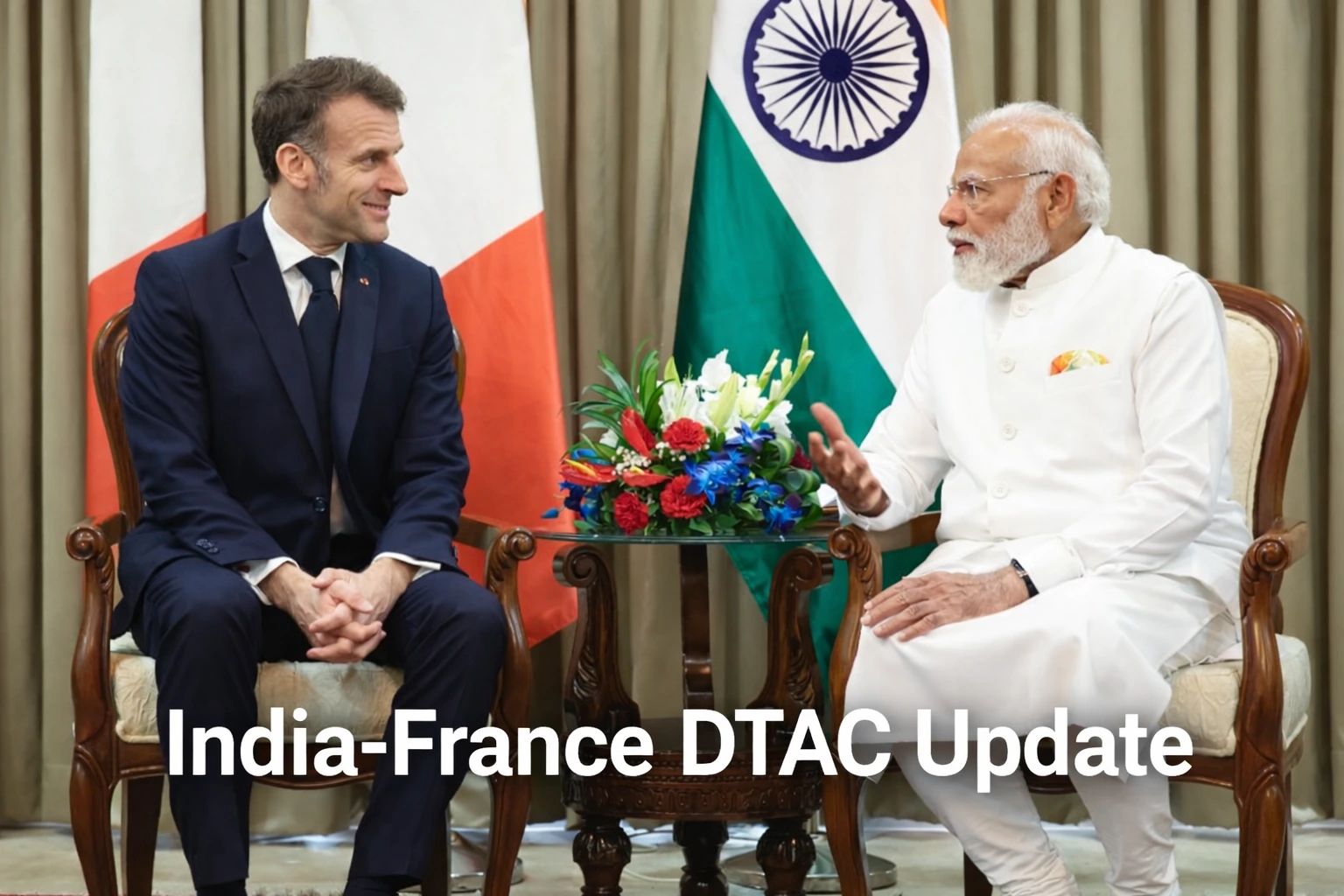
India and France signed an Amending Protocol on February 23, 2026, to update their Double Taxation Avoidance Convention (DTAC) originally signed in 1992. The protocol revises capital gains taxation rights, dividend tax rates, and information exchange rules. The move directly impacts multinational investors, cross-border businesses, and bilateral capital flows between the two economies. Officials expect the update to enhance tax certainty, reduce litigation, and support long-term investment and technology collaboration.
What Happened in the India-France DTAC Amendment
During the official visit of the President of France to India, both governments signed a protocol amending the India-France DTAC signed on September 29, 1992. The agreement was signed by the Central Board of Direct Taxes (CBDT) Chairperson and the French Ambassador to India, formalizing key tax treaty reforms.
The amendment grants full taxing rights on capital gains from the sale of shares to the country where the company is resident. It also replaces the flat 10% dividend tax rate with a tiered system of 5% for shareholders holding at least 10% equity and 15% for others. Additionally, the protocol removes the Most-Favoured-Nation (MFN) clause and aligns the definition of Fees for Technical Services with international treaty norms.
| Key Feature | Updated Provision |
| Capital Gains Taxation | Taxing rights shifted to company’s country of residence |
| Dividend Tax Rate | 5% (≥10% holding), 15% (others) |
| MFN Clause | Removed to reduce treaty ambiguity |
| Information Exchange | Expanded under international standards |
Why Did the DTAC Amendment Happen
The amendment reflects a broader global push to modernize tax treaties under the OECD’s Base Erosion and Profit Shifting (BEPS) framework and the Multilateral Instrument (MLI). As cross-border investments and digital services expand, outdated tax provisions often create disputes, double taxation risks, and compliance uncertainty.
India has been actively renegotiating tax treaties to protect its tax base and reduce treaty shopping risks seen in older agreements. Removing the MFN clause helps eliminate interpretational conflicts that have historically led to litigation and arbitration in international tax cases.
Bigger Context Behind India-France Tax Cooperation in Economy and Geopolitics
India and France share a strategic partnership covering defence, aerospace, nuclear energy, and Indo-Pacific cooperation. Bilateral trade has crossed $13 billion in recent years, with French investments concentrated in infrastructure, aviation, and renewable energy sectors in India.
From a geopolitical standpoint, modernizing the tax treaty supports deeper economic alignment as both countries push supply chain diversification and strategic autonomy. France remains one of India’s key European partners in defence procurement and technology transfer, making tax clarity critical for long-term capital deployment.
The alignment of the technical services definition with the India-US tax treaty framework also indicates India’s effort to standardize tax agreements with major strategic economies.
| Economic Dimension | Strategic Relevance |
| Foreign Direct Investment | Improves investor confidence and legal clarity |
| Technology Collaboration | Smoother taxation of technical service payments |
| Tax Dispute Reduction | Lower litigation and clearer treaty interpretation |
| Global Compliance | Alignment with BEPS and MLI standards |
How the DTAC Update Affects Markets, Companies, Investors, and Economy
For global investors, the revised capital gains taxation rule provides clearer jurisdiction, reducing uncertainty in mergers, acquisitions, and equity exits involving India-based companies. This is particularly relevant for private equity funds and institutional investors operating through European structures.
The new 5% dividend tax rate for significant shareholders may incentivize long-term strategic investments instead of short-term portfolio flows. Sectors such as defence manufacturing, infrastructure, clean energy, and aviation could see increased French participation due to improved tax predictability.
Enhanced exchange of information and assistance in tax collection will strengthen enforcement against tax evasion and profit shifting. This aligns with India’s fiscal strategy to widen the tax base while maintaining competitive tax policies to attract foreign investment.
| Stakeholder | Impact |
| Multinational Corporations | Greater tax certainty and reduced compliance risks |
| Foreign Investors | Improved dividend taxation structure |
| Government Revenues | Stronger tax transparency and enforcement |
| Capital Markets | Potential rise in cross-border investment flows |
What Happens Next in India-France Tax Treaty Policy
The Amending Protocol will enter into force after both India and France complete their domestic ratification and legal procedures. Implementation timelines typically depend on legislative approvals and administrative notifications in both jurisdictions.
In the medium term, the updated DTAC could act as a model for India’s future treaty revisions with OECD and EU nations. As global tax transparency standards tighten, further treaty updates may focus on digital taxation, anti-avoidance rules, and automated information exchange frameworks.
If executed smoothly, the amendment is expected to improve bilateral investment flows, reduce tax litigation costs, and strengthen economic integration between India and one of its key European strategic partners.
Frequently Asked Questions
What is the India-France DTAC amendment?
It is a protocol signed in February 2026 to update the 1992 tax treaty covering capital gains, dividends, and tax cooperation provisions.
How does the new dividend tax structure work?
Dividends will be taxed at 5% for investors holding at least 10% equity and 15% for all other shareholders.
Why is the MFN clause removal important?
It removes legal ambiguity and reduces disputes related to treaty interpretation and preferential tax treatment.
When will the amended DTAC come into effect?
It will take effect after both countries complete their internal ratification procedures under domestic law.
Conclusion
The India-France DTAC amendment represents a strategic tax policy modernization aligned with global compliance standards and evolving cross-border investment trends. By clarifying capital gains taxation, restructuring dividend tax rates, and strengthening information exchange, the updated treaty enhances investor confidence and fiscal transparency. Over time, the reform is likely to support stronger bilateral capital flows, lower tax disputes, and deeper economic cooperation between India and France.

BBW News Desk is the editorial team of BigBreakingWire, a digital newsroom focused on global finance, markets, geopolitics, trade policy, and macroeconomic developments.
Our editors monitor government decisions, central bank actions, international trade movements, corporate activity, and economic indicators to deliver fast, fact-based reporting for investors, professionals, and informed readers.
The BBW News Desk operates under the editorial standards of BigBreakingWire, prioritizing accuracy, verified information, and timely updates on major global developments.









Be First to Comment