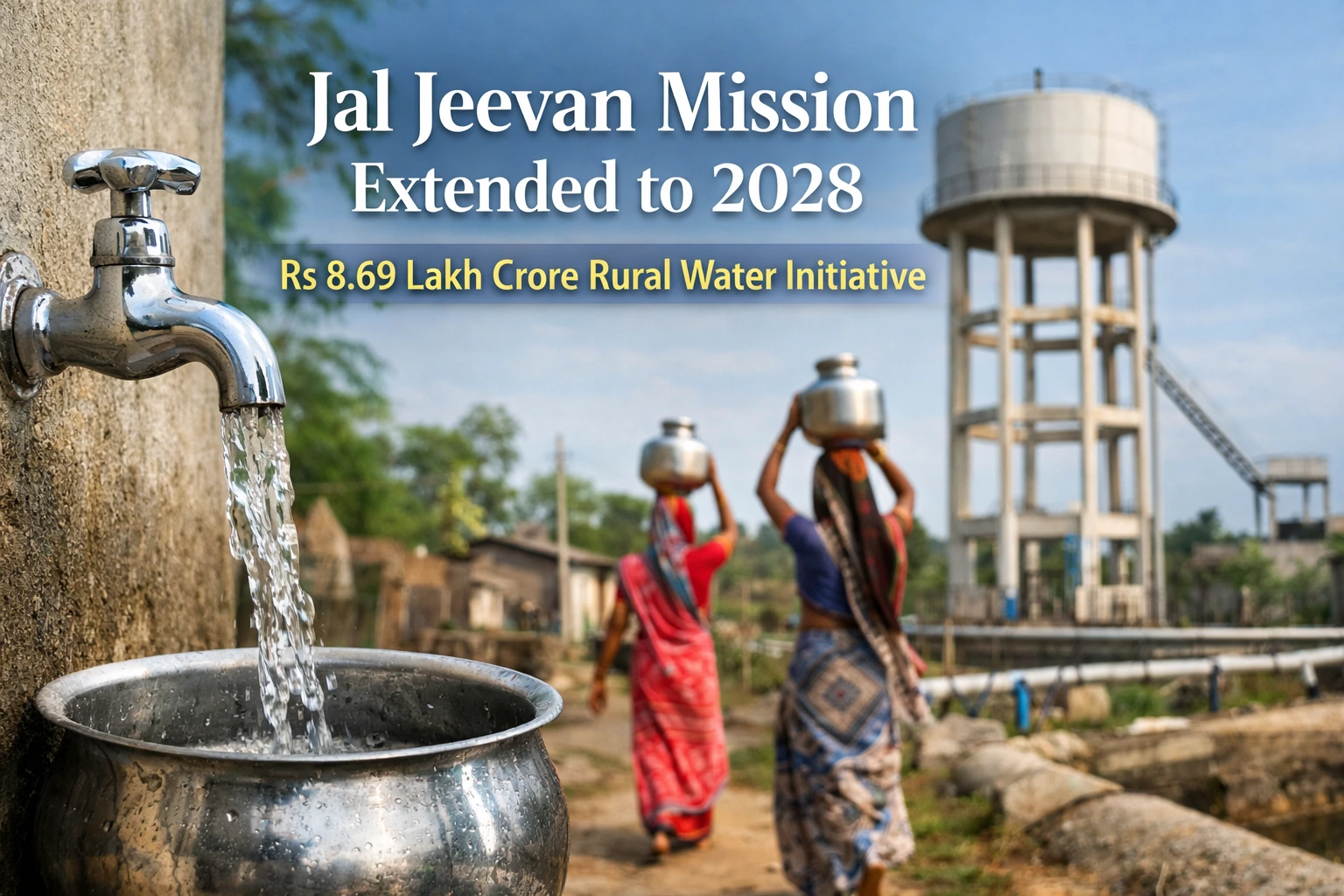
The Union Cabinet led by Prime Minister Narendra Modi has approved the extension and restructuring of the Jal Jeevan Mission (JJM) until December 2028 with an enhanced total outlay of Rs 8.69 lakh crore. The central government will contribute Rs 3.59 lakh crore, up from Rs 2.08 lakh crore approved in 2019.
The policy shift marks a transition from simply building rural water infrastructure to delivering reliable drinking water services through governance reforms, digital monitoring, and institutional strengthening. The mission aims to provide tap water connections to all 19.36 crore rural households across India.
Government data shows that rural tap water coverage has increased from 3.23 crore households in 2019 to about 15.80 crore households today, covering roughly 81.61% of rural India. The expanded programme, often referred to as JJM 2.0, will now focus on sustainability, community participation, and long term service delivery.
What Happened in Jal Jeevan Mission 2.0
The Cabinet approved the restructuring of the Jal Jeevan Mission to move beyond infrastructure construction and focus on reliable service delivery of rural drinking water. The mission will now operate with a larger financial envelope and a stronger institutional framework for water governance.
The revised programme introduces a national digital platform called “Sujalam Bharat,” which will digitally map water supply systems from the source to the household tap. Every village will receive a unique service area identification number to improve monitoring and transparency.
Local governments will play a larger role in implementation. Gram Panchayats and Village Water and Sanitation Committees will certify completion of water projects under a process called “Jal Arpan,” ensuring local accountability before declaring villages as “Har Ghar Jal.”
| Policy | Details |
| Programme | Jal Jeevan Mission 2.0 |
| Total Outlay | Rs 8.69 lakh crore |
| Central Assistance | Rs 3.59 lakh crore |
| Previous Central Share (2019) | Rs 2.08 lakh crore |
| Target Completion | December 2028 |
| Total Rural Households | 19.36 crore |
Why Did the Government Restructure Jal Jeevan Mission
The restructuring reflects a growing recognition that infrastructure alone cannot guarantee reliable water access. Many earlier water supply schemes across India suffered from poor maintenance, groundwater depletion, and weak local governance.
By shifting the programme toward service delivery, the government is attempting to ensure that water supply systems remain operational for decades. The new framework emphasizes monitoring, community ownership, and sustainable water sources.
Another major factor is rural economic development. Access to reliable drinking water directly improves health outcomes, productivity, and gender equality by reducing the time women spend collecting water from distant sources.
Bigger Context Behind Rural Water Policy in India
India faces one of the world’s largest water stress challenges. According to government estimates, several states already face groundwater depletion, while rapid urbanization and climate variability are increasing pressure on freshwater resources.
Improving rural drinking water access has therefore become both a development priority and a public health strategy. The World Health Organisation estimates that safe water access can significantly reduce waterborne diseases and child mortality rates.
The Jal Jeevan Mission also fits into India’s broader economic strategy of rural infrastructure expansion. Large scale investments in water, sanitation, and housing are intended to support long term economic growth while improving living standards in rural regions.
In global terms, India’s rural water programme is one of the largest public infrastructure projects focused on household water connectivity. The scale of investment places it alongside major infrastructure programmes seen in emerging economies across Asia.
| Indicator | 2019 | 2026 |
| Rural households with tap water | 3.23 crore | 15.80 crore |
| Coverage percentage | 17% | 81.61% |
| Additional connections added | – | 12.56 crore |
How the Programme Affects Economy, Employment, and Markets
The Jal Jeevan Mission has already generated significant economic activity in rural infrastructure sectors. According to research by the Indian Institute of Management Bangalore and the International Labour Organisation, the programme could create around 59.9 lakh direct and 2.2 crore indirect person years of employment.
The initiative also has broader economic implications. Construction of pipelines, water treatment plants, and storage systems supports industries such as cement, steel, pumps, pipes, and engineering services.
Public sector banks and infrastructure companies may benefit from increased project financing, while state governments will receive additional central funding support. Rural consumption may also improve as households gain better health outcomes and save time previously spent fetching water.
| Economic Impact Area | Estimated Impact |
| Women freed from water collection | 9 crore |
| Daily time saved globally | 5.5 crore hours |
| Potential reduction in child mortality | 30% |
| Estimated lives saved annually | 1,36,000 |
| Direct employment potential | 59.9 lakh person years |
What Happens Next in India’s Rural Water Programme
The next phase of the mission will focus on achieving 100% rural household tap connectivity by December 2028. States will sign separate implementation agreements with the central government to ensure timelines and accountability.
The government also plans to strengthen digital monitoring through the Sujalam Bharat platform, enabling real time tracking of water supply networks across villages. This could help reduce leakages, improve maintenance planning, and increase transparency.
In the long term, policymakers aim to evolve the programme into a utility based water service model that delivers reliable 24×7 rural drinking water supply. The initiative is aligned with India’s broader development vision of becoming a developed economy by 2047.
Frequently Asked Questions
What is the Jal Jeevan Mission?
The Jal Jeevan Mission is a Government of India programme launched in 2019 to provide functional household tap water connections to all rural households.
How much funding has been allocated for Jal Jeevan Mission 2.0?
The total programme outlay is Rs 8.69 lakh crore, with the central government contributing Rs 3.59 lakh crore.
How many rural households currently have tap water in India?
About 15.80 crore rural households have tap water connections, representing roughly 81.61% of rural households.
What is the target completion date for universal rural tap water coverage?
The government aims to provide tap water connections to all 19.36 crore rural households by December 2028.
Conclusion
The extension of the Jal Jeevan Mission represents one of India’s largest public infrastructure investments focused on rural welfare and public health. By shifting the programme toward long term service delivery, the government is attempting to address both water security and rural development challenges.
If implemented effectively, the expanded mission could reshape rural infrastructure, generate large scale employment, and improve health outcomes across millions of households. The coming years will determine whether the programme can achieve its ambitious goal of universal rural drinking water access while maintaining sustainability and financial discipline.

BBW News Desk is the editorial team of BigBreakingWire, a digital newsroom focused on global finance, markets, geopolitics, trade policy, and macroeconomic developments.
Our editors monitor government decisions, central bank actions, international trade movements, corporate activity, and economic indicators to deliver fast, fact-based reporting for investors, professionals, and informed readers.
The BBW News Desk operates under the editorial standards of BigBreakingWire, prioritizing accuracy, verified information, and timely updates on major global developments.








Be First to Comment