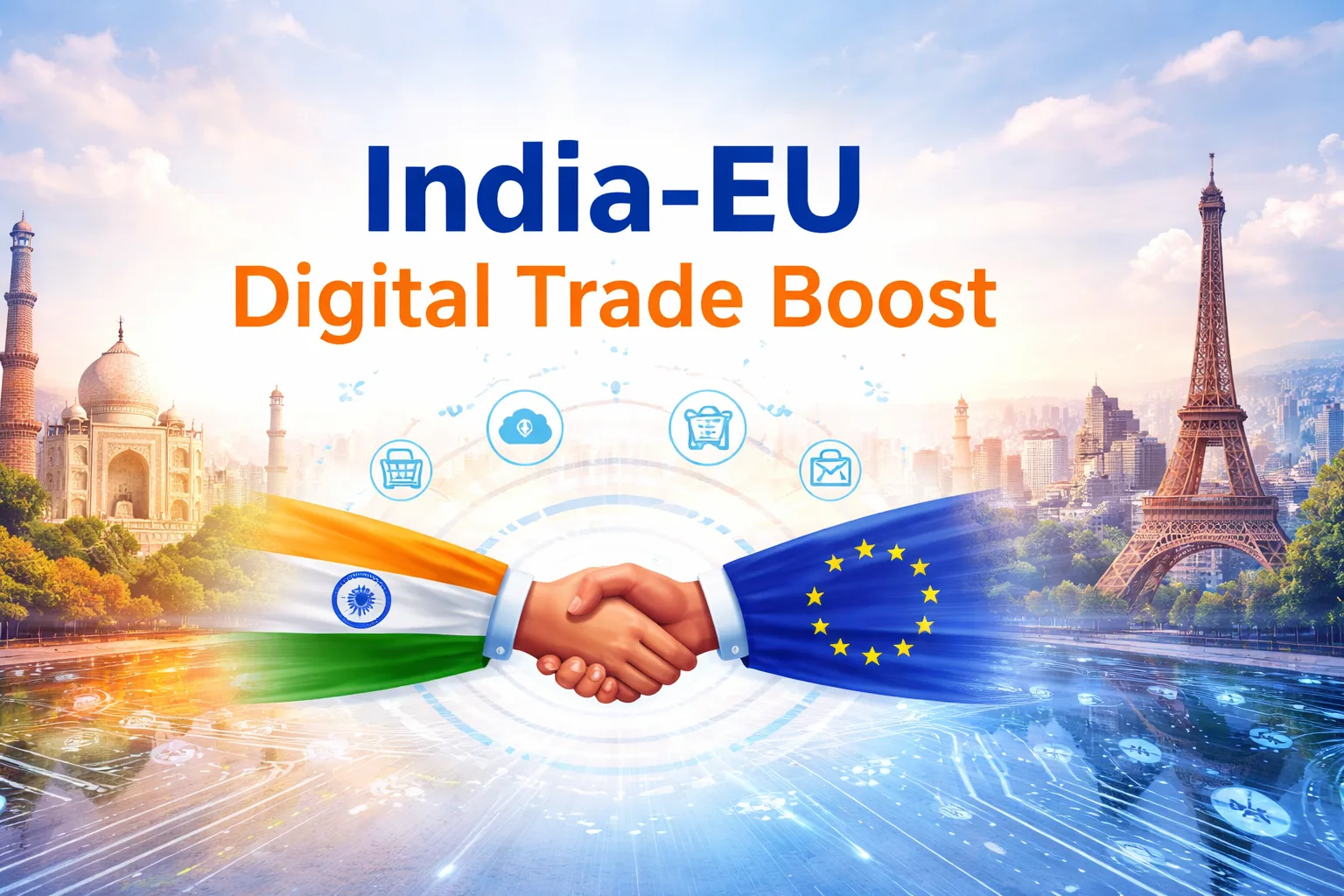
India and the European Union are advancing digital trade cooperation under the proposed India–EU Free Trade Agreement (FTA) by promoting paperless trade, e-invoicing, e-contracts and e-authentication. The goal is to create a secure and trusted digital ecosystem for cross-border transactions. This move is expected to ease trade flows, support startups and MSMEs, and strengthen goods and services trade between India and the EU.
The development directly affects exporters, digital service providers, startups, MSMEs and global businesses engaged in India–EU trade. It also signals stronger regulatory and technical cooperation in digital commerce.
What Happened in the India–EU FTA Digital Trade Framework
According to information submitted in the Rajya Sabha on February 13, 2026, the digital trade chapter of the India–EU FTA establishes a facilitative framework for secure electronic transactions. It promotes the use of paperless trade systems, electronic invoicing, digital contracts and electronic authentication to simplify cross-border trade procedures.
The agreement also includes provisions on online consumer protection, cyber security, unsolicited electronic messages and source code safeguards. These measures are designed to increase consumer confidence and business trust in digital transactions between India and the European Union.
Why the India–EU Digital Trade Push Matters for Global Commerce
Digital trade is becoming a core driver of global commerce, especially in services, e-commerce and cross-border digital payments. By enabling interoperable digital systems, India and the EU aim to reduce paperwork, transaction delays and compliance costs for businesses.
The Administrative Arrangement on Advanced Electronic Signatures and Seals, signed on January 27, 2026 during the 16th India–EU Summit, creates a cooperation framework for electronic signatures, electronic seals and Public Key Infrastructure (PKI) systems aligned with both legal systems. This improves legal recognition of digital contracts across jurisdictions.
Bigger Context Behind India–EU Digital Trade and Startup Integration
The digital trade chapter specifically recognizes the importance of integrating Indian startups and MSMEs into global digital trade growth. Regulatory and technical cooperation is expected to improve market access opportunities for digital service providers and technology firms.
This aligns with India’s broader strategy to become a global digital economy hub while expanding exports of IT services, fintech solutions and digital platforms to European markets.
Key Digital Infrastructure Supporting India–EU Digital Trade Ecosystem
India has built one of the world’s largest digital public infrastructure systems to support secure digital transactions and compliance.
Aadhaar has generated over 143+ crore digital identities, making it the largest biometric ID programme globally. Unified Payments Interface (UPI) serves 6.5 crore merchants and connects 685 banks, accounting for 81% of India’s digital payments and nearly 49% of global real-time digital payments.
DigiLocker has over 65.01 crore registered users and more than 950+ crore issued digital documents from 2412 issuers. Meanwhile, the UMANG app provides access to 2390+ government services through a single mobile platform.
Cyber Security and Trust Measures in India–EU Digital Trade Cooperation
To ensure secure digital trade, India has strengthened cyber security frameworks through agencies like CERT-In, the National Cyber Coordination Centre (NCCC), and the Indian Cybercrime Coordination Centre (I4C). These institutions monitor threats, coordinate incident response and enhance cyber resilience.
Additional mechanisms such as the National Critical Information Infrastructure Protection Centre (NCIIPC) and Cyber Swachhta Kendra focus on infrastructure protection, malware removal and cyber hygiene awareness. Regular cyber drills and a Cyber Crisis Management Plan have also been implemented across ministries and critical sectors.
How India–EU FTA Digital Trade Provisions Affect Businesses, MSMEs and Exporters
The shift toward paperless documentation and digital authentication can significantly reduce trade friction for exporters and importers. MSMEs and startups are likely to benefit the most as digital compliance systems lower entry barriers to international markets.
Service providers will gain from improved interoperability of electronic signatures and digital contracts, enabling faster deal execution and reduced legal uncertainties in cross-border trade.
Digital Skills and Workforce Development Supporting India’s Digital Trade Growth
The government is also investing in digital talent development through initiatives like IndiaAI FutureSkills and FutureSkills PRIME. The IndiaAI Mission aims to support 500 PhD fellows, 5,000 postgraduates and 8,000 undergraduates in AI-related fields, with 290 fellowships already awarded.
More than 26.2 lakh candidates have registered on the FutureSkills PRIME platform, with over 16.65 lakh enrolled in courses related to AI, Big Data, IoT, cyber security and emerging technologies. NIELIT has trained 43 lakh+ candidates through digital literacy and cyber security programmes via 56 centres and 9000+ training partners.
What Happens Next in the India–EU Free Trade Agreement Digital Trade Agenda
Going forward, deeper regulatory alignment and technical cooperation will be crucial for implementing interoperable digital trade systems between India and the EU. Successful execution could accelerate digital exports, fintech growth and cross-border e-commerce expansion.
Further negotiations and policy coordination under the India–EU FTA framework are expected to focus on secure data flows, digital trust standards and startup ecosystem integration.
Frequently Asked Questions
What is the digital trade chapter in the India–EU FTA?
It is a framework that promotes secure electronic transactions, paperless trade, e-invoicing, e-contracts and digital authentication to ease cross-border trade between India and the EU.
How does paperless trade help businesses?
Paperless trade reduces documentation delays, lowers costs, speeds up customs processes and improves efficiency for exporters, MSMEs and global companies.
Why are electronic signatures important in India–EU trade?
Advanced electronic signatures and seals ensure legal recognition of digital contracts, enabling secure and faster cross-border digital transactions.
Who benefits the most from India–EU digital trade cooperation?
Startups, MSMEs, exporters, fintech firms, and digital service providers benefit the most due to easier compliance, faster transactions and improved market access.
Conclusion
The India–EU FTA’s digital trade chapter marks a strategic shift toward secure, paperless and technology-driven global commerce. With strong digital infrastructure, cyber security frameworks and skill development initiatives, India is positioning itself as a key digital trade partner for the European Union in the coming years.

Bringing you the latest updates on finance, economies, stocks, bonds, and more. Stay informed with timely insights.
















Be First to Comment