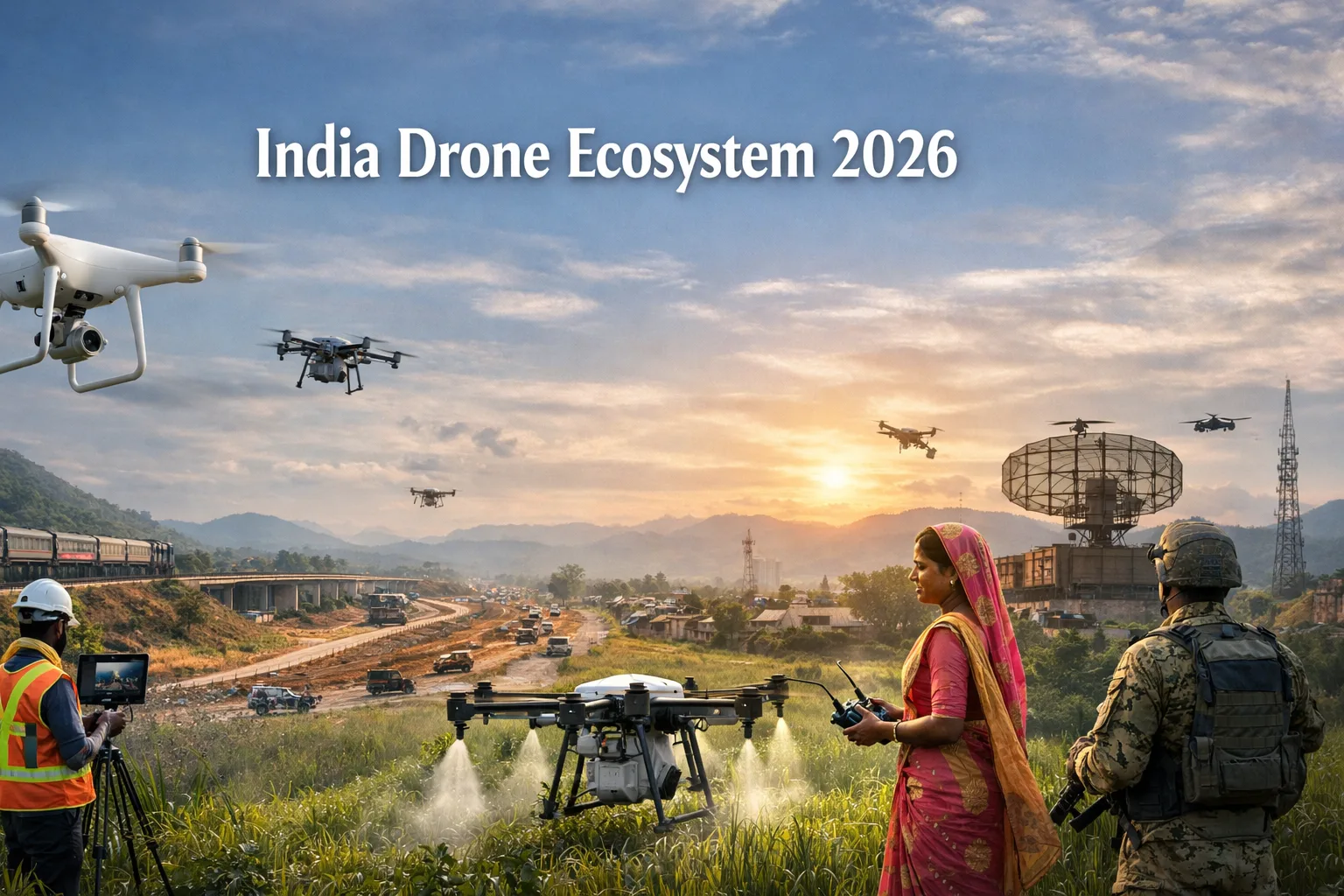
India’s drone ecosystem has rapidly evolved into a regulated and scalable sector backed by strong policy reforms and digital governance platforms. As of February 2026, over 38,500 drones are registered, nearly 39,890 certified remote pilots are active, and 244 DGCA-approved training organisations are operational.
This growth matters because drones are now integrated into agriculture, land surveys, infrastructure monitoring, disaster response, and defence operations. Government schemes like SVAMITVA and Namo Drone Didi are directly benefiting farmers, rural communities, and public agencies.
With liberalised Drone Rules, 5% GST on drones, and PLI incentives for manufacturing, India is building a future-ready drone ecosystem that supports innovation, employment, and efficient public service delivery.
What Happened in India’s Drone Ecosystem Expansion 2026
India has moved from experimental drone use to a structured ecosystem supported by regulations, training infrastructure, and digital approval systems. The Digital Sky and eGCA platforms have simplified drone registration, certification, and compliance processes.
| Key Ecosystem Metric | Data (2026) | Significance |
|---|---|---|
| Registered Drones (UIN) | 38,575+ | Shows rapid adoption across sectors |
| Certified Remote Pilots (RPC) | 39,890 | Growing skilled workforce |
| DGCA Approved Training Organisations | 244 | Strong institutional training capacity |
| States/UTs in SVAMITVA MoU | 31 | Nationwide policy implementation |
Why Did India’s Drone Ecosystem Grow Under Drone Rules and Policy Reforms
The Drone Rules 2021 and amendments in 2022 and 2023 significantly reduced regulatory complexity. Forms were cut from 25 to 5 and approvals reduced from 72 to just 4, making drone operations easier for startups, MSMEs, and service providers.
Nearly 90% of Indian airspace was declared a Green Zone for drone operations up to 400 feet. The traditional pilot licence requirement was replaced by DGCA-issued Remote Pilot Certificates, lowering entry barriers.
| Policy Reform | Key Change | Impact on Ecosystem |
|---|---|---|
| Drone Rules 2021 | Forms reduced from 25 to 5 | Faster approvals and compliance |
| Airspace Liberalisation | 90% Green Zone access | Ease of commercial drone flights |
| GST Reduction (2025) | Uniform 5% GST on drones | Lower operational and training costs |
| PLI Scheme | Rs 120 crore outlay | Boost to domestic manufacturing |
Bigger Context Behind Digital Sky Platform and Drone Manufacturing Push in India
The Digital Sky platform acts as a single-window system for drone registration, airspace mapping, and flight permissions. Regulatory services like pilot certification and type approvals are now integrated with eGCA, improving transparency and operational efficiency.
The Production Linked Incentive (PLI) scheme for drones and components is encouraging indigenous manufacturing and strengthening India’s self-reliant drone supply chain, especially among startups and MSMEs.
How Drone Adoption in India is Transforming Agriculture, Governance and Infrastructure
Drones are now widely used in flagship schemes like SVAMITVA for rural land mapping and PMFBY for crop assessment. This improves accuracy, transparency, and faster service delivery.
| Sector | Drone Application | Real Impact |
|---|---|---|
| Agriculture | Crop spraying and precision farming | Higher productivity and lower input cost |
| Land Mapping (SVAMITVA) | Drone-based village surveys | 2.76 crore property cards prepared |
| Infrastructure | Highway and railway inspections | Better monitoring and maintenance |
| Disaster Management | Live aerial surveillance | Faster rescue coordination |
| Defence | Border surveillance and intelligence | Enhanced national security response |
Impact of Namo Drone Didi and SVAMITVA Scheme on Rural Economy
The Namo Drone Didi scheme, launched in November 2023, has distributed 1,094 drones to Women Self Help Groups, including over 500 drones under the initiative. This shift from manual to precision agriculture is improving rural income and empowering women-led service models.
Under the SVAMITVA scheme, drone surveys have been completed in 3.28 lakh villages, covering about 95% of the total target of 3.44 lakh villages. Around 2.76 crore property cards have been prepared for 1.82 lakh villages across 31 states and UTs.
How India’s Drone Ecosystem Affects Startups, Employment and Drone-as-a-Service Market
The ecosystem is creating opportunities in manufacturing, analytics, training, and Drone-as-a-Service (DaaS) models. Programs like SwaYaan have conducted 857+ activities and benefited over 26,000 participants through 337 collaborations.
Innovation platforms such as Bharat Drone Mahotsav, Bharat Drone Shakti, and the National Innovation Challenge for Drone Application and Research (NIDAR) are encouraging startups and research institutions to develop autonomous and sector-specific drone solutions.
What Happens Next for India’s Drone Ecosystem Growth and Global Leadership
Going forward, India is expected to expand domestic drone manufacturing, increase pilot training capacity, and integrate drones deeper into government programs and smart governance systems. Continued budget support, GST rationalisation, and innovation incentives will further accelerate adoption.
With strong regulatory reforms, digital infrastructure, and policy backing, India is positioning itself as a global hub for unmanned aerial systems, combining technological self-reliance with inclusive economic development.
Frequently Asked Questions
1. How many drones are registered in India in 2026?
Over 38,575 drones are registered and issued Unique Identification Numbers under the Digital Sky system as of February 2026.
2. What is the GST rate on drones in India?
The GST on drones was reduced to a uniform 5% in September 2025 to promote adoption and reduce operational costs.
3. How many villages have been surveyed under SVAMITVA using drones?
Drone surveys have been completed in 3.28 lakh villages, covering about 95% of the national target.
4. What is the Namo Drone Didi scheme?
It is a government initiative providing drones to women SHGs to support precision farming, improve productivity, and create rural livelihoods.
Conclusion
India’s drone ecosystem has transformed into a policy-driven, innovation-led sector impacting agriculture, governance, infrastructure, and defence. With continued regulatory support, manufacturing incentives, and digital integration, drones will play a critical role in India’s economic modernization and smart public service delivery in the coming years.

BBW News Desk is the editorial team of BigBreakingWire, a digital newsroom focused on global finance, markets, geopolitics, trade policy, and macroeconomic developments.
Our editors monitor government decisions, central bank actions, international trade movements, corporate activity, and economic indicators to deliver fast, fact-based reporting for investors, professionals, and informed readers.
The BBW News Desk operates under the editorial standards of BigBreakingWire, prioritizing accuracy, verified information, and timely updates on major global developments.








Be First to Comment