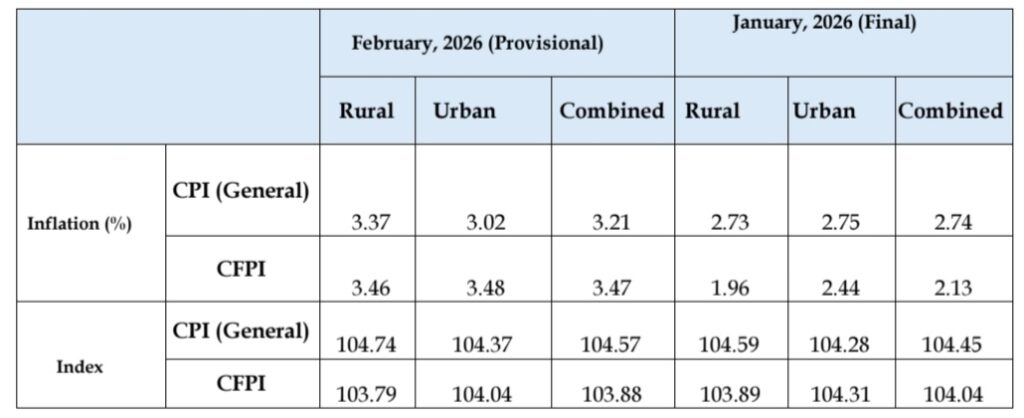
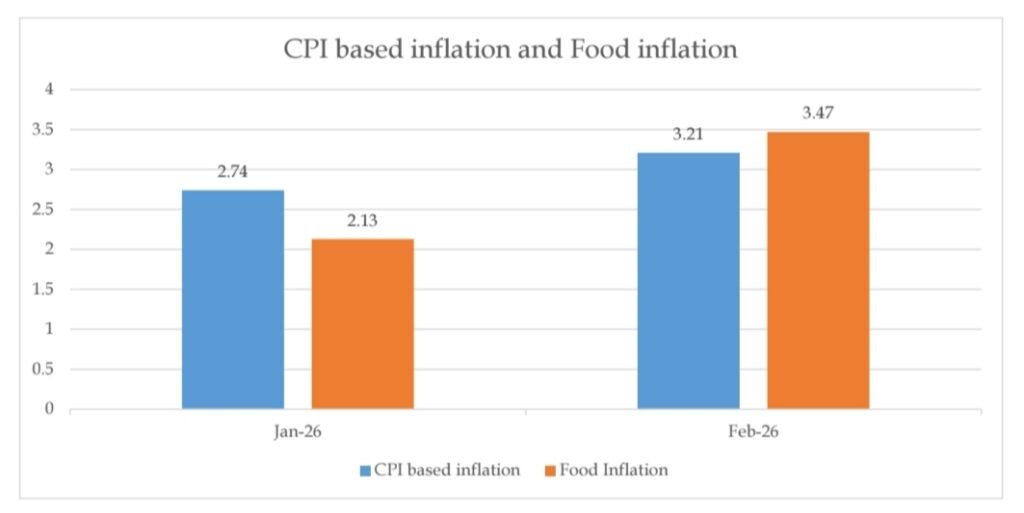
India consumer price inflation rose slightly in February 2026, reflecting a modest increase in food costs even as some vegetable prices declined sharply. Data released by the National Statistics Office showed that annual retail inflation measured by the Consumer Price Index stood at 3.21% in February, compared with 2.74% in January. The increase of about 47 basis points indicates that price pressures in the economy remain contained but are beginning to move higher.
The data shows that inflation remained well below the Reserve Bank of India medium term target of 4%. However the month to month rise suggests that food prices and certain consumer categories continue to influence overall inflation dynamics.
Food inflation rose to 3.47% in February compared with 2.13% in January. The increase reflects price changes across several food items even though some vegetables recorded a sharp decline in prices during the month. The National Statistics Office said that the price index for tomato peas and cauliflower recorded a monthly decline of more than 10% in February compared with January.
At the rural level inflation stood at 3.37% while urban inflation was slightly lower at 3.02%. Food inflation in rural areas was recorded at 3.46% while urban food inflation was marginally higher at 3.48%. The data suggests that food costs are rising broadly across both rural and urban regions.
Housing inflation remained relatively stable during the month. Housing inflation for February was reported at 2.12%. Rural housing inflation stood at 2.43% while urban housing inflation was recorded at 2.00%.
A breakdown of inflation across consumption categories shows that food and beverages inflation stood at 3.35%. Clothing and footwear recorded inflation of 2.81%. Recreation sport and culture inflation was reported at 2.21%. Education services inflation stood at 3.33% while restaurants and accommodation services recorded inflation of 2.73%.
Transport prices showed mild deflation with inflation recorded at negative 0.05%. Information and communication prices increased only marginally at 0.25%. Health related inflation was recorded at 1.90%.
One category that saw a sharp surge in prices was personal care social protection and miscellaneous goods where inflation reached 19.64%. Analysts say this category includes products whose prices tend to be influenced by global commodity movements and domestic demand.
The data also highlighted strong price increases in several specific items. Silver jewellery prices recorded extremely high inflation of 160.84% on a yearly basis. Gold diamond and platinum jewellery inflation stood at 48.16%. Coconut prices rose by 46.16% while tomato prices increased by 45.29% compared with the same period last year.
At the same time several food staples saw significant declines in prices. Garlic prices fell by 31.09% on a yearly basis. Onion prices dropped by 28.20%. Potato prices declined by 18.46% while arhar or tur prices fell by 16.00%. Litchi prices also declined by 11.52%.
State level data showed that some regions experienced higher inflation than others. Telangana recorded consumer inflation of 5.02%. Rajasthan reported inflation of 3.53%. Kerala recorded inflation of 3.50% while Andhra Pradesh reported 3.45%. West Bengal recorded inflation of 3.44%.
Economists say the moderate inflation environment provides room for policymakers to balance growth and price stability. With inflation remaining close to the lower end of the Reserve Bank of India target range, financial markets are likely to monitor upcoming data to assess whether the recent increase reflects temporary food price movements or the beginning of broader price pressures.
The National Statistics Office collects price data from more than 1400 urban markets and over 1400 villages across India. The next consumer price inflation data for March 2026 will be released on 13 April 2026.
BofA on February CPI: Inflation Rising Slowly
Bank of America says February CPI shows inflation is increasing, but the pace remains gradual. Food prices have risen, while services inflation is still relatively contained.
The West Asia conflict could push WPI higher in March due to energy costs. However, CPI impact may stay limited as the government manages fuel prices. BofA expects RBI to keep rates unchanged with a neutral stance.

BBW News Desk is the editorial team of BigBreakingWire, a digital newsroom focused on global finance, markets, geopolitics, trade policy, and macroeconomic developments.
Our editors monitor government decisions, central bank actions, international trade movements, corporate activity, and economic indicators to deliver fast, fact-based reporting for investors, professionals, and informed readers.
The BBW News Desk operates under the editorial standards of BigBreakingWire, prioritizing accuracy, verified information, and timely updates on major global developments.









Be First to Comment