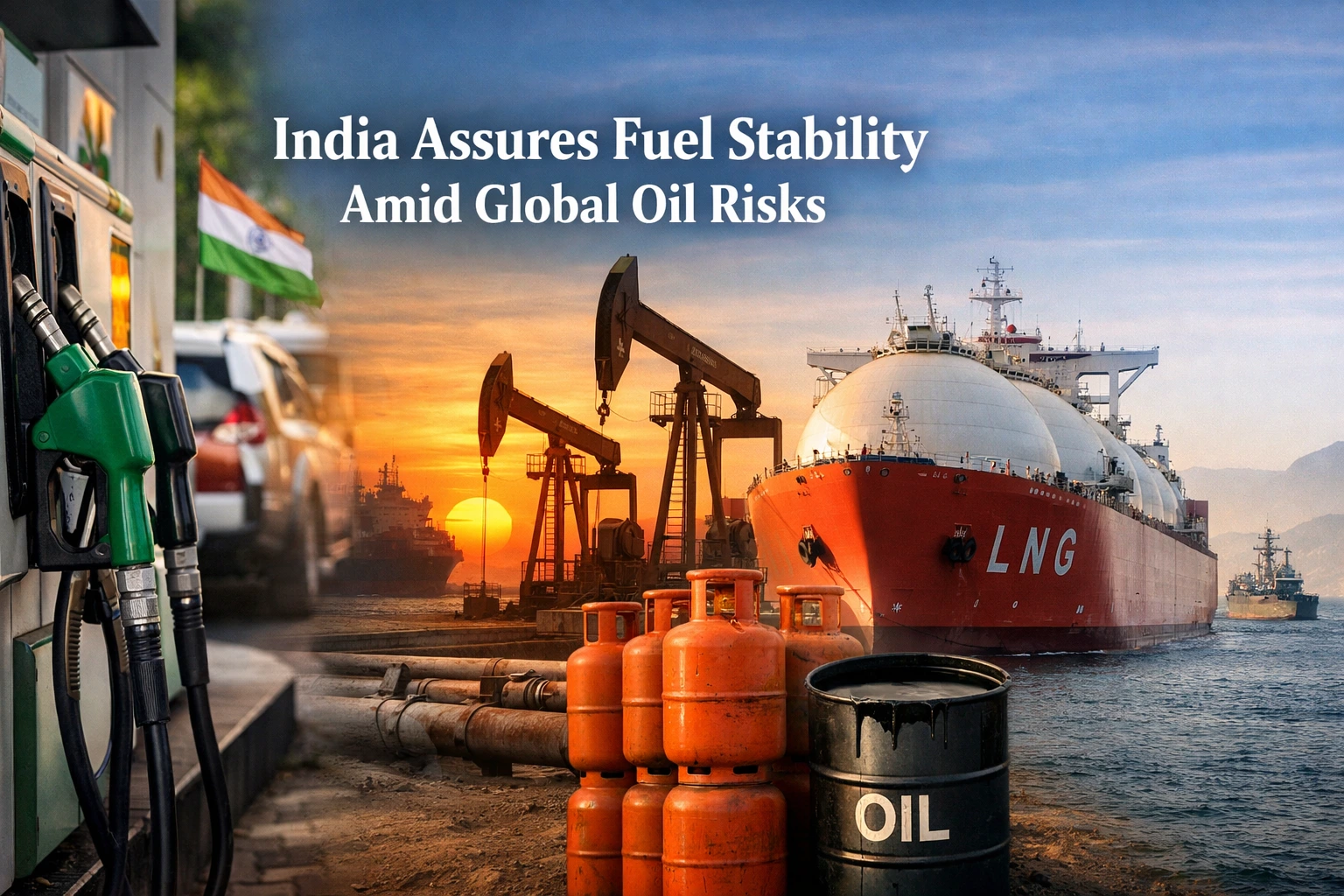
India has sufficient fuel supplies and does not plan to raise petrol or diesel prices in the near term, government sources said amid rising global energy tensions. Officials indicated that price increases are unlikely unless crude oil prices cross $130 per barrel.
India currently holds around 25 days of crude oil inventory and another 25 days of petrol and diesel stock, providing roughly eight weeks of combined energy reserves. The government also confirmed that fuel exports will continue without restrictions.
Authorities have increased LPG booking gaps to 25 days to prevent hoarding and instructed refineries to boost domestic LPG production. Officials said India has also increased crude imports from routes outside the Strait of Hormuz, strengthening energy security as geopolitical risks rise in the Middle East.
What Happened in India’s Energy Supply Strategy
Government officials confirmed that India currently has stable energy supplies across petrol, diesel, LPG, LNG, and aviation turbine fuel. Authorities stated that there is no shortage of petrol or diesel at fuel pumps across the country.
India has increased crude oil sourcing from outside the Strait of Hormuz to reduce geopolitical supply risks. The share of crude imported through alternative routes has risen from 60% to 70%, while only about 40% of imports continue to pass through the sensitive Middle East shipping corridor.
The government also confirmed that there are no plans to release crude oil from India’s strategic petroleum reserves at this stage, indicating confidence in existing inventories and supply contracts.
| Energy Indicator | Status |
| Crude Oil Inventory | 25 days |
| Petrol and Diesel Inventory | 25 days |
| Total Energy Reserve | Approximately 8 weeks |
| Crude Import Outside Strait of Hormuz | 70% |
| Crude Through Strait of Hormuz | 40% |
Officials also said India continues to import Russian crude under existing contracts, maintaining a diversified energy sourcing strategy.
Why the Government Adjusted Fuel and LPG Policies
The government’s latest measures aim to prevent supply disruptions and panic buying amid global uncertainty in oil markets. Officials noted that some LPG consumers had started booking cylinders every 15 days instead of the earlier 55-day cycle, raising concerns about hoarding.
To address this, the LPG booking interval has been increased from 21 days to 25 days. Refineries have also been instructed to prioritize domestic LPG supply over commercial connections to ensure household availability.
Authorities are simultaneously working to expand LPG import partnerships. Energy exporters such as Algeria, Australia, Canada, and Norway have reportedly approached India to supply LPG.
| Policy Measure | Government Action |
| LPG Booking Period | Increased from 21 days to 25 days |
| LPG Production | Refineries asked to increase output |
| Supply Priority | Domestic consumers prioritized |
| New LPG Partners | Algeria, Australia, Canada, Norway |
Officials also confirmed that LNG supply for industrial use may be diverted to domestic consumers if needed to maintain uninterrupted household energy availability.
Bigger Context Behind India’s Energy Security Strategy
India’s energy security planning has gained urgency due to rising geopolitical tensions in the Middle East, particularly near the Strait of Hormuz, one of the world’s most critical oil shipping routes. Around 20% of global oil supply flows through this narrow corridor.
For energy-importing economies like India, disruptions in this region can quickly translate into higher fuel costs, inflation, and pressure on currency markets.
India imports more than 85% of its crude oil requirements. Over the past three years, the country has diversified sourcing by increasing purchases from Russia and expanding supply agreements with producers in Africa and the Americas.
This diversification strategy has helped reduce exposure to geopolitical chokepoints and stabilize domestic fuel pricing despite global market volatility.
| Energy Dependency Indicator | India |
| Crude Oil Import Dependency | Over 85% |
| Global Oil Passing Through Strait of Hormuz | About 20% |
| India’s Alternative Supply Share | 70% |
How Energy Policy Stability Affects Markets and Economy
Stable fuel pricing plays a critical role in controlling inflation in India, where petrol and diesel costs influence transportation, logistics, and food prices across the economy.
If crude oil prices remain around $100 per barrel as officials expect, retail fuel prices are likely to remain stable. However, a sustained spike above $130 per barrel could pressure the government to reconsider pricing policies.
Energy supply stability also supports aviation, logistics, manufacturing, and fertilizer sectors that rely heavily on petroleum products and LNG.
For investors, policy signals around fuel price stability can influence stocks in sectors such as oil marketing companies, airlines, transport companies, and petrochemical producers.
What Happens Next in India’s Energy Market
India is expected to continue expanding crude sourcing from diversified global suppliers while strengthening domestic refining capacity. The government is also likely to monitor Middle East geopolitical developments closely before making major policy changes.
If global oil markets remain volatile, India may increase strategic reserves or expand long term supply contracts to protect domestic energy stability.
For now, officials say India remains in a comfortable position with adequate fuel inventories, diversified import routes, and stable supply partnerships.
Frequently Asked Questions
Will petrol and diesel prices increase in India?
Government sources say prices are unlikely to increase unless global crude oil prices rise above $130 per barrel.
Does India have enough fuel supply?
Yes. India currently has about 25 days of crude oil inventory and another 25 days of petrol and diesel stock, totaling roughly eight weeks of reserves.
Why was the LPG booking period increased?
The booking interval was raised from 21 days to 25 days to prevent hoarding and black marketing of LPG cylinders.
Is India restricting fuel exports?
No. Officials confirmed that there are currently no plans to impose restrictions on fuel exports.
Conclusion
India’s latest energy policy signals reflect a proactive strategy to safeguard fuel supplies amid global geopolitical uncertainty. By diversifying crude sourcing, strengthening inventories, and prioritizing domestic consumption, the government aims to shield the economy from external supply shocks.
While global oil prices remain a key risk factor, India’s current stock levels and supply diversification provide a buffer against immediate disruptions. The government’s ability to manage energy imports and domestic supply will remain crucial for inflation control, market stability, and economic growth in the months ahead.

BBW News Desk is the editorial team of BigBreakingWire, a digital newsroom focused on global finance, markets, geopolitics, trade policy, and macroeconomic developments.
Our editors monitor government decisions, central bank actions, international trade movements, corporate activity, and economic indicators to deliver fast, fact-based reporting for investors, professionals, and informed readers.
The BBW News Desk operates under the editorial standards of BigBreakingWire, prioritizing accuracy, verified information, and timely updates on major global developments.














Be First to Comment