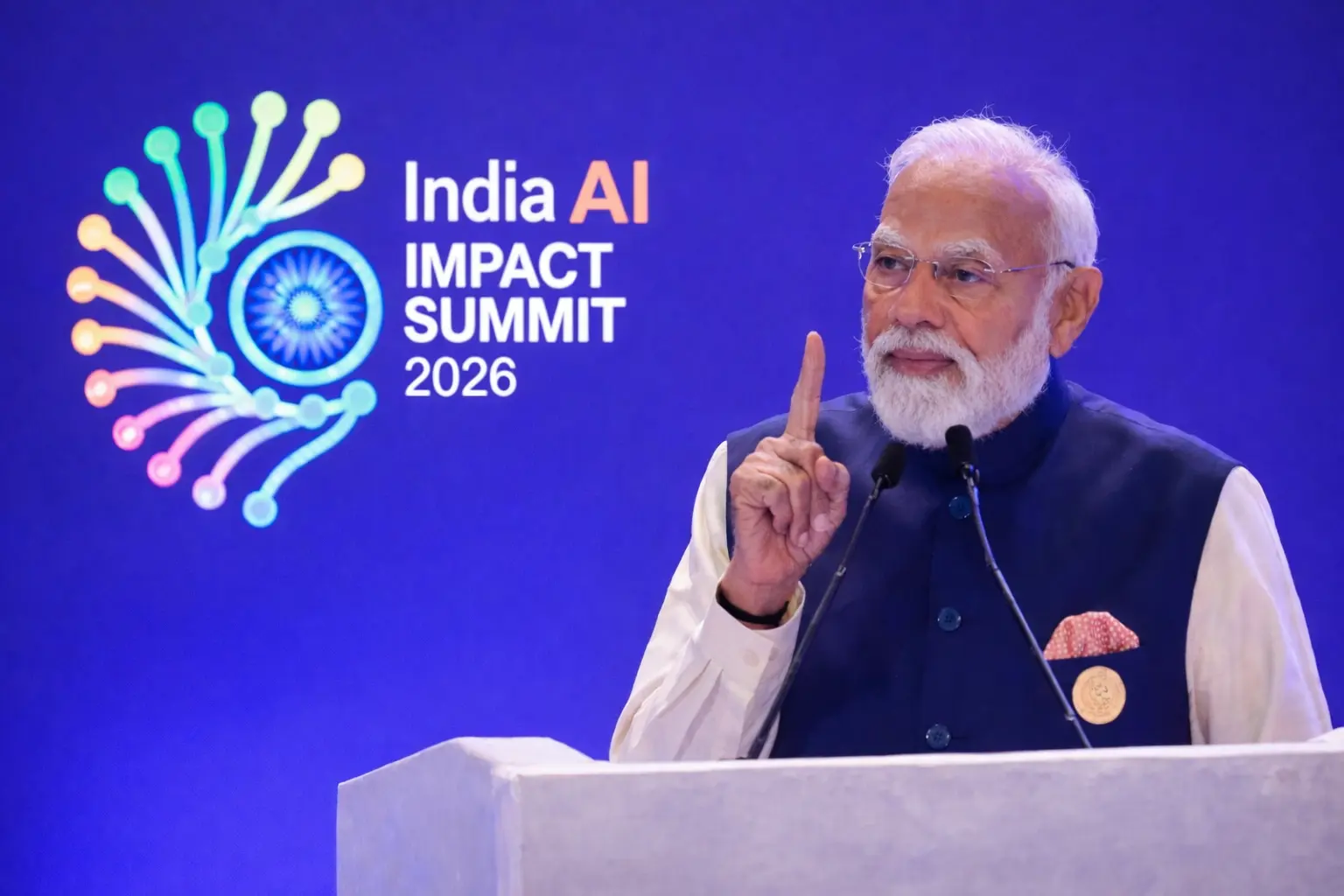
India hosted the India AI Impact Summit 2026 in New Delhi from February 16 to 20, bringing together global technology leaders, policymakers, and researchers to discuss the future of artificial intelligence. During the summit, Prime Minister Narendra Modi introduced the M.A.N.A.V. framework, a human-centric roadmap for AI governance and innovation. The vision focuses on ethical systems, accountable governance, national sovereignty, inclusive access, and trusted AI. This matters because India, with over one-sixth of the global population and a rapidly growing digital economy, is emerging as both a major AI developer and large-scale adopter of advanced technologies.
What Happened at the India AI Impact Summit 2026 in New Delhi
The India AI Impact Summit 2026 was held at Bharat Mandapam in New Delhi, drawing participation from global policymakers, AI companies, academic experts, and innovation leaders. The event focused on shaping responsible AI development and global governance standards.
In his inaugural address on February 19, Prime Minister Narendra Modi presented the M.A.N.A.V. framework, which stands for Moral and Ethical Systems, Accountable Governance, National Sovereignty, Accessible and Inclusive AI, and Valid and Legitimate Systems. The framework positions AI not as an independent technological force, but as a tool aligned with human dignity, ethics, and societal values.
| Event | Date | Location | Key Focus |
|---|---|---|---|
| India AI Impact Summit 2026 | Feb 16–20, 2026 | New Delhi (Bharat Mandapam) | Human-centric AI governance and innovation |
Why Did India Launch the M.A.N.A.V. AI Vision Framework
India’s AI strategy reflects its unique position as a fast-growing digital economy with the world’s largest youth population and one of the biggest technology talent pools. With rising global concerns about AI ethics, data control, and deepfakes, India is attempting to balance innovation with regulation.
The government aims to create a structured AI ecosystem supported by policy, infrastructure, and education reforms. The IndiaAI Mission, approved with an outlay of over Rs 10,300 crore, is a central pillar supporting compute infrastructure, datasets, skilling, and AI research.
| MANAV Pillar | Core Focus | Policy Direction |
|---|---|---|
| Moral and Ethical Systems | Fairness and transparency | Ethical AI education and oversight |
| Accountable Governance | Regulation and institutional oversight | IndiaAI Mission and AI Governance Guidelines |
| National Sovereignty | Data and compute independence | Semiconductor and DPI initiatives |
| Accessible and Inclusive AI | Broad access to AI tools | Compute portals and AI datasets |
| Valid and Legitimate Systems | Trust, safety, and legality | AI safety and deepfake regulation |
Bigger Context Behind India’s Human-Centric AI Strategy
Globally, governments are tightening AI regulations due to risks related to bias, misinformation, and job disruption. India’s approach focuses on inclusive growth rather than restrictive regulation alone.
The National Education Policy 2020 has already integrated AI literacy and computational thinking into academic curricula. This early exposure aims to create a future-ready workforce capable of handling ethical and technical challenges in AI deployment.
At the summit, India also secured a Guinness World Records title after receiving 250,946 pledges within 24 hours for an AI responsibility campaign. This signals a public shift toward ethical AI awareness at scale.
How IndiaAI Mission and Digital Infrastructure Support the MANAV Vision
The IndiaAI Mission plays a major role in operationalizing the MANAV framework by strengthening compute capacity, governance systems, and innovation funding. The mission supports shared access to GPUs, TPUs, datasets, and research tools for startups and institutions.
| Initiative | Function | Impact on AI Ecosystem |
|---|---|---|
| IndiaAI Compute Portal | Shared GPU and TPU access | Lowers entry barriers for startups and researchers |
| IndiaAI Kosh | Datasets and AI models repository | Boosts innovation across sectors |
| National Supercomputing Mission | High-performance computing infrastructure | Strengthens domestic AI research capability |
| MeghRaj GI Cloud | Government cloud platform | Scalable AI deployment in public services |
These platforms are designed to democratize AI development in sectors like healthcare, agriculture, education, and governance, ensuring affordability and large-scale adoption.
How the MANAV AI Framework Affects Global Tech Policy, Markets, and Society
The MANAV vision signals that India wants to be a rule-setter in global AI governance rather than just a technology consumer. By focusing on ethical AI, accountable governance, and sovereign infrastructure, India is aligning its AI growth with economic security and digital resilience.
The emphasis on trusted and lawful AI also addresses rising concerns about deepfakes and synthetic media. The Information Technology (Intermediary Guidelines and Digital Media Ethics Code) Amendment Rules, 2026 now formally regulate synthetically generated content, strengthening digital accountability.
For global tech firms, this means higher compliance standards when operating in India’s AI ecosystem. For startups and investors, it creates a structured and policy-backed innovation environment with long-term regulatory clarity.
What Happens Next for India’s AI Strategy After the 2026 AI Impact Summit
Following the summit, India is expected to accelerate investments in semiconductor manufacturing, sovereign datasets, and indigenous AI model development. The government is also likely to expand AI skilling programs and public infrastructure support.
With rapid growth in AI adoption and increasing global collaboration, India’s next phase will focus on scaling innovation while maintaining ethical oversight and data governance standards.
Frequently Asked Questions (FAQs)
What is the India AI Impact Summit 2026?
It is a global AI policy and technology summit held in New Delhi from February 16 to 20, 2026, focused on responsible and human-centric artificial intelligence.
What is the M.A.N.A.V. AI framework?
MANAV stands for Moral and Ethical Systems, Accountable Governance, National Sovereignty, Accessible and Inclusive AI, and Valid and Legitimate Systems.
How much funding has been allocated to the IndiaAI Mission?
The IndiaAI Mission has an approved outlay of more than Rs 10,300 crore to strengthen compute, data, skilling, and AI innovation infrastructure.
Why is India’s AI policy important globally?
India represents a large technology market with massive data scale, talent, and digital infrastructure, making it a key player in shaping global AI governance standards.
Conclusion
The India AI Impact Summit 2026 marks a strategic shift in how India approaches artificial intelligence. Through the MANAV vision, the country is aligning technological growth with ethics, governance, and inclusivity. As AI becomes central to economic and geopolitical competitiveness, India’s human-centric model could play a defining role in shaping the global AI future.

BBW News Desk is the editorial team of BigBreakingWire, a digital newsroom focused on global finance, markets, geopolitics, trade policy, and macroeconomic developments.
Our editors monitor government decisions, central bank actions, international trade movements, corporate activity, and economic indicators to deliver fast, fact-based reporting for investors, professionals, and informed readers.
The BBW News Desk operates under the editorial standards of BigBreakingWire, prioritizing accuracy, verified information, and timely updates on major global developments.









Be First to Comment