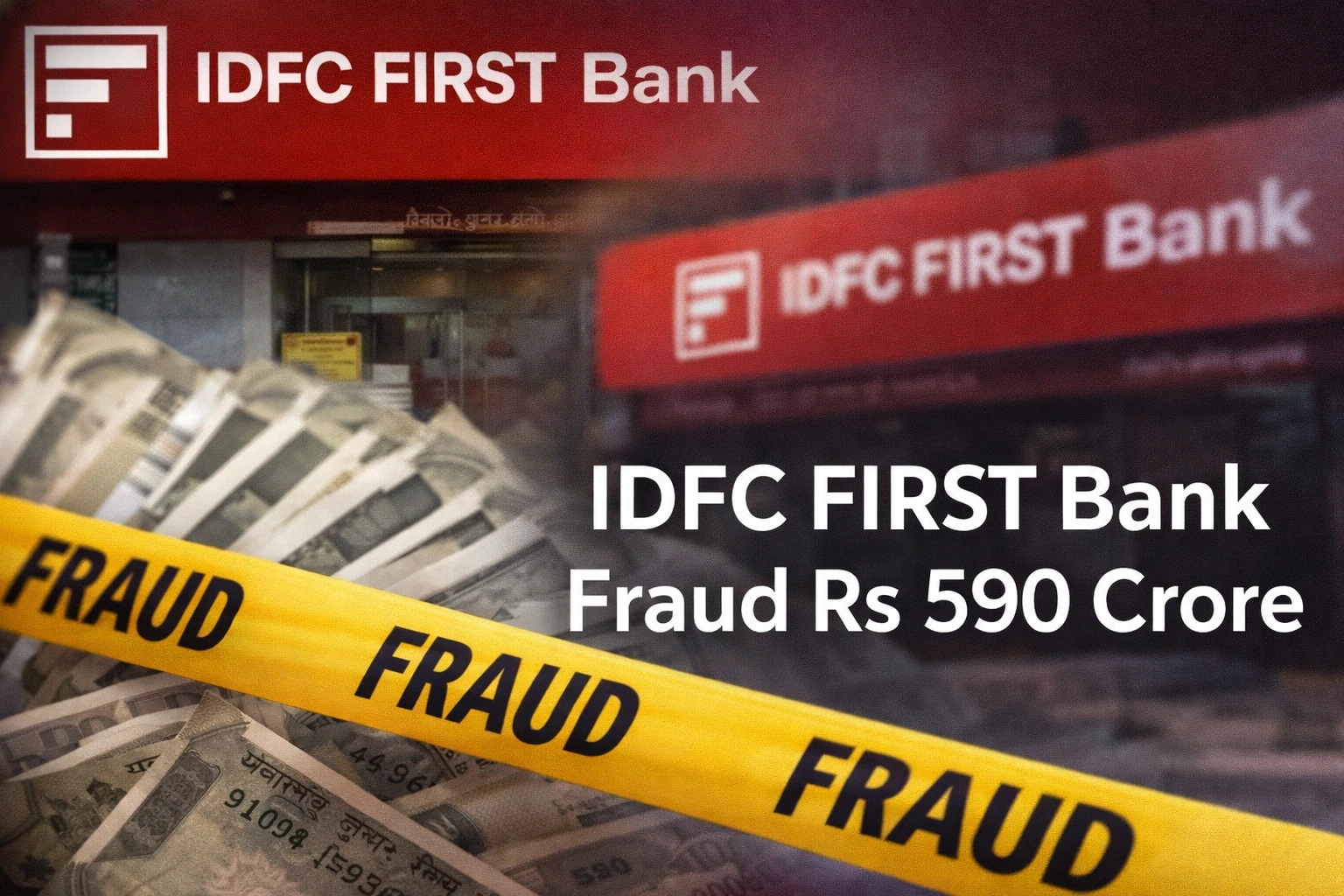
IDFC FIRST Bank has disclosed a potential fraud involving government-linked accounts at its Chandigarh branch, with approximately Rs 590 crore currently under reconciliation. The disclosure was made on February 21, 2026, under SEBI Listing Regulations after discrepancies were found in balances linked to certain Haryana government departments. Four officials have been suspended, regulators and police have been informed, and a forensic audit has been initiated. The bank stated the issue is confined to a specific set of government-linked accounts and does not impact other customers.
What Happened in the IDFC FIRST Bank Fraud Disclosure
IDFC FIRST Bank identified unauthorized and potentially fraudulent activities involving a group of accounts connected to certain Haryana government entities. The discrepancies were first noticed when a department requested closure of its account and transfer of funds to another bank, during which the reported balances did not match internal records.
Further engagement with other Haryana government-linked accounts from February 18, 2026 revealed additional mismatches between account balances and figures mentioned by the concerned entities. Based on a preliminary internal review, the aggregate amount under reconciliation across these accounts is about Rs 590 crore, though the final financial impact remains subject to validation, recoveries, and legal outcomes.
| Key Fact | Details |
| Bank | IDFC FIRST Bank |
| Estimated Amount | Rs 590 crore under reconciliation |
| Branch Involved | Chandigarh Branch |
| Date of Disclosure | February 21, 2026 |
| Accounts Involved | Specific Haryana Government-linked accounts |
| Immediate Actions | Suspensions, forensic audit, police complaint |
Why Did the Fraud Detection Happen
The issue surfaced during a reconciliation exercise triggered by an official request from a Haryana government department to close accounts and transfer funds. Reconciliation processes often expose irregularities when reported balances differ from actual ledger positions, especially in high-value institutional accounts.
Banking systems handling government funds involve layered approvals, audits, and periodic balance validations. Any discrepancy in such accounts raises compliance concerns under SEBI Listing Obligations and Disclosure Requirements and internal risk management frameworks.
Preliminary findings suggest the involvement of certain employees and possible external counterparties, pointing toward internal control lapses rather than a widespread system-level failure across the bank’s operations.
Bigger Context Behind Banking Fraud Risks in Economy and Geopolitics
Fraud in government-linked banking accounts carries broader economic implications because these funds are tied to public expenditure, administrative payments, and state-level fiscal operations. Disruptions or discrepancies in such accounts can affect financial governance and public fund management credibility.
India’s banking sector has tightened fraud detection norms over the past decade following multiple high-value fraud cases, with stronger RBI supervision, real-time monitoring, and mandatory disclosures under SEBI regulations. Early disclosure in such cases reflects a regulatory shift toward transparency and investor protection.
Globally, governance risks in financial institutions are closely monitored by institutional investors and rating agencies, especially in emerging markets like India where banking stability plays a key role in capital inflows and macroeconomic confidence.
How the Fraud Affects Markets, Companies, Investors, and Economy
From a market perspective, governance-related disclosures can create short-term sentiment pressure on banking stocks, even when the incident is operationally contained. Investors typically assess provisioning risk, recoverability, and internal control strength before pricing long-term impact.
The bank has clarified that the matter is restricted to a specific set of Haryana government-linked accounts and does not extend to retail or other customer accounts, which helps limit systemic risk perception. Recovery mechanisms such as lien marking on beneficiary accounts and legal action could reduce the net financial loss.
| Impact Area | Expected Effect |
| Stock Market Sentiment | Short-term volatility due to governance concerns |
| Investors | Focus on provisioning and recovery prospects |
| Banking Governance | Stricter internal audit and compliance checks |
| Public Sector Fund Management | Higher scrutiny on reconciliation and controls |
The suspension of four suspected officials, notification to statutory auditors, and initiation of an independent forensic audit indicate a containment-focused response, which is generally viewed positively in governance assessments.
What Happens Next in the IDFC FIRST Bank Investigation
The bank has informed its regulator, filed a complaint with police authorities, and is appointing an external agency to conduct a forensic audit. The statutory auditors and board committees have also reviewed the matter, signaling elevated oversight.
The final financial impact will depend on claim validation, recovery from beneficiary accounts, legal proceedings, and liability determination of involved entities. If recoveries are successful, the net balance sheet effect may be significantly lower than the headline reconciliation amount of Rs 590 crore.
| Next Step | Likely Outcome |
| Forensic Audit | Detailed tracing of transactions and accountability |
| Legal Proceedings | Criminal and civil action against responsible parties |
| Regulatory Review | Compliance evaluation under SEBI and banking norms |
| Recovery Efforts | Potential reduction in final financial impact |
Frequently Asked Questions
What is the fraud amount disclosed by IDFC FIRST Bank?
The bank stated that around Rs 590 crore is currently under reconciliation in identified government-linked accounts.
Which accounts are involved in the fraud case?
The issue is confined to a specific group of accounts linked to certain Haryana government departments at the Chandigarh branch.
Has the bank taken regulatory and legal action?
Yes, the bank has informed regulators, filed a police complaint, and initiated a forensic audit while cooperating with investigating agencies.
Does this fraud impact other bank customers?
No, the bank clarified that the matter does not extend to other customers and is limited to specific government-linked accounts.
Conclusion
The Rs 590 crore reconciliation-related fraud disclosure highlights the increasing regulatory scrutiny and governance expectations in India’s banking sector. While the issue appears contained to a defined set of government-linked accounts, the forensic audit, recovery actions, and legal proceedings will determine the final financial impact. For investors and policymakers, the case reinforces the importance of strong internal controls, transparent disclosures, and robust audit systems in maintaining financial stability and institutional trust.
Update: Haryana Removes IDFC First Bank and AU Small Finance Bank from Government Banking Panel
In an official circular issued on Sunday, Feb 22, the Haryana finance department ordered the immediate removal of IDFC First Bank and AU Small Finance Bank from its list of approved banks. This decision follows the disclosure of a Rs 590 crore fraud linked to Haryana government accounts in IDFC First Bank. The government has directed all departments to stop using these banks for any deposits, transactions, or investments, and to transfer balances and close existing accounts at the earliest. The circular has been sent to all state departments and banks operating in Haryana.

BBW News Desk is the editorial team of BigBreakingWire, a digital newsroom focused on global finance, markets, geopolitics, trade policy, and macroeconomic developments.
Our editors monitor government decisions, central bank actions, international trade movements, corporate activity, and economic indicators to deliver fast, fact-based reporting for investors, professionals, and informed readers.
The BBW News Desk operates under the editorial standards of BigBreakingWire, prioritizing accuracy, verified information, and timely updates on major global developments.









Be First to Comment