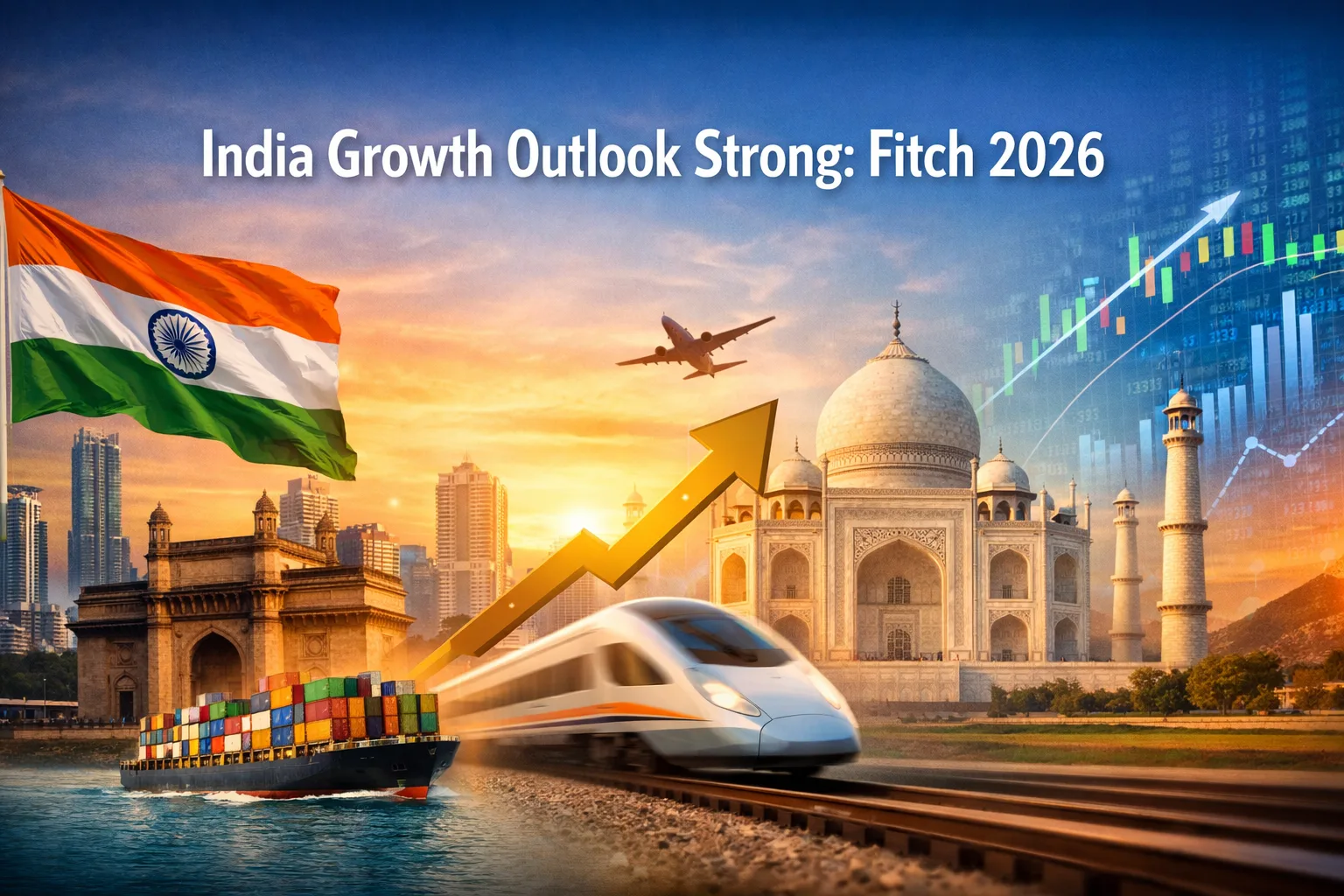
Fitch Ratings has said that India and several Southeast Asian economies maintain strong external financial buffers and solid medium-term growth prospects despite weaker governance metrics and limited fiscal flexibility. The agency expects global growth to slow in 2026, but India is still projected to grow faster than most BBB-rated peers.
The report highlights India (BBB-/Stable), Indonesia (BBB/Stable), Malaysia (BBB+/Stable), and the Philippines (BBB/Stable) as relatively resilient, with strong foreign-exchange reserves and structural growth advantages. However, low government revenue ratios and declining fiscal room to handle shocks remain key credit challenges.
India stands out with a projected 6.4% GDP growth in 2026, significantly above the BBB median of 2.4%, reinforcing its position as a high-growth economy among emerging markets.
What Happened in Fitch Ratings’ Assessment of India and Asian Sovereign Credit Profiles
Fitch Ratings released a comparative sovereign outlook covering India, Indonesia, Malaysia, the Philippines, and Thailand, focusing on growth, fiscal strength, governance, and external finances. The agency noted that all five economies have stronger external buffers than many similarly rated countries in other regions.
India, Indonesia, Malaysia, and the Philippines retain Stable Outlooks, while Thailand holds a Negative Outlook due to weaker growth prospects and fiscal consolidation risks. The ratings range from BBB- for India to BBB+ for Malaysia and Thailand.
Why Fitch Ratings Expects Strong Growth for India in 2026
Fitch forecasts India’s GDP growth at 6.4% in 2026, the highest among the five sovereigns assessed. This compares with 5.7% for the Philippines, 4.8% for Indonesia, 4.0% for Malaysia, and 1.9% for Thailand.
The agency noted that even with slower global growth in 2026, economic activity in these Asian economies should remain materially stronger than the BBB-rated global median of 2.4%. For India, sustained high growth is expected to gradually improve structural indicators such as GDP per capita and share in global GDP.
Bigger Context Behind India’s Strong External Buffers and Trade Position
Fitch emphasized that external finance buffers are generally strong across the region. Foreign-exchange reserve coverage exceeds the BBB median for most sovereigns, including India, which also holds a net external creditor position alongside Thailand and Malaysia.
These strong external balances provide resilience against global financial shocks and currency volatility. The agency also noted that India and its regional peers are well-positioned to benefit from structural shifts in global trade patterns and supply chain diversification.
Key Fiscal and Governance Risks Highlighted in Fitch’s India Credit Outlook
Despite strong growth and external strength, Fitch flagged weaker governance and public finance metrics compared with global peers. Revenue ratios across these economies remain below the BBB median of 25.8% of GDP, limiting fiscal flexibility.
The report also noted that fiscal space to respond to economic shocks has declined over the past decade. This trend is relevant for India as well, where strong growth has not fully translated into higher government revenue ratios.
Political and governance challenges were also highlighted across the region, although Malaysia showed improvement due to greater political stability. Public discontent and spending pressures in some countries could lead to higher fiscal burdens over time.
How Fitch’s 2026 Growth Outlook Affects India’s Economy and Investors
For investors, Fitch’s projection reinforces India’s status as a high-growth emerging market with relatively stable external finances. Strong growth above 6% can support corporate earnings, infrastructure investment, and long-term capital inflows.
However, the agency’s warning on weaker fiscal metrics and low revenue ratios suggests that government spending capacity during downturns may be more limited than in higher-rated economies.
India’s stronger external creditor position and large foreign-exchange reserves also reduce risks from global capital outflows and currency shocks, which is a key positive factor for sovereign stability.
What Happens Next for India and Asian Sovereign Ratings According to Fitch
Fitch indicated that Thailand faces greater downgrade pressure if fiscal consolidation weakens and debt stabilisation is delayed. In contrast, India and most regional peers maintain Stable Outlooks, reflecting balanced risk profiles.
Going forward, sustained high growth, improved revenue collection, and fiscal discipline will be critical factors influencing India’s long-term credit trajectory. Structural economic expansion could gradually strengthen its sovereign metrics over time.
Frequently Asked Questions
What is Fitch’s GDP growth forecast for India in 2026?
Fitch forecasts India’s GDP growth at 6.4% in 2026, significantly above the BBB-rated global median of 2.4%.
Why does Fitch say India has strong external buffers?
India has high foreign-exchange reserves and a net external creditor position, which helps protect the economy from global financial shocks.
What are the main risks Fitch highlighted for India?
The key risks include low government revenue ratios, limited fiscal flexibility, and weaker governance metrics compared to global peers.
How does India compare with other BBB-rated economies?
India’s growth outlook is materially stronger than most BBB-rated peers, while its external finances are also relatively robust.
Conclusion
Fitch’s latest assessment underscores India’s position as a high-growth economy with strong external buffers despite fiscal and governance constraints. While slower global growth in 2026 may temper activity, India’s projected 6.4% expansion and resilient external finances keep its sovereign outlook stable, provided fiscal discipline and revenue improvements continue over the medium term.

BBW News Desk is the editorial team of BigBreakingWire, a digital newsroom focused on global finance, markets, geopolitics, trade policy, and macroeconomic developments.
Our editors monitor government decisions, central bank actions, international trade movements, corporate activity, and economic indicators to deliver fast, fact-based reporting for investors, professionals, and informed readers.
The BBW News Desk operates under the editorial standards of BigBreakingWire, prioritizing accuracy, verified information, and timely updates on major global developments.




























Be First to Comment