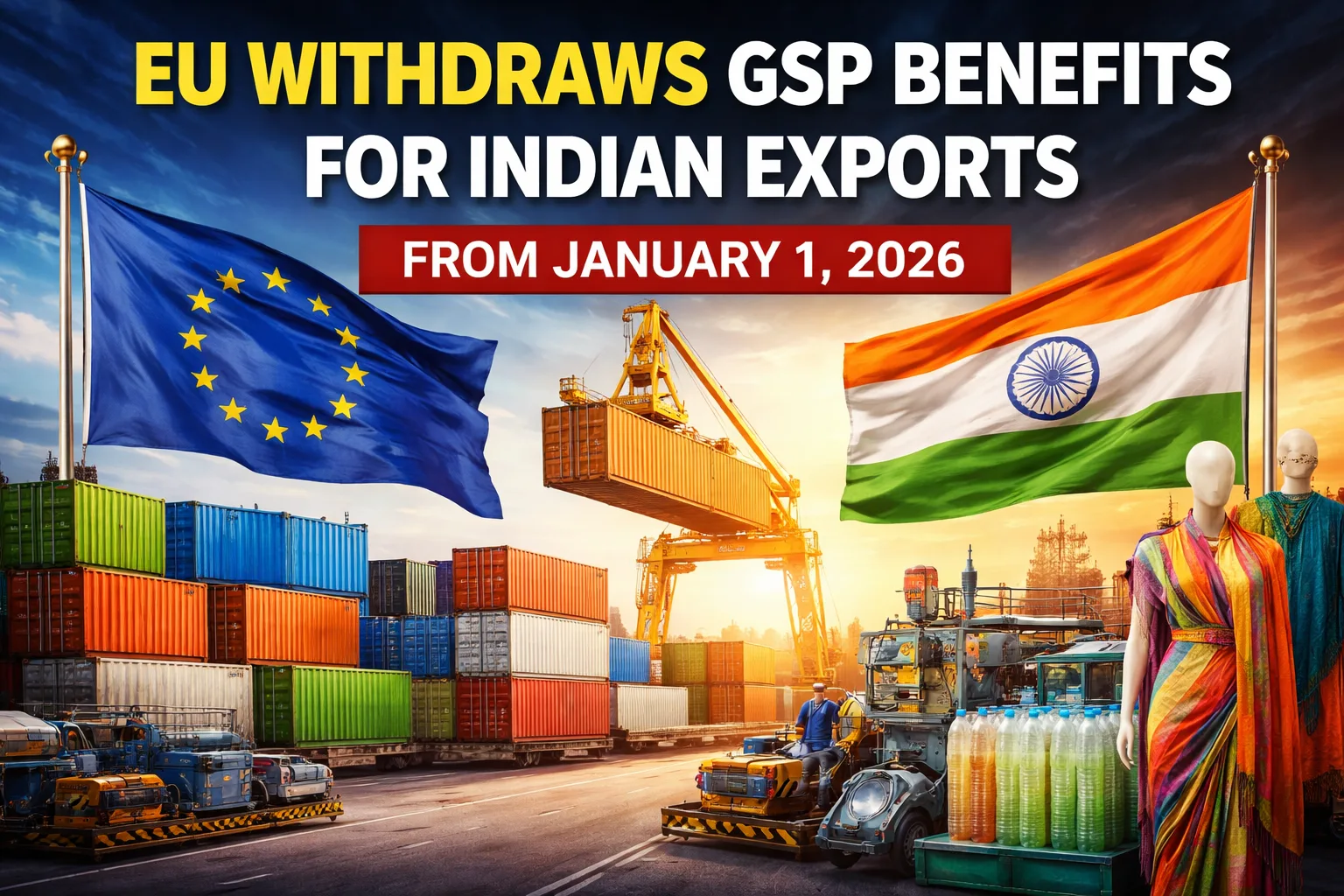
The European Union has withdrawn tariff concessions for several major Indian export sectors under its Generalised Scheme of Preferences GSP. The move will take effect from January 1 2026 and will significantly raise import duties on nearly 87% of India’s exports to the 27 nation European bloc.
The decision comes at a challenging time for exporters as global trade demand remains weak and cost pressures continue to rise. Key sectors impacted include textiles plastics chemicals metals and machinery which together form a large share of India’s shipments to Europe.
Why Has the EU Withdrawn GSP Benefits for India
The withdrawal follows a regulation adopted by the European Commission on September 25 2025 and later notified in the Official Journal of the European Union. The action is taken under the EU’s GSP graduation rules which require tariff benefits to be suspended once exports from a country become competitive enough in a specific sector.
Under these rules the suspension will remain in place for three years starting January 1 2026 and ending December 31 2028. Similar GSP withdrawals have also been applied to Indonesia and Kenya.
Which Indian Export Sectors Are Affected
The suspension covers a wide range of products that form the backbone of India’s exports to the EU. These include
- Textiles and apparel
- Plastics and plastic products
- Chemicals
- Base metals
- Machinery and mechanical equipment
With GSP benefits removed exporters from these sectors will now have to pay full Most Favoured Nation MFN duties while selling goods in the EU market.
How Much Will Tariffs Increase
Under the GSP Indian exporters enjoyed lower duty rates compared to standard MFN tariffs. For example apparel exports that earlier attracted a duty of 9.6% under GSP will now face a full MFN tariff of 12%.
Such increases directly impact pricing and margins especially in highly competitive and price sensitive markets like Europe. Exporters may either absorb the cost or risk losing market share to rivals from other countries.
Impact on Indian Exporters
The withdrawal is expected to hit Indian exporters hard in the short term. Higher duties reduce price competitiveness and may lead to lower order volumes particularly in textiles and labor intensive manufacturing sectors.
Small and medium exporters who rely heavily on preferential access are likely to feel the pressure the most. Industry bodies have warned that some exporters may need government support or faster trade agreement relief to remain competitive.
Timing Ahead of India EU Free Trade Agreement
The EU decision comes just weeks before the expected conclusion of the long pending India EU Free Trade Agreement talks scheduled around January 27. While the FTA is expected to eventually lower tariffs on both sides exporters will face a difficult transition period until the agreement comes into force.
Trade experts say the GSP withdrawal could increase urgency on both sides to finalize and implement the FTA quickly to avoid prolonged trade disruption.
India EU Trade Relationship Explained
The European Union is India’s largest trading partner. Total trade in goods between India and the EU stood at €120 billion in 2024 accounting for 11.5% of India’s overall trade.
India ranks as the EU’s 9th largest trading partner with a 2.4% share of total EU goods trade. This is lower than the USA at 17.3% China at 14.6% and the UK at 10.1%.
Trade between India and the EU has grown by nearly 90% over the past decade reflecting deepening economic ties.
Key Trade Composition Between India and the EU
The EU mainly imports machinery appliances chemicals base metals mineral products and textiles from India.
On the other hand the EU exports machinery transport equipment and chemicals to India.
Trade in services between the two sides reached €59.7 billion in 2023 with EU service exports worth €26 billion.
Foreign Investment Links Between India and the EU
The EU is also a major foreign investor in India. EU foreign direct investment stock in India rose to €140.1 billion in 2023 from €82.3 billion in 2019.
India’s FDI stock in the EU stands at €10.3 billion. Around 6,000 European companies currently operate in India across sectors such as manufacturing technology energy and services.
What Happens Next
Until the India EU FTA is implemented Indian exporters will need to adjust to higher tariffs and reassess pricing strategies. Industry groups are expected to seek temporary relief measures and faster trade facilitation support from the Indian government.
For now the GSP withdrawal marks a significant shift in India EU trade dynamics with short term pain for exporters but potential long term relief if the free trade agreement moves forward as planned.
India EU Set to Announce FTA and Key Agreements
An EU official said India and the European Union are likely to announce their long awaited Free Trade Agreement next week. The deal is expected to substantially lower tariffs, with Germany’s Friedrich Merz noting that most of the trade agreement has already been negotiated.
Alongside the FTA, India and the EU are also expected to sign a defence pact and a separate MoU on mobility in select sectors, marking a broader push to strengthen strategic and economic ties.
India EU Trade Deal Talks Conclude, Formal Signing After Legal Review
India and the European Union have concluded negotiations on their Free Trade Agreement, with an official announcement expected tomorrow. Commerce Secretary Rajesh Agrawal said the deal will be balanced and forward looking, aimed at deepening economic integration between both sides.
The agreement will be formally signed after a legal review process, which is expected to take around six months. According to the Commerce Secretary, the pact is set to significantly boost trade and investment flows between India and the EU.

BBW News Desk is the editorial team of BigBreakingWire, a digital newsroom focused on global finance, markets, geopolitics, trade policy, and macroeconomic developments.
Our editors monitor government decisions, central bank actions, international trade movements, corporate activity, and economic indicators to deliver fast, fact-based reporting for investors, professionals, and informed readers.
The BBW News Desk operates under the editorial standards of BigBreakingWire, prioritizing accuracy, verified information, and timely updates on major global developments.










Be First to Comment