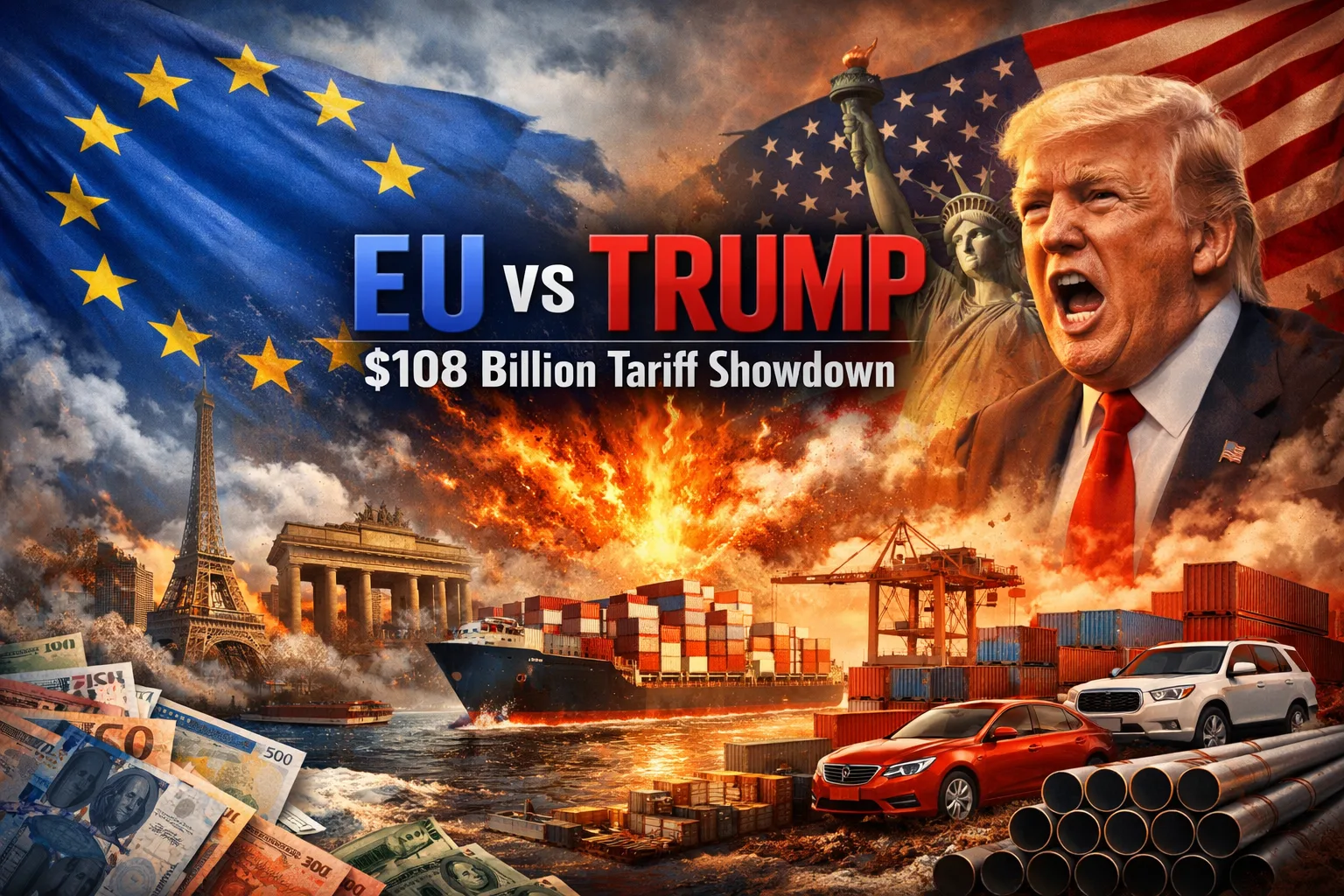
The European Union is preparing strong countermeasures after US President Donald Trump threatened new tariffs on European countries linked to a dispute over Greenland. The situation has raised fresh fears of a transatlantic trade war and has already shaken global markets.
What is the Greenland tariff dispute
Donald Trump has warned that the United States could impose a 10 percent tariff on selected European countries starting February 1. The threat is linked to his long standing demand that the US should gain control of Greenland. Trump has said that global security requires complete US control over the island.
Countries potentially targeted include Denmark Norway Sweden Germany France Finland the Netherlands and the United Kingdom.
EU response $108 billion in possible tariffs
According to officials familiar with the discussions the European Union is weighing retaliatory tariffs on up to 93 billion euros worth of US goods which is roughly 108 billion dollars.
EU leaders are said to be largely united and are exploring several response options including
- Imposing tariffs on US exports
- Suspending a recently agreed US EU trade deal
- Activating the EU anti coercion instrument which is designed to respond to economic pressure from foreign powers
How big is the economic impact on Europe
Economists at Goldman Sachs believe the direct economic hit to Europe may be limited if the tariffs are implemented.
Key estimates from Goldman Sachs
- Euro area GDP could fall by around 0.1 percent
- Affected countries may see GDP decline between 0.1 and 0.2 percent
- Germany would be the worst hit with a potential 0.2 percent decline or up to 0.3 percent under broader tariffs
Goldman also warned that the impact could become much larger if business confidence weakens or if financial markets react sharply.
Impact on inflation and interest rates
Goldman Sachs expects the inflation impact from these tariffs to be very small. Because of this central banks in Europe are still likely to cut interest rates if economic growth slows.
European stocks and auto shares hit hard
European markets reacted immediately to the tariff threats.
At market open
- Euro Stoxx 50 fell around 1.7 percent
- Germany DAX dropped 1.3 percent
- France CAC 40 declined 1.6 percent
- Italy FTSE MIB slipped 1.6 percent
- UK FTSE 100 fell about 0.4 percent
Why automakers are under pressure
European carmakers were among the biggest losers because the US is a key market for them.
- Mercedes Benz shares fell nearly 7 percent
- BMW dropped around 7 percent
- Volkswagen declined more than 5 percent
Trump has suggested that tariffs could rise from 10 percent in February to as high as 25 percent by June. This comes on top of existing trade pressures and could seriously hurt profit margins for European automakers.
Trump links Greenland issue to Nobel Peace Prize
In a letter to Norwegian Prime Minister Jonas Gahr Store Trump also linked the Greenland issue to his frustration over not receiving the Nobel Peace Prize. He said that he no longer feels bound by expectations of international approval and will focus only on what he believes is best for the United States.
These remarks triggered sharp reactions across Europe with French President Emmanuel Macron calling for a strong and unified EU response.
Key questions answered
Will the US tariffs definitely happen
No. Goldman Sachs and other analysts say it is highly uncertain whether the tariffs will actually be implemented. Political negotiations could still change the outcome.
How serious is the risk of a trade war
The risk is real but still manageable. Both sides have powerful economic tools and may prefer negotiation over escalation.
Which sectors are most at risk
Automobiles industrial goods and manufacturing exports to the US are the most exposed sectors.
Conclusion
The Greenland tariff dispute shows how quickly geopolitical issues can turn into economic shocks. While the immediate GDP impact may look small market reactions suggest investors are nervous. If tensions escalate confidence could suffer and the damage could spread beyond trade numbers.
For now markets will closely watch political signals from Washington and Brussels as February approaches.

BBW News Desk is the editorial team of BigBreakingWire, a digital newsroom focused on global finance, markets, geopolitics, trade policy, and macroeconomic developments.
Our editors monitor government decisions, central bank actions, international trade movements, corporate activity, and economic indicators to deliver fast, fact-based reporting for investors, professionals, and informed readers.
The BBW News Desk operates under the editorial standards of BigBreakingWire, prioritizing accuracy, verified information, and timely updates on major global developments.






















Be First to Comment