
Asian oil refiners are rapidly shifting crude sourcing strategies as supply through the Strait of Hormuz remains severely disrupted, forcing buyers to secure alternative barrels at higher costs. With one of the world’s most critical energy routes nearly shut since early March, refiners across the region are prioritizing supply security over pricing.
Refiners in China, South Korea, India, and Thailand have sharply increased purchases from the United States, Angola, and the North Sea. These buyers are paying elevated premiums to lock in prompt deliveries, reflecting growing concerns about potential shortages. Market participants indicate that the urgency to secure cargoes has intensified in recent days, with companies moving quickly to ensure uninterrupted operations.
The shift marks a clear change in buying behavior. After initial hesitation when tensions escalated, Asian refiners have now turned aggressive, securing millions of barrels outside their traditional Middle East suppliers. Instead of relying on spot market opportunities, companies are increasingly focused on building reliable inventories to manage ongoing uncertainty.
The disruption stems from escalating geopolitical tensions involving Iran, the United States, and Israel, which have effectively halted flows through the Strait of Hormuz. The route typically carries nearly twenty percent of global oil supply, making its closure one of the most significant shocks to energy markets in recent years. The tightening supply situation has pushed global crude benchmarks higher and triggered emergency sourcing across Asia.
India has been particularly affected by the surge in oil prices. The Indian crude basket has risen to 142.69 dollars per barrel as of March 16, tracking gains in Oman, Dubai, and Brent benchmarks. The spike in input costs is placing significant pressure on oil marketing companies, whose margins are already under stress.
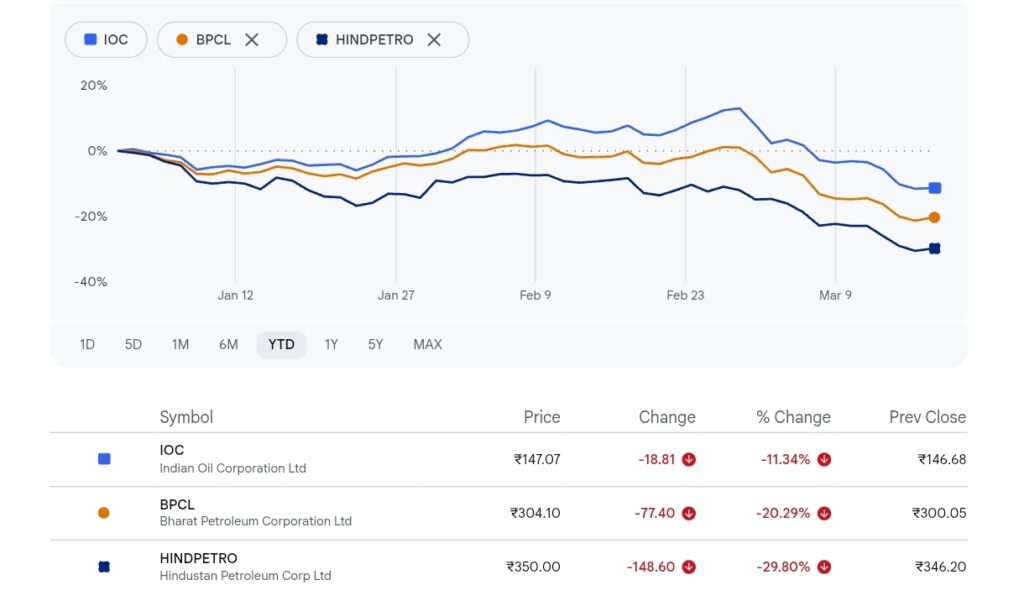
According to Elara Securities, companies such as HPCL and BPCL could see earnings decline between 90 percent and 180 percent if fuel prices are not increased. This warning highlights the severity of margin compression currently facing the sector. At the same time, Nomura has pointed to a sharp decline in blended marketing margins across HPCL, BPCL, and IOC, estimating a drop of around Rs 40 per litre.
The financial strain on oil marketing companies has also influenced investor sentiment. Energy stocks linked to refining and marketing operations are under pressure as markets assess the likelihood of government intervention on fuel pricing. Investors are increasingly cautious, given the risk that companies may be unable to fully pass on higher crude costs to consumers.
Beyond equities, the surge in oil prices is also affecting broader financial markets. Rising energy costs are adding to inflation concerns, which could influence bond yields and monetary policy expectations. Higher oil prices tend to weaken consumer demand and increase input costs for industries, raising concerns about economic growth momentum.
The current situation underscores the vulnerability of global energy supply chains to geopolitical shocks. For Asian refiners, the immediate priority remains securing crude supply, even at higher costs. However, if disruptions persist, the impact could extend beyond energy markets, affecting corporate earnings, inflation trends, and overall economic stability.

BBW News Desk is the editorial team of BigBreakingWire, a digital newsroom focused on global finance, markets, geopolitics, trade policy, and macroeconomic developments.
Our editors monitor government decisions, central bank actions, international trade movements, corporate activity, and economic indicators to deliver fast, fact-based reporting for investors, professionals, and informed readers.
The BBW News Desk operates under the editorial standards of BigBreakingWire, prioritizing accuracy, verified information, and timely updates on major global developments.















Be First to Comment