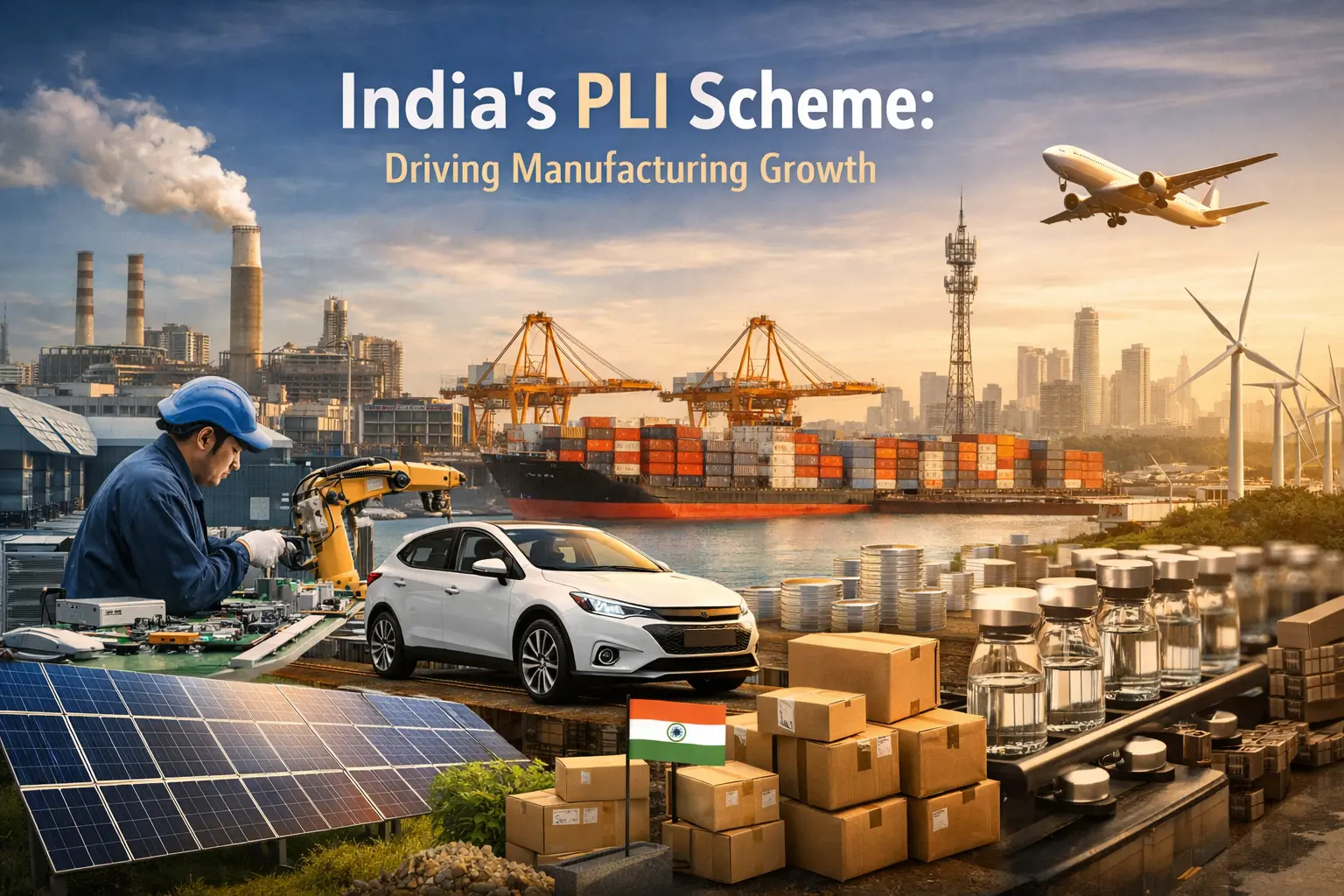
India’s Production Linked Incentive (PLI) Scheme, launched in 2020 with an outlay of Rs 1.91 lakh crore, is showing strong results across 14 strategic sectors. As of 31 December 2025, the scheme has attracted over Rs 2.16 lakh crore in investments, generated more than 14.39 lakh jobs, and driven cumulative sales above Rs 20.41 lakh crore.
The policy is significant because it directly links incentives to incremental production, encouraging companies to manufacture in India rather than import. It affects major industries such as electronics, pharmaceuticals, telecom, automobiles, textiles, and solar energy.
For businesses, investors, and policymakers, the PLI scheme is emerging as a core pillar in strengthening domestic manufacturing, boosting exports, and reducing import dependence.
What Happened in India’s Production Linked Incentive (PLI) Scheme
The Government of India confirmed that the PLI Scheme has seen strong industry participation, with 836 approved applications across 14 strategic sectors. The initiative was designed to strengthen India’s manufacturing ecosystem and deepen localisation.
According to official data released on 20 February 2026, the scheme has delivered steady growth in investment, production capacity, exports, and employment since its launch.
| Key Metric | Performance (As of 31 Dec 2025) |
|---|---|
| Total Outlay | Rs 1.91 lakh crore |
| Approved Applications | 836 across 14 sectors |
| Cumulative Investment | Rs 2.16 lakh crore+ |
| Cumulative Sales/Production | Rs 20.41 lakh crore+ |
| Cumulative Exports | Rs 8.3 lakh crore+ |
| Jobs Generated | 14.39 lakh+ (direct and indirect) |
| Incentives Disbursed | Rs 28,748 crore |
Why the Production Linked Incentive (PLI) Scheme Was Introduced
The PLI Scheme was launched in 2020 to reduce India’s import dependence and build global manufacturing competitiveness. Instead of traditional subsidies, the government introduced performance-linked incentives tied to incremental sales of goods made in India.
This outcome-based model ensures transparency and efficiency while encouraging companies to expand production capacity, adopt technology, and increase domestic value addition.
Sector-Wise Impact of the PLI Scheme on India’s Manufacturing Ecosystem
Electronics Manufacturing and IT Hardware Under PLI Scheme
The electronics sector has seen one of the strongest transformations. Mobile phone imports have fallen nearly 77% since FY 2020–21, while over 99% of domestic demand is now met through local production.
Manufacturing has moved beyond simple assembly to deeper localisation of components such as printed circuit board assemblies, batteries, camera modules, and display units.
Pharmaceuticals and Medical Devices Manufacturing Growth
The scheme enabled domestic manufacturing of 191 bulk drugs for the first time, resulting in import substitution of around Rs 1,785 crore. Domestic value addition has increased to 83.7%, strengthening India’s pharmaceutical supply chain.
It has also supported indigenous development of biosimilars, monoclonal antibodies, and advanced medical devices like imaging systems and diagnostic equipment.
Automobiles and Advanced Automotive Technology Investments
The PLI program has catalysed investments in electric mobility, power electronics, and advanced safety systems. Reported sales of Rs 32,879 crore in FY 2025–26 indicate early traction in technology-led automotive manufacturing.
Telecom and Networking Products Expansion
Telecom and networking product sales have grown more than six-fold compared to the FY 2019–20 base year. Exports in this segment have reached Rs 21,033 crore, reflecting improved global competitiveness.
A key milestone is the deployment of India’s indigenous end-to-end 4G technology stack by BSNL, placing India among a limited group of nations with such capability.
| Sector | Major Impact | Strategic Outcome |
|---|---|---|
| Electronics | 77% drop in mobile imports | Higher localisation and exports |
| Pharmaceuticals | 191 bulk drugs manufactured domestically | Import substitution and supply resilience |
| Telecom | 6x sales growth | Indigenous technology development |
| Automobiles | EV and tech investments | Future-ready manufacturing base |
Bigger Context Behind India’s Manufacturing Localization Push Through PLI
India historically relied heavily on imports for electronics, solar equipment, and critical pharmaceutical inputs. The PLI framework aims to reverse this trend by building domestic production scale and integrating India into global value chains.
For example, the High Efficiency Solar PV Modules segment alone targets 48 GW of integrated manufacturing capacity with investment commitments of nearly Rs 52,942 crore.
Similarly, white goods manufacturing is expanding with domestic production of compressors, motors, copper tubes, and LED drivers, with value addition expected to reach 75–80% by 2028–29.
| PLI Target Area | Strategic Goal | Expected Outcome |
|---|---|---|
| Solar PV Modules | 48 GW manufacturing capacity | Reduced import dependence |
| White Goods | Local component ecosystem | 75–80% value addition by 2028–29 |
| Food Processing | Rs 9,200 crore+ investments | Export-ready processing technologies |
How the PLI Scheme Affects Industry, Jobs, and Exports in India
The scheme has generated over 14.39 lakh direct and indirect jobs, making it a major employment driver in manufacturing and supply chains.
Exports exceeding Rs 8.3 lakh crore indicate that Indian manufacturers are becoming more competitive globally. Increased domestic production also reduces reliance on imports, improving trade balance and economic resilience.
For companies, the incentive-linked structure lowers production risk and encourages long-term capital expenditure in India.
What Happens Next for the Production Linked Incentive (PLI) Scheme
Going forward, the focus will likely shift towards deeper localisation, higher value addition, and expansion into advanced manufacturing technologies. Continued incentive disbursement and capacity scaling are expected to further strengthen India’s position as a global manufacturing hub.
As more projects become operational, sectors such as electronics, renewable energy, and advanced materials could see accelerated growth in exports and domestic production.
Frequently Asked Questions (FAQs)
What is the PLI Scheme in India?
The Production Linked Incentive (PLI) Scheme is a government initiative launched in 2020 that provides financial incentives to companies based on incremental production in India.
How much investment has the PLI Scheme attracted?
As of 31 December 2025, the scheme has attracted cumulative investments exceeding Rs 2.16 lakh crore across 14 sectors.
Which sectors benefit the most from the PLI Scheme?
Key sectors include electronics, pharmaceuticals, telecom, automobiles, solar PV modules, textiles, white goods, and food processing.
How many jobs has the PLI Scheme created?
The scheme has generated more than 14.39 lakh direct and indirect jobs across manufacturing and related industries.
Conclusion
The PLI Scheme is steadily transforming India’s manufacturing landscape by driving investments, exports, and employment while reducing import dependence. With strong sector participation and rising production capacity, it is set to remain a critical policy tool for long-term industrial growth and global competitiveness.

BBW News Desk is the editorial team of BigBreakingWire, a digital newsroom focused on global finance, markets, geopolitics, trade policy, and macroeconomic developments.
Our editors monitor government decisions, central bank actions, international trade movements, corporate activity, and economic indicators to deliver fast, fact-based reporting for investors, professionals, and informed readers.
The BBW News Desk operates under the editorial standards of BigBreakingWire, prioritizing accuracy, verified information, and timely updates on major global developments.










Be First to Comment