
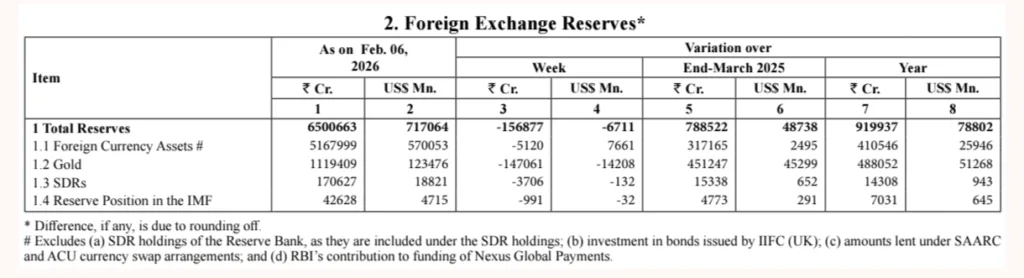
India’s foreign exchange reserves fell to $717.06 billion as of February 6, 2026, according to the latest data released by the Reserve Bank of India (RBI). The decline was driven mainly by a sharp fall in gold reserves and a drop in foreign currency assets. This movement matters because forex reserves are a key indicator of economic stability, currency strength, and external risk protection.
The data affects policymakers, investors, currency markets, and import-dependent sectors, as reserves directly influence the rupee’s stability and India’s ability to manage global financial shocks.
What Happened in India’s Foreign Exchange Reserves Data (Feb 2026)
India’s total foreign exchange reserves stood at Rs 65,00,663 crore (US$ 717,064 million) as of February 6, 2026. On a weekly basis, reserves declined by Rs 1,56,877 crore (US$ 6,711 million), reflecting a significant short-term contraction.
Foreign Currency Assets (FCA), the largest component of reserves, were recorded at US$ 570,053 million. However, they showed a weekly drop of US$ 761 million, indicating pressure from global currency movements and possible RBI interventions in the forex market.
Gold reserves saw the sharpest fall, declining by US$ 14,208 million week-on-week to US$ 123,476 million. SDRs (Special Drawing Rights) fell by US$ 132 million to US$ 18,821 million, while India’s reserve position in the IMF dropped by US$ 32 million to US$ 4,715 million.
Why Did India’s Forex Reserves Fall in February 2026
The major reason behind the decline appears to be the sharp reduction in gold reserves and fluctuations in foreign currency assets. Gold valuation changes and global price adjustments often impact the overall reserve figures.
Additionally, central bank interventions to stabilize the Indian rupee during global currency volatility can lead to short-term reserve depletion. When the RBI sells dollars to support the rupee, forex reserves naturally decline.
Exchange rate movements against major currencies such as the US dollar, euro, and yen also influence the valuation of foreign currency assets held in reserves.
Bigger Context Behind India’s Forex Reserve Trends
Despite the weekly fall, India’s reserves remain significantly higher on a yearly basis. Compared to the same period last year, total reserves have increased by Rs 9,19,937 crore (US$ 78,802 million), showing strong long-term accumulation.
Foreign currency assets rose by US$ 25,946 million year-on-year, while gold reserves increased by US$ 51,268 million, reflecting India’s continued diversification strategy toward gold as a safe-haven asset.
Since the end of March 2025, reserves have grown by US$ 48,738 million, highlighting that the recent decline is more of a short-term fluctuation rather than a structural weakness.
How India’s Forex Reserve Movement Affects Markets, Rupee, and Economy
Forex reserves play a critical role in maintaining currency stability. A decline in reserves can increase pressure on the Indian rupee, especially during periods of global market uncertainty and capital outflows.
Higher reserves give the RBI stronger power to manage inflation, external debt obligations, and import bills, particularly for crude oil and essential commodities. With reserves still above $700 billion, India remains in a relatively strong external position.
For investors and global rating agencies, stable reserves signal macroeconomic resilience and reduce concerns about external vulnerabilities.
What Happens Next for India’s Foreign Exchange Reserves and RBI Policy
Going forward, forex reserve trends will depend on global dollar strength, crude oil prices, capital flows, and RBI’s currency management strategy. If global volatility persists, reserves may see intermittent fluctuations due to active forex interventions.
However, strong capital inflows, rising exports, and steady economic growth could support reserve rebuilding in the coming months. Analysts will closely track weekly RBI data for signals on rupee stability and external sector health.
Frequently Asked Questions (FAQs)
1. What are India’s foreign exchange reserves now?
India’s forex reserves stood at $717.06 billion as of February 6, 2026, according to RBI data.
2. Why did India’s forex reserves fall recently?
The decline was mainly due to a sharp fall in gold reserves and a drop in foreign currency assets, along with valuation changes and possible RBI interventions.
3. Are India’s forex reserves still strong?
Yes, despite the weekly decline, reserves remain strong above $700 billion and have increased significantly on a yearly basis.
4. How do forex reserves impact the Indian economy?
Forex reserves help stabilize the rupee, manage inflation, support imports, and protect the economy from global financial shocks.
Conclusion
India’s foreign exchange reserves saw a notable weekly decline in early February 2026, driven mainly by gold valuation changes and forex asset movements. However, the overall reserve position remains robust on a yearly basis, indicating continued external strength. Future reserve trends will largely depend on global market conditions, capital flows, and RBI’s currency management actions.
US Dollar Loses Ground as Gold Emerges as Key Global Reserve

BBW News Desk is the editorial team of BigBreakingWire, a digital newsroom focused on global finance, markets, geopolitics, trade policy, and macroeconomic developments.
Our editors monitor government decisions, central bank actions, international trade movements, corporate activity, and economic indicators to deliver fast, fact-based reporting for investors, professionals, and informed readers.
The BBW News Desk operates under the editorial standards of BigBreakingWire, prioritizing accuracy, verified information, and timely updates on major global developments.


















Be First to Comment